
Chamber music as a conversation
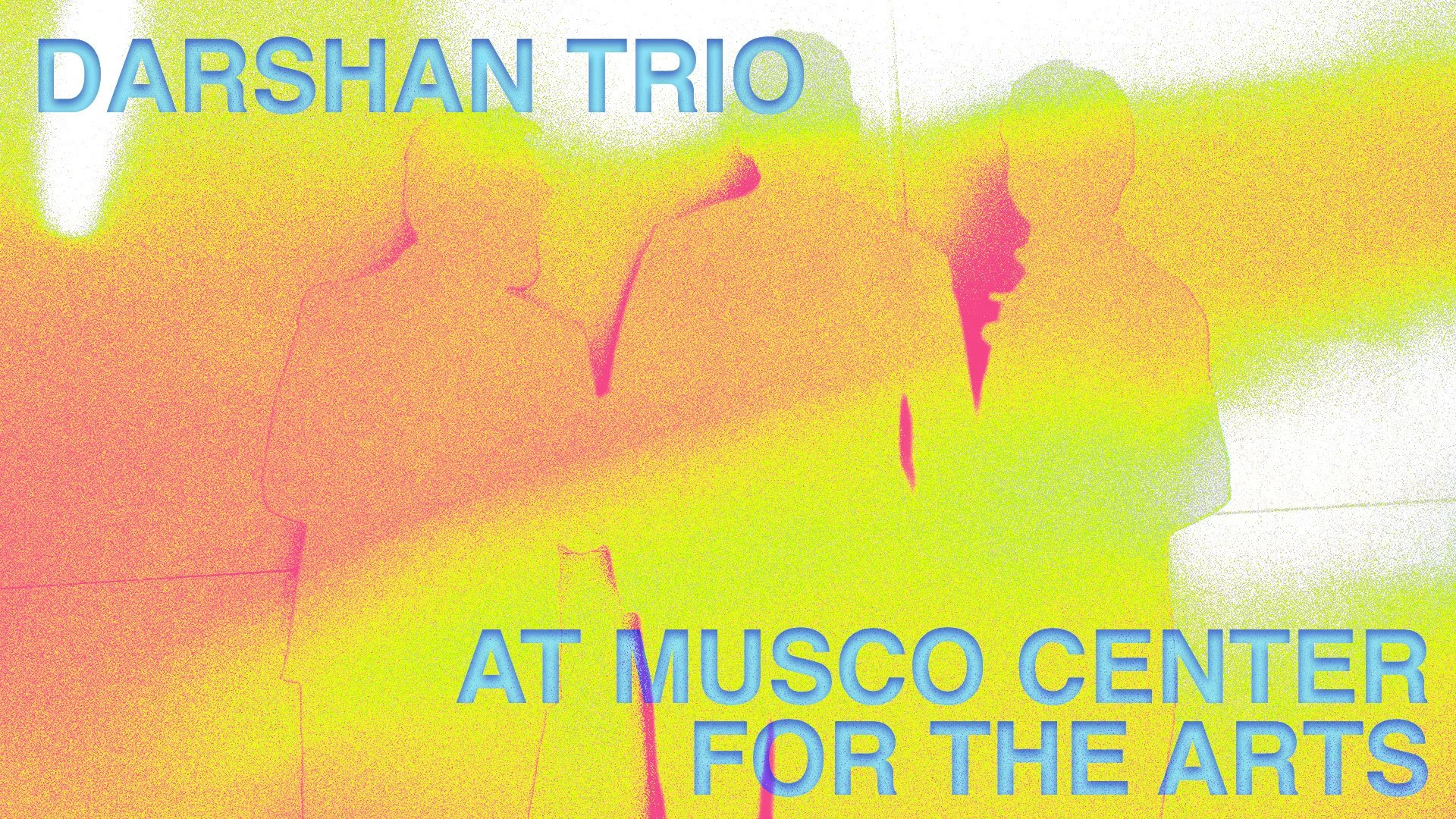
Collage by Easton Clark, Photo Editor
“In a chamber setting, we can invite the audience into something very close and personal. It’s almost like letting them sit inside the rehearsal with us,” said Yoshika Masuda, cellist of The Darshan Trio.
“That immediacy and transparency create a different kind of electricity.”
On Feb. 19 at Musco Center for the Arts, the ensemble did just that. Between the audience and musicians, it was as if the fourth wall was broken; the performance was a musical conversation among equals, where the listener was invited to not only look at the stage ahead, but look within.
Along with Masuda, who is also assistant professor of cello and director of strings at Chapman, the Los Angeles-based trio includes violinist Vijay Gupta and pianist Dominic Cheli. The trio formed in 2021, a time emerging from the pandemic that had the members thinking about the artistic life they would like to move forward with.
“There was an immediate sense of connection — musically, yes, but also personally. It felt almost like love at first sight,” said Masuda.
Masuda compares the group’s sound formation to that of stars. Whether it’s the “star stuff” Carl Sagan quotes — that “we are made of star-stuff. We are a way for the universe to know itself" — or the members’ ideas that sometimes collide with one another. Out of that direction, something is born.
Musuda reflects that playing in this ensemble has helped him grow not only as a musician, but as a human being. As deeply generous and thoughtful people, it’s that “goodness” that carries into the music. As Masuda said, when there is trust and mutual respect, the music breathes differently.
“One lesson I’ve learned is that the strongest musical moments often come from listening — truly listening — rather than asserting,” said Masuda. “I feel incredibly lucky that the three of us are often on such similar wavelengths that we understand each other without needing many words.”
Performing “The Art of the Hymn” — which explored three works spanning two centuries, incorporating hymn melodies by J.S. Bach, Felix Mendelssohn and Charles Ives — the trio brought the audience on a journey.
“What fascinates us is how each composer embeds hymn material according to their own voice and worldview,” Masuda said.
The program began with modernist composer Charles Ives’ “Piano Trio,” embedded with “Rock of Ages” and folk songs like “Sailor’s Hornpipe.” The hymns throughout are layered with themes of memory, community and American identity.
It’s a haunting piece that is referential of Ives’ days as a student at Yale. In the first of three movements, each instrument gets to play “professor,” taking turns dominating philosophical melodies in back-and-forth discussion before reaching an agreement in the end: C major.
The next piece, J.S. Bach’s “Chaconne arr. D. Cheli” premiere, was newly arranged by the trio’s pianist, Cheli. Unlike the hymns in Ives’, Bach’s are structural and theological.
In balancing the composers’ integrities with their own artistic voices, Masuda’s philosophy is built on bringing something living to the present.
“The composers left us clues — in the notes, the phrasing, the structure, even in what they chose not to write,” said Masuda. “And when we study their lives and historical context, the music begins to speak even more clearly.”
Among interpreting a piece through its historical context, it also involves a level of imagination for the musicians.
“Interpretation, for me, isn’t about imposing something onto the piece. It’s about finding the human truth within it and sharing that truth in a way that resonates today,” said Masuda.
In the last piece, Felix Mendelssohn’s “Trio No. 2 in C minor (30'),” the hymns are lyrical and Romantic, almost nostalgic. It was astoundingly played by the musicians, each voice blending together in a wonderful color.
The trio’s name, Darshan, refers to a kind of sacred seeing, a seeing beyond seeing.
“Through this performance, we hope to offer that experience: hearing beyond hearing,” said Masuda. “We hope listeners might encounter something familiar in a completely new light, or discover something unexpected within themselves.”