
Chapman’s student musicians embodied the force in ‘Star Wars: A New Hope’
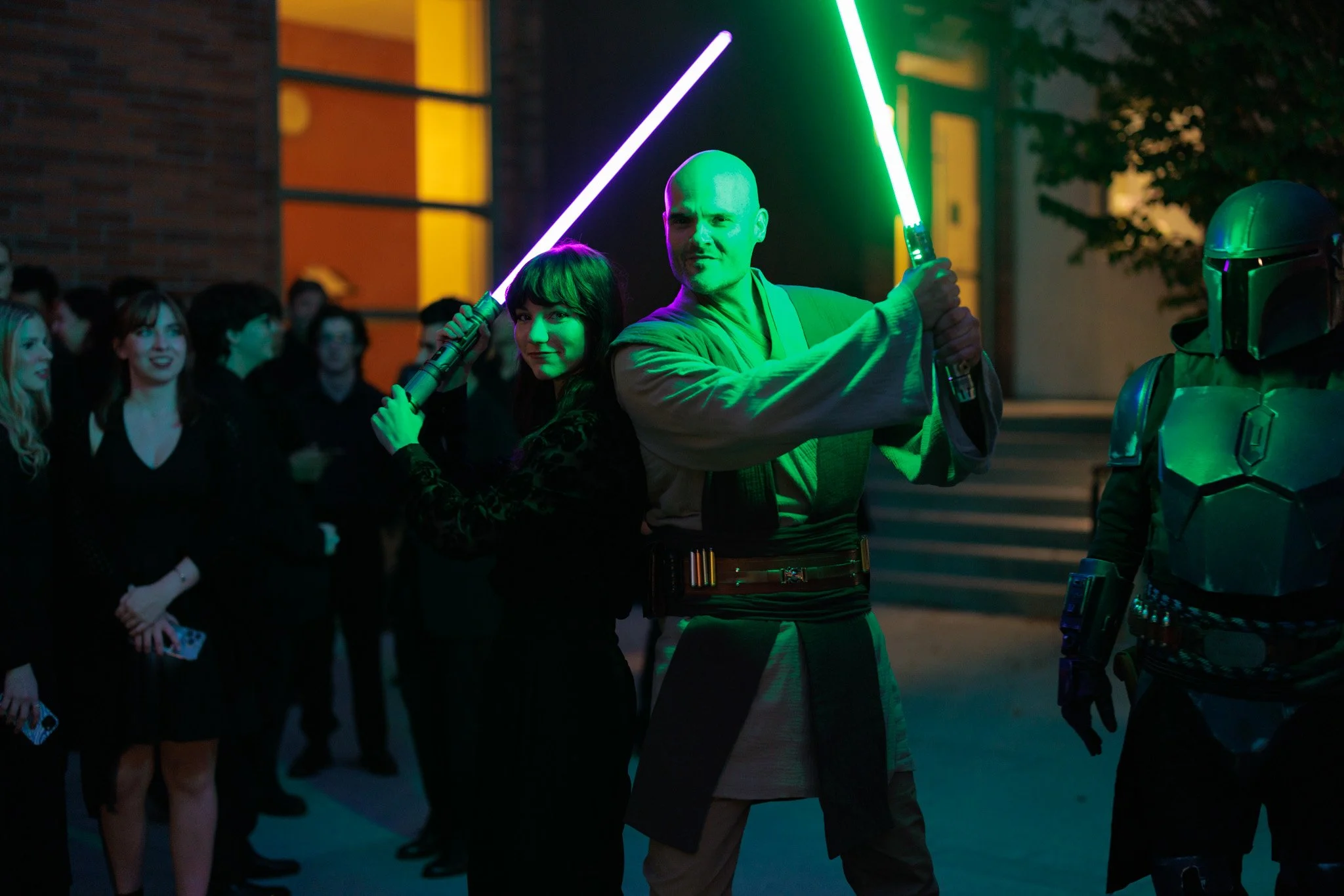
Photo courtesy of the Musco Center for the Arts
Performing a full-length feature film in one sitting is a feat universities rarely attempt, but for Chapman, undertaking such a technical beast proved the conservatory could handle such large scale projects.
Once they got the green light from composer John Williams’ team, The Chapman Orchestra (TCO) began rehearsals for the show, a live orchestra-backing of “Star Wars: A New Hope” which was licensed by Disney Concerts.
“Rehearsing this masterpiece is like preparing a symphony on hyperspeed,” said Danko Druško, director of orchestral studies and conductor of TCO. “The music is symphonically complex, filled with all the color and nuance of late-romantic writing.”
Playing a score performed live to film, Druško felt that the emotional impact was amplified tenfold as the orchestra breathed life into every frame in real time.
Francisco Martinez Devis, junior cello performance major, felt that he could connect with the film in a time-traveling sense while being a part of the concert.
“I'm connecting to every single other person who's played the film at the same time, and we're all playing together on the same cello. They're playing it through me, and we're all creating music at the same time, and I'm traveling through time to play with John Williams,” said Martinez Devis.
While an extravagant and entertainment-focused performance, for some, it was also a spiritual experience. “Star Wars” fans filled every single seat in Musco Center for the Arts, bringing an electric energy into the space.
“People suddenly see the orchestra differently. They realize that all those sounds they loved in the movie were created by real musicians,” said Druško.
With about two months and 16 rehearsals to piece every element together, the Chapman musicians had to adjust to the grandiose and intense orchestration that is John Williams’ style.
Musicians found his composition to have resemblance from composers such as Mahler, Mussorgsky, Shostakovich, Stravinsky and Holst, with leitmotifs as iconic as Wagner’s. However, many felt its level of difficulty surpassed scores such as “Mahler 1,” a piece they had performed in Spring 2025.
“In the ‘Star Wars’ score, there are some very obvious allusions to pieces by those composers,” said Ella Magen, senior instrumental conducting and cello performance major. “There's a pretty direct quote from Stravinsky's “The Rite of Spring” in one of the earlier cues in ‘A New Hope.’”
This translates into the string section of “Star Wars: A New Hope,” but most prominently, the brass. With the string section’s fast, running passages that acted as a support, it was the brass that stayed prominent as a powerful sound.
“It definitely felt harder because there were no really distinct melodies, and a lot of the music the violins had, the melodies tended to get covered by the brass or winds,” said Sarah Schmainda, concertmaster of TCO and senior violin performance major.
As concertmaster, Schmainda played a huge role in learning the piece and representing precision. From staying in tune to leading sectionals, she had no room for error.
“I found taking that responsibility to be quite a task, especially with such a small section at first, before the ringers and before anyone who is auditing joined,” said Schmainda.
Schmainda felt that TCO may have had a greater challenge than the studio musicians that recorded the soundtrack for the film in 1977.
“We had a harder task to put everything together and then all play in one sitting, rather than learning each piece at a time,” said Schmainda.
In playing along with the movie screen, the musicians and conductor prepared with a click track that would then be in their ears on stage. All musicians were also individually mic’d during the performance.
“I have never had to play with a click track in my ear and follow the conductor as well,” said Jacob Reed, junior cello and conducting performance major. “There were some really quite high standards that were required.”
According to Reed, the music required the musicians to go from one extreme to the next, and still have to be completely relaxed, or else it would be difficult for them to make it through the nearly two and a half hour concert.
Along with getting to perform such an exciting score, a select number of students got to conduct it in rehearsals for their conducting midterm. Magen, along with others, conducted “Throne Room” and “Main Title Theme” with the click.
“That was an incredibly interesting experience because I had never conducted film music before,” said Magen. “It takes a lot of thinking outside the box and a lot of practicing conducting in a different way because the internal timing, or the timing in general, is not coming from you, it's coming from a machine giving you your beats.”
Druško’s approach in conducting the concert came from the idea of honoring the collective memory that the audience holds of the film’s iconic themes, but also reminding listeners that this is live symphonic art.
“It’s about respecting the nostalgia while revealing the craftsmanship behind it,” said Druško. “John Williams wrote this music with the same rigor and imagination as Mahler or Strauss, and when you treat it that way, the audience realizes just how sophisticated it truly is.”
Alexis Reeves, junior business and accounting major and TCO violist, felt that it’s special experiences like these that help garner more interest for the classical music world. Shmainda shared this sentiment and feels since Chapman’s ability to partner with Disney is unique to the university, it helps get people to continue to be in the concert hall.
“At the end of the day, that’s what art and music education should be about,” said Druško. “Creating unforgettable experiences, lifting our spirits, fostering collaboration, inspiring both performers and audiences alike and changing the world for the better, one note at a time.”
Editor’s Note: The author of this story, Zoë Edeskuty, played the violin in this production.