
Great loves and forbidden passions: ‘Tchaikovsky: A Love Letter’ premieres at Chapman’s Musco Center
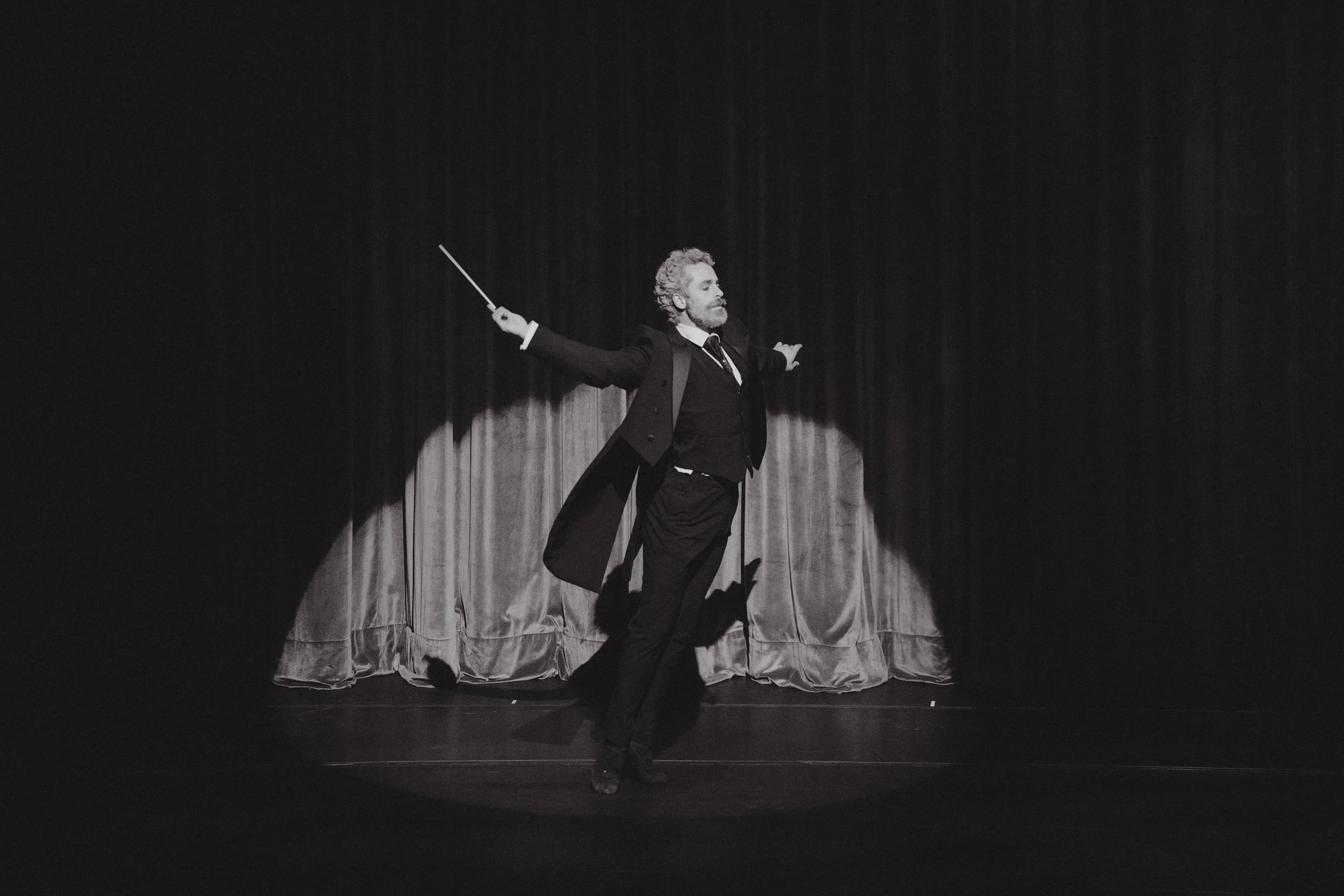
Photo Courtesy of INTUITV ARTSHIP Production Team
A crowd murmurs inside Chapman’s Musco Center for the Arts. The seats are filled with a varied array of attendees: some young, some old, some dressed in formal attire, others in more casual clothing. As the lights dim, the audience falls quiet, before erupting in cheers and applause as a suited man enters the stage holding a conductor’s baton. This is a balletic portrayal of famous 19th-century Russian composer Pyotr Ilyich Tchaikovsky, whose story is about to unfold onstage.
The curtain lifts to reveal a vibrant woman clad in a long yellow dress; this is “Museic,” not a person, but an embodied version of music itself — one of the great loves of Tchaikovsky’s life.
On Sept. 5, “Tchaikovsky: A Love Letter” had its world premiere here at the Musco Center. Showing for one night only, the ballet was created and directed by Vitor Luiz and Tara Ghassemieh, a married couple with extensive dance experience who together founded INTUITV ARTSHIP, an organization that aims to tell contemporary stories through the medium of ballet.
Luiz and Ghassemieh also dance lead roles in the performance, with Luiz portraying the older version of Tchaikovsky, and Ghassemieh portraying Museic. (The younger version of Tchaikovsky is played by David Prottas, as the show shifts back and forth between time periods.)
INTUITV ARTSHIP has a heavy focus on telling stories that empower freedom and highlight minority voices.
“Every story we tell, we likely will be highlighting or shining light on a group or body of people that needs to be seen and needs to be honored and needs to be accepted,” Ghassemeieh said.
INTUITV ARTSHIP’s first production, “The White Feather: A Persian Ballet Tale,” addresses the battle for freedom of expression in Iran and is dedicated to Iran’s “Woman, Life, Freedom” Movement.
According to Ghassemieh, ballet is illegal in Iran — a rule she is resistant to.
“Me, being the first Iranian-American principal ballerina, I have a very big duty and a big mission to bring ballet back to Iran,” Ghassemieh said.
In a similar vein, “Tchaikovsky: A Love Letter” aims to highlight freedom for LGBTQ+ voices.
In 19th-century Russia, according to the show’s program, “love between men was criminalized as muzhelozhstvo, punishable by exile, forced labor, and public ruin.” The ballet discusses Tchaikovsky’s relationships with male partners and the societal challenges he faces due to his sexual orientation.
“We are very rooted in freedom: freedom of artistic expression, freedom to love, freedom to just simply be,” Ghassameieh said.
Set to Tchaikovsky’s own musical compositions (including his “Piano Concerto No. 1,” “Sleeping Beauty Rose Adagio,” “Pathétique” Symphony, and music from “The Nutcracker”), the story focuses on two of Tchaikovsky’s male lovers. The first is Eduard Zak (danced by Marshall Whiteley), a young musician introduced to Tchaikovsky by his brother Modest. At first shy and awkward with one another, Museic brings them together, placing their hands in one another’s. The relationship soon blossoms, as Zak and Tchaikovsky exchange letters and perform an intimately-choreographed dance filled with lifts, soft touches, and gentle embraces.
However, the relationship soon takes a tragic turn. As they continue their intimate relationship, several dancers cross the stage in pairs, casting critical glances as they pass the two men together. Crushed under the pressure of outside rumors and negative judgments, Tchaikovsky abandons Zak.
Heartbroken, Zak writes one last letter before taking his own life. Tchaikovsky is devastated. At the funeral, an intense spotlight shines upon the two lovers as Tchaikovsky embraces Zak’s body; Museic grieves alongside him.
Later, Tchaikovsky becomes involved with Prince Vladimir Davydov (danced by Maté Szentes). The pair dance intimately, their moves reflecting a sense of passion as the music swells in the background. However, the relationship again ends in tragedy — and leads to his demise.
In several ways, the ballet pays homage to the circumstances surrounding Tchaikovsky’s death. The score used throughout most of the ballet is Tchaikovsky’s “Pathétique” symphony — Tchaikovsky’s last orchestration. He was dead nine days after its premiere.
The official cause of Tchaikovsky’s 1893 death was reported as cholera. However, according to co-creator Tara Ghassemieh, testimonies and theories from people close to Tchaikovsky show that he committed suicide after being confronted and condemned by the “Court of Honor” — in this case, a group of individuals from the university Tchaikovsky attended and taught at — for being gay.
“His family was threatened. He was gonna be shipped to Siberia. They were gonna burn his music, and theory states that he was left with two choices. Either he lives in exile and in shame, or his music lives,” Ghassemeieh said.
Tchaikovsky chose his music.
Onstage, Tchaikovsky takes his own life by drinking a vial of liquid. As he drops to the ground, Museic is lifted above him, still wielding his conductor’s baton: although Tchaikovsky is dead, his music lives on.
In Ghassemeieh’s eyes, this sacrifice is the reason we have Tchaikovsky today. And his influence heavily shaped the landscape of ballet, an influence that persists even now. That’s why she felt it was so important to share the story of Tchaikovsky’s suicide.
“This was something we felt we needed to do, to honor him, and his truth,” Ghassemeieh said.
Ghassemeieh and Luiz faced challenges in funding the show. They had been in the final round in line to be given a federal grant for the show. However, after National Endowment for the Arts (NEA) grants were cut in May, they, along with many other arts institutions, were no longer eligible for federal funding.
“Do we persevere and push forward with no financial backing that was secured and just pray we make it, or do we pull back, not do the performance, wait to make the money, and then go?” Ghassemeieh said.
Pulling back would have been the safer choice. But Ghassemeieh and Luiz instead took the riskier path, believing that the universe would provide because what they were doing was necessary and important. So they pushed forward with the show.
They barely managed, and Ghassemeieh noted that she and her husband have not made any money from the show.
“We did this with a handful of people that volunteered their time or made peanuts compared to what they should be making, including those dancers, because they believed in this story and they believe in our company,” Ghassemeieh said.
Those who worked on the ballet aren’t the only ones who believe in the importance of the story; many audience members do as well.
Andres and Emily Hillman are siblings who attended the ballet with their mother. Andres, a former pre-professional ballet dancer whose favorite composer is Tchaikovsky, wanted to attend the show as a gift for his 19th birthday. He loved the show.
“I think it's important to lift queer voices, especially in places where they were initially demonized,” Andres said.
In a world where prejudice and oppression against LGBTQ+ people remains prevalent, Ghassemeieh understands the continued value of stories like these.
“Unfortunately, we haven't learned much, and we haven't evolved very much, from when Tchaikovsky was condemned,” Ghassemeieh said.
INTUITV ARTSHIP was highly intentional with their timeline for the show; they first announced the ballet during LGBTQ+ Pride Month, and premiered it during Suicide Prevention Month.
The creators of the ballet also chose to partner with current LGBTQ+ musicians; in one scene, Tchaikovsky enters into a dreamy interlude, moving in synchronicity with dancers clad in top hats and gloves. The scene is set to a jazzy version of the “Dance of the Sugar Plum Fairy,” inspired by Duke Ellington’s rendition of the piece. The music for the scene was performed live by two saxophonists from the Gay Freedom Band of Los Angeles, who volunteered their time to take part in the production.
“It was more about this flash forward in time of the future, of not only where his music would go, but where gay men would be able to actually live in a more exposed and free way,” Ghassemeieh said.
Indeed, the ballet highlights the lengths Tchaikovsky went to in order to hide his sexuality. To suppress rumors that he was gay, Tchaikovsky was very briefly married to a woman, Antonina Milyukova (danced by Victoria Jenkins).
Tchaikovsky’s annoyance with Antonina is shown onstage through some of the few utterances made during the ballet: the shrill sounds of Antonina’s laughter and cries, demonstrating the grating effect she has on him.
Antonina throws herself at Tchaikovsky, desperately trying to seduce him, to no avail — Tchaikovsky rebuffs her advances, responding only with clearly-platonic patting of her hands and head, walking away from her as she tries to pursue him. When they do dance together, it seems he is only going through the motions of the choreography.
The only “woman” Tchaikovsky shares a truly intimate choreography with throughout the show is Museic: not an actual person, but a symbol of his art, embodied by a female figure.
"His greatest love was really his music,” Ghassemeieh said. “And it had nothing to do with sexuality or gender.”
According to Ghassemeieh, the goal is to take “Tchaikovsky: A Love Letter” on tour.
“Our goal is to go to LA, San Francisco, New York, and we'd also like to do Houston and London — but that's a big undertaking,” Ghassemeieh said. “So that would obviously take a massive amount of sponsorship, which we believe the show deserves.”
Since they can no longer rely on federal or state grants, they will need individual sponsors to achieve their goal.
“And so our prayer is that someone was in the audience, or obviously from video footage, we will be able to build that budget so we can take this ballet abroad,” Ghassemeieh said.
In the meantime, INTUITV ARTSHIP is working towards several future projects. One is “Odile,” a feminist retelling of Swan Lake through the eyes of the Black Swan, in which Odile is from Persia. Next year, they plan to present their annual holiday production, which will be “It’s a Wonderful Life.”
And as INTUITV ARTSHIP produces new work, Ghassemeieh, who was born and raised in Orange County, would like to continue showing at the Musco.
“When I did a tour of the Musco, I just fell in love. I saw that theater and I thought, this is our home theater,” Ghassemeieh said.
If all of Ghassemeieh’s hopes come true, more of the world may soon get a taste of “Tchaikovsky: A Love Letter” and its unique, subversive vision — and the Chapman community may host more of INTUITV ARTSHIP’s unconventional, boundary-expanding work.