
Midnight Mirage puts students where the music is
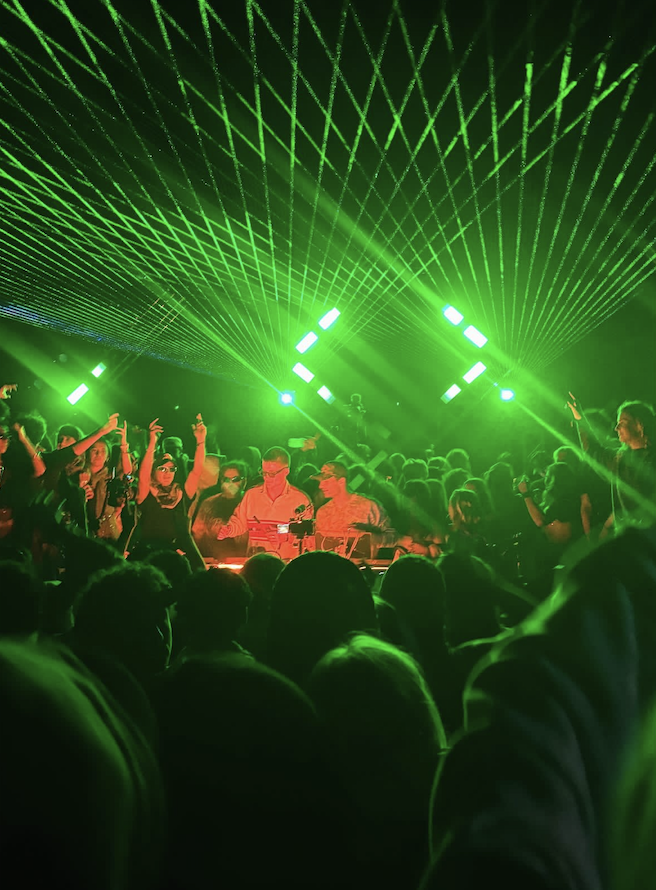
Photo courtesy of Redline
At 10 a.m. on Saturday, May 9, over 1,000 phones pinged with a location in the middle of the desert. That night, it would be overtaken by students, an elaborate stage and enough lasers to make a corner of the Mojave feel like EDC, all for Midnight Mirage — a one-night music festival put on by Chapman students near Lancaster, California.
Redline, a production company composed of senior business administration majors Brys McCaw and Charlie Foy, took charge of putting on Midnight Mirage. The two recruited a team of nine additional friends and collaborators, all current Chapman students, and one alum to help facilitate the event.
“We sat down and figured out what (our) strengths were, and realized we were missing a lot of important aspects,” said Foy. “We thought about all the really talented people we know… So we reached out to all of them, and our philosophy was kind of to assemble ‘The Avengers’ to put this on.”
And that’s exactly what they did; with a strong marketing push and word spreading fast across campus, the team ended up capping ticket sales four days before the event took place, having sold 1,200 tickets in total.
“The way we were selling tickets, I think if we didn’t (cap it), it probably would’ve gotten up to 1,800,” said McCaw.
Midnight Mirage is not the first student-thrown event of its kind. Last year, Disco Dunes brought students to Lucerne Valley — before that, Sonic Sands — and so on. It’s not even the first thrown this year; Afterglow, a similar event, occurred on April 25 in Maple Valley, CA.
It is, however, the first year Foy and McCaw undertook the ambitious task of producing the event. Learning from past years, this year’s festival was highly prepared; security guards surveyed the perimeter of the stage area, a medic tent stood to the side and water bottles, bathrooms and wash stations were abundant.
“The idea actually came from Disco Dunes, and I talked to (the organizer) Jack Donovan (about it) about a year ago,” said McCaw. “I’d just gotten back from abroad, and I had been planning on doing this type of event in Washington state, where I’m from — that was the original idea. Me and Charlie always talked about doing Pike Joshua Tree together, so it was in our heads for a long time.”
On the same note, Foy said: “It’s such a special event to us and to other people, and we wanted to open it up to the whole school because Chapman’s a great community, but it’s really segmented at times. We wanted to do one big event where the whole school can come together. It was one of those things that was just a crazy idea in our heads for a solid three months until we actually started planning in January.”
As McCaw and Foy quickly found out, the desert doesn’t do the work for you — their team put in hours of planning and logistics between designing the stage, curating the music, creating the marketing and finding a place that could host an all-night festival for over 1,000 people.
“We did four, five trips to scout the location,” said Foy. “(After the event), we drove back and I looked at Brys and said, ‘I’m not coming back to the desert for at least a year.’”
But despite the many challenges they faced, everything they'd been working toward since January came together on May 9 — the music didn't stop until the morning, and by all accounts, nobody wanted it to.
All artists who shared the stage were Chapman students; in total, there were 14 DJs and one live band: Where’s West? Foy and McCaw put genuine commitment into curating the lineup, selecting DJs with intention.
“To Brys and I, especially Brys, it’s really important for the night to progress sonically,” said Foy. “He put a lot of effort into thinking about that.”
At around 1:15 a.m., Foy and McCaw joined the ranks of DJs with their own set.
“A lot of people didn’t know that we put on the event, which was actually a good thing,” said Foy. “It let us do what we wanted, and we played the music that we wanted.”
Getting to play also meant McCaw and Foy could take in the night they'd built from the best possible vantage point — the stage itself.
“Playing the set, the amount of work and stress that went into it, it was surreal,” Foy said. “It culminated in that moment, and I tried to take it in as best I could.”
When it was all over — the music faded, the desert went quiet and the sun had long risen — the lasers and the lineup ended up just scratching the surface. The production was impressive, but it was never really the point.
While the success of the night was almost overwhelming, the notion McCaw and Foy really wanted to leave people with was something simpler.
“Chapman, at times, can feel really segregated,” said Foy. “You have Dodge (College of Film and Media Arts), you have the business school, you have different frats and sororities. We put this on with the idea of bringing everyone together and just remembering that we all go to the same school. It’s a small school, you know, we all kind of have diverse interests, but we just wanted one night for everyone to have fun and be with their friends and meet new people.”
Somewhere between the first set and sunrise, it seems they pulled it off. For one night in the desert, Redline’s team helped build a community that made Chapman feel a little smaller — and because of that, a little more like home.