
‘No one is alone’ with CSOP's ‘Into the Woods’
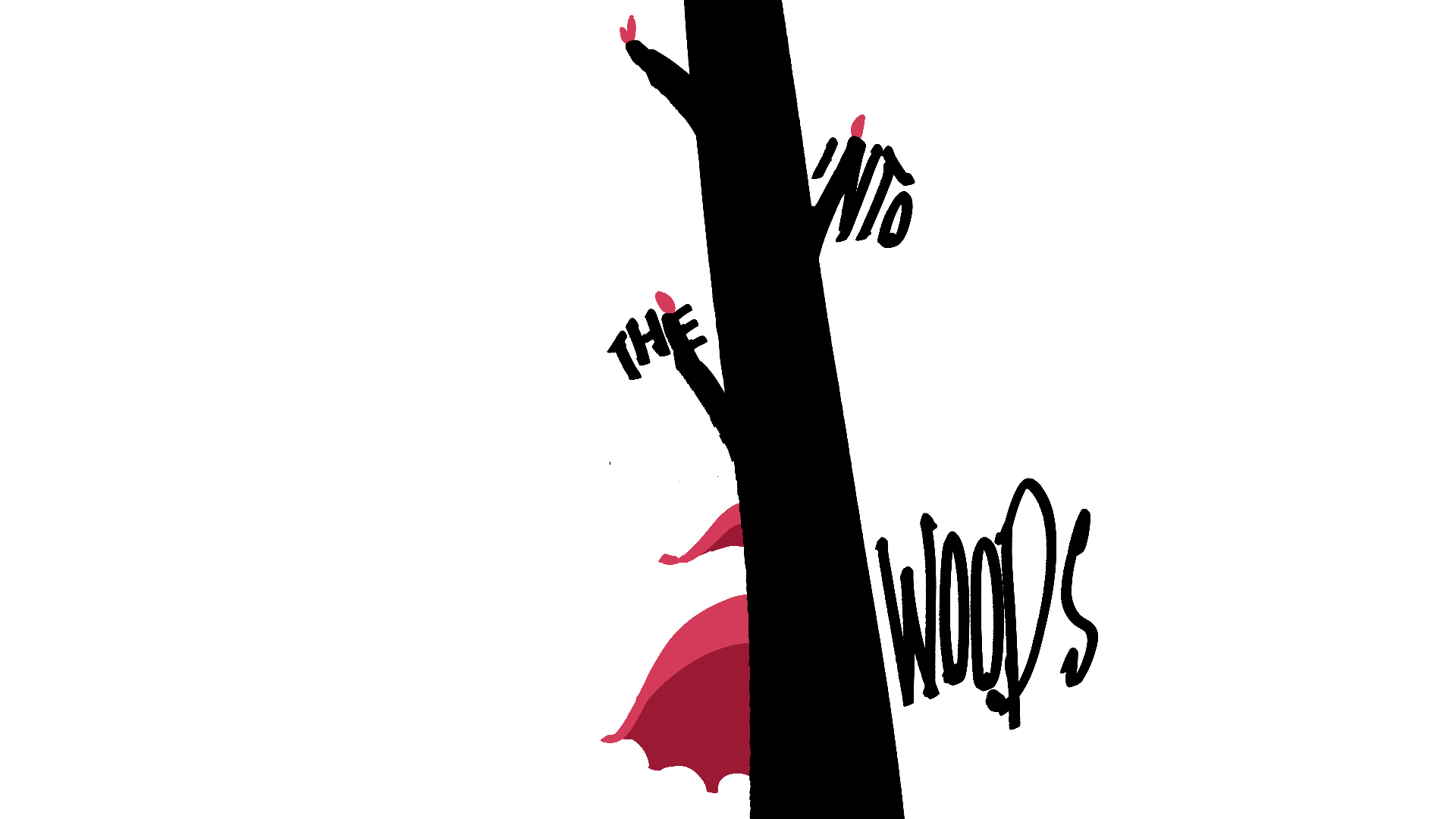
Illustration by Kamaal Samuel, Illustrator
As the red curtains pulled up, revealing an illustrious set of trees appearing to go on forever, I felt a collective gasp from the audience.
This isn’t the kind of gasp you’d hear in a sitcom’s laugh track, but an unrivaled sense of awe at what we were seeing on stage in Memorial Hall. I’ve been to many student productions in my time at Chapman, and I’m not speaking with hyperbole when I say none have felt quite as illustrious as Chapman Student Organized Productions’ (CSOP’s) production of “Into the Woods.”
“None of us are getting paid on this production; we're all doing this in addition to our classes, in addition to our other jobs, in addition to our work,” said senior creative producing major Brent Stefani, the show’s scenic designer and co-technical director. “We're doing this for our own enjoyment and our own love for the craft. There have been hundreds of hours of work going into this by over a hundred students. Many of us have been working on this since October 2025. It's May now, and we're finally seeing our work come to fruition.”
Stephen Sondheim’s 1986 musical follows several characters from the Brothers Grimm fairy tales as their winding paths through the woods intersect. Centering the Baker and the Baker’s Wife as they try to reverse a family curse from a Witch, these familiar stories are flipped on their head as “Into the Woods” takes dark and twisting turns which depart from the source material.
“When people go into it and they hear the word fairy tale, they have this notion in their head that it's something wonderful, magical and overall beautiful,” said freshman screen acting major Katie Ruoo, who played the Baker’s Wife. “‘Into the Woods’ contradicts this idea of perfection because perfection does not exist in any form … I think at first maybe it's a bit jarring, and maybe audiences feel a bit uncomfortable, but what I love so much about ‘Into the Woods’ is it forces you to sit in that discomfort, really evaluate it and reflect upon it.”
The show’s first act largely adheres to the expectations of the fairy tale genre, but after the characters receive their “happy endings,” the show continues with a second act questioning these assumptions of “happiness.” While the show is generally well-regarded in its 40-year history, the second act has always been a point of contention within theater communities.
Many high school productions forgo the second act altogether in favor of the first act’s more traditional storytelling. But, to the cast and crew of CSOP’s production, the second act was clearly at the center of their work.
“What we get out of the second act is this idea that salvation doesn't come from you winning the lottery or someone coming to save you at the last moment, but rather someone sitting beside you in the dark,” said the show’s director and senior film and television production major Ian Blom. “It prioritizes connection over triumph, people over power. I think the world needs this story because I hope it'll bring us closer together as humans, as individuals, and realize that no one makes it through their story alone.”
While “Into the Woods” is often a fragmented show, breaking its characters apart, the ultimate themes of finding community clearly struck a chord with those who worked on CSOP’s production. In many ways, this focus on camaraderie mirrors the experiences behind the scenes as the cast and crew spent months preparing for the three performances.
“Ever since the pandemic, especially for our generation, we look at finding community and finding our people in unknown places,” said Stefani. “Whether you are fortunate or unfortunate, you find your community, you find friends and camaraderie in unlikely places, sometimes even through unlikely or unfortunate circumstances.”
Despite being written in the ‘80s, this is a show that has held up and is still being performed regularly to this day. While some of the themes may have changed, its approaches to things like gender have stood the test of time.
Even as the show deals with topical issues of the 1980s, notably being seen by many critics as an allegory for the AIDS crisis, its dismantling of gender roles in these original fairy tales is a theme with clear prevalence in today’s public discourse.
“I think that this show particularly uses fairy tales to talk about the male and female roles that we experience in everyday life. Especially today, when we talk about gender and its fluid structure,” said junior English literature major and the CSOP production’s Baker, Cary Trott. “We have these standards for people, and just because we're trying to progress and move forward doesn't mean that they don’t still affect us and that they're completely omnipresent within our culture.”
These are all conversations that have been present in CSOP’s process from its early days of pre-production in October. As the student organization focuses on bringing a level of professionalism to its productions, the students involved reflected on a deep sense of accomplishment with their work on the show.
Cast activities like a live discussion with Pamela Winslow Kashani, the 1986 Broadway show’s original Rapunzel, created an elevated space of connection with the show. All of this clearly paid off, as the heightened sense of storytelling left a discernable impact on the audience.
“When you get to that stage, it's you and the real-life human sitting in front of you,” said screenwriting junior and Production Stage Manager Leyla Bultan. “‘Into the Woods' does such a good job of bridging the gap between the audience and the fairy tale characters, and making these whimsical storybook clichés into real people with real wants and real needs.”
Although it’s easy to get tunnel vision on our college course loads, internship prospects and the crushing weight of career expectations, passion projects like this are the pulse of the university experience. Student-run theater organizations like CSOP offer safe spaces to build community and express ourselves in ways we can’t always do in the classroom.
“Theater tells stories of people who can't always do so, who don't have the access or ability to tell people about what they need to tell people,” said Ruoo. “I'm a firm believer in the idea that all art is political. Art is social, art is cultural and I think it's a wonderful encapsulation of how we can inform people about what's going on in the world. Theater does such a great job at really captivating audiences to listen to the story that they're telling and that they want to tell.”
While the short run of “Into the Woods” finished on May 9, the show’s impact is much more far-reaching. As the school year comes to an end, we find ourselves at a time when many feel increasingly isolated. But it’s through spaces like a full audience in Memorial Hall on a Saturday night that I feel a sense of community.
Perhaps this is why we are still performing the same musicals 40 years later. Bringing people from across the university together for three hours of twisted fairy tales, we are reminded that no one is alone in the woods.
“(Theater) asks us to be vulnerable. We can't really hide behind a mask; we just have to show up unequivocally as ourselves and not make excuses,” said Blom. “When we can bring that on stage to an audience, it's people who have all chosen to spend their time in one place, and the energy is palpable. You'll hear someone in front of you laugh. You can kind of feel someone next to you cry. We always need theater. Especially in a world where more stuff is going toward AI, I don't think there's anything that will replace theater. There's a craving for this human connection more than ever.”