
The stars are a little more reachable after watching Chapman’s production of ‘The Little Prince’
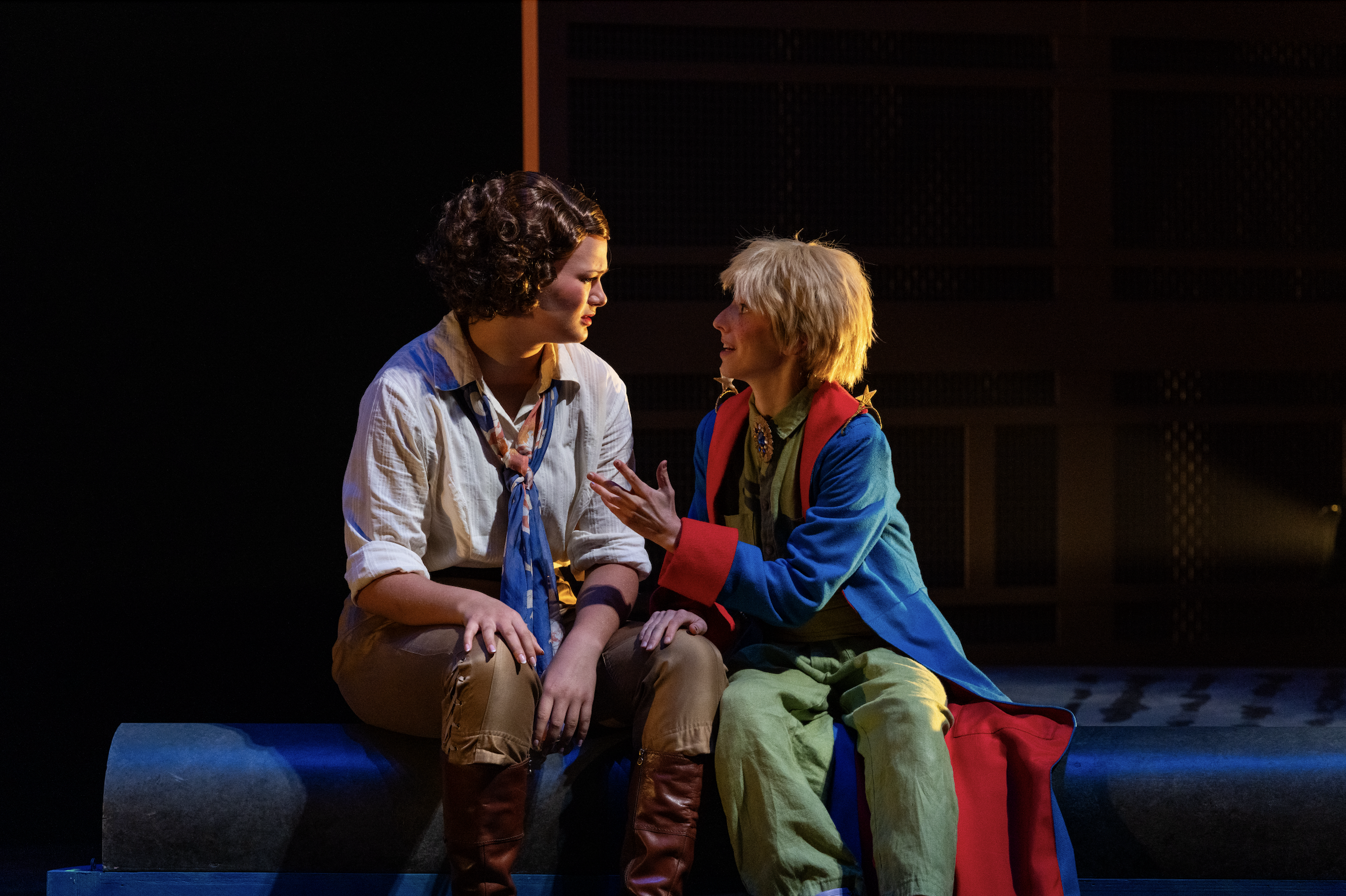
Photo Courtesy of College of Performing Arts; Photo Credit: Cameron Kish
With silver garlands of stars hanging from Asteroid B-612 (the Musco Center for the Arts stage), an aviator lost with her broken plane (a giant book) and whimsical soundscapes, the audience enters into the world of “The Little Prince,” a tale of love, wonder and loss.
From Sept. 25-27, Chapman’s College of Performing Arts put on an adaptation of Antoine de Saint-Exupéry’s 1943 novella, “The Little Prince,” directed by Chapman professor and award-winning theater artist, Nick Gabriel.
Lights up and curtains drawn, the play opens in the past with an aviator played by sophomore theatre performance major Evelyn Hall, sketching a drawing on her giant sketchpad. A projected image of her drawing appears on stage: a boa constrictor swallowing an elephant. Or is it a hat?
Familiar with the story since childhood, Hall knew she wanted to be a part of Chapman’s production, on or off stage.
“I had never performed in Musco before, but stepping onto that stage was such a magical experience. The architecture itself allows for a beautiful resonance throughout the space, and it’s truly a gift to perform or share any kind of art there,” said Hall.
Hall wanted to create a balance of sentimentalism and amusement in bringing the Aviator to life. She used the “crossing the threshold” technique, where she walked across an imaginary line into the play space, a reminder to herself that she can be free in her actions.
Flashing to the present, the disenchanted Aviator’s broken airplane in the unknown territory of the Sahara Desert, a young, otherworldly boy named Little Prince — played by junior theatre performance major Cassidy Gray — stumbles upon the Aviator with a playful interrogation of curiosity. “Draw me a sheep,” the Little Prince said.
Clad in a green shirt and pants with a yellow scarf to match a yellow belt, and a magnificently cosmic blue coat with an epaulet of stars ornamented on each shoulder, the Little Prince is a character like no other.
“In a world where we are constantly comparing ourselves to others, overthinking, and swimming in anxiety, the Little Prince is a breath of fresh air who follows his instincts and devotes himself to a cosmic journey all for the purpose of love,” said Gray.
In its charming and dream-like tone, “The Little Prince” is a story following the pair as they bond through the limbo of being stranded in the desert. For the next two weeks, Little Prince recounts his life story and the lessons he has learned as the Aviator works to fix her plane.
The stage transforms into the realms Little Prince has visited throughout the galaxy as he tells the Aviator about the people he has met along the way, such as the Businessman, the Lamplighter, the Geographer, the King, the Conceited Man, the Snake, the Fox and his beloved Rose.
To guide the audience through this journey is the ensemble.
“Our director Nick Gabriel described it as if we were facilitating the turning of pages in a book,” said Julia Franca, sophomore theatre performance major and ensemble member in “The Little Prince.”
The ensemble’s participation, shifting from a collective of scolding elderly perspectives squashing imagination to the menacing baobab creatures of the Little Prince’s planet, and then to a wall of common roses, represented the embracement of a childlike perspective, according to Franca.
“To me, getting into character meant focusing on being expressive physically, which served me for moments such as the baobabs and the wall of roses, and also attempting to be a personification of the whimsical aura this story has,” Franca said.
Franca’s favorite line from the play is during a moment when the Little Prince says farewell to the Aviator, but the Aviator doesn’t know where to find the Little Prince’s planet in the night sky. So, he says: “Then all the stars will be your friends.”
“That encapsulates for me the concept of ‘taming,’ which is crucial to the narrative, which means something will have a special connection to someone because of their experiences. I find that this is true for many people that will attach a meaning to something because it reminds them of a loved one or a memory, and I think that is one of the great joys of life,” said Franca.
Audience member and sophomore film and television production major Tahlia Pompel said that in this production in particular, she enjoyed the sets, the use of projections, the costumes, the movement and especially the music that accompanied it.
“I think the music was my favorite part, it added so much to the mood and nostalgia of the play. My favorite character was the businessman; I found him to be the most comedic, and the physicality choices of the actor were perfect,” said Pompell.
The Businessman, played by sophomore data science and theatre double major Thomas Kuo, represents all the grown-ups in the world.
“I think there’s something there about people who have fallen out of love with what they do, or perhaps a passion turned to obsession. The act of counting stars (which the Businessman does) is, by nature, rather whimsical. Yet when performed by the Businessman, it turns into a task, a driving force, a duty that must be upheld at all costs,” said Kuo.
According to Kuo, preparation for a production like this starts months before opening night.
“Entire teams of creative heads, designers and others work towards making sure the process goes smoothly, especially once we get into the chaos of tech week — adjusting to the stage from the rehearsal space and lightning-fast costume changes are two of the many unexpected instances one could run into in the weeks leading up to the show,” said Kuo.
With a reference tattoo on her left arm to prove her love for the story, Pompel deeply connects with the themes and message of the story itself.
Pompel’s tattoo is of the boa constrictor digesting an elephant doodle that the Aviator first draws and describes. A key symbol in the story, often misinterpreted by adults as a hat, “this drawing/tattoo represents continuing to be creative and curious and have a nonconforming way of thinking, and, once we grow up, to avoid becoming narrow-minded and forgetting what it’s like to be a child,” said Pompel.
According to Pompel, the production lived up to her expectations as an audience member in some capacities, but not in others.
“I appreciated the creative ways the Snake and Rose character expressed themselves, especially physically. However, what I really did not appreciate was the interpretation of the Fox character,” said Pompel.
The Fox, played by senior screen acting major Zachary McDevitt, chose a laid-back, “cool guy” portrayal, an archetype different from the book and movie.
“The Fox’s laid-back, chill, aloof character was incompatible with the theme of forming connections, rendering the idea that ‘one runs the risk of weeping a little, if one lets himself be tamed’ not as touching as it has the potential to be,” said Pompel.
On the other hand, according to Hall, some of the cast’s favorite scenes were with Fox.
“The choices McDevitt made in portraying that character were hilarious and really served the scene well. Personally, I was always amazed by the first act, especially the journey through the planets. The way the actors created characters who were entertaining, funny and layered was truly admirable,” said Hall.
Pompel was also wondering how much of the stage production was within the script, and how much of it was the directors’ and actors’ choices.
“For example,” Pompel said, “the Rose being Hawaiian and the Snake being African — were they decisions by the director based on the casting, or were these actors casted to fit these scripted roles? In the book and movie, these characters are not coupled with a certain evident ethnic/cultural characteristic.”
The Rose, played by senior Tehani Kekuawela and the Snake, played by sophomore Ariel Russell, were pivotal characters in conveying the themes of the story.
The Rose is the Little Prince’s only flawed relationship, representing growth and commitment. Beautifully adorned in traditional Hawaiian attire, Kekuawela personified the Rose in dance.
“A particularly impactful moment was when the Rose pricked the Little Prince on purpose with her thorn and told him to ‘go back to his precious Baobabs.’ It is the first time in the story that the ‘innocent’ Little Prince is confronted with a real dilemma of love,” said Gray.
The Snake represents death and the cyclical transformation of life. While appearing to be the play's antagonist, the snake is not inherently evil, but instead an inevitable loyal friend.
The Conceited Man, played by junior theatre performance major Leah Jacobson, is a comedic sing-song character that represents the want to be loved and admired as an adult.
“In connection to the story, the conceited man visualizes the loneliness of maturing and the Little Prince recognizes the importance of companionship and care,” said Jacobson.
From the first rehearsal to the first performance, Jacobson’s understanding of the story has concluded that the Aviator is struggling with her identity as an adult and when she crashes in the desert, the Little Prince helps her revert back to her imagination to help her survive.
The play dips into themes of growing up and the importance of embracing one's imagination even when having “important things to do,” as the Aviator often claims to the Little Prince. The Little Prince serves as the Aviator’s tether to a childlike sense of wonder, revealing the more important things that life has to offer.
The King, played by senior theatre performance major Ansley Teal, is another character that conveys the absurd ego of adulthood.
“To me, the King simultaneously represents those who are alienated from society by their status, and those whose status is entirely empty,” said Teal. “The King can only connect with other people as his subjects (rather than equals) while ironically having no actual control over the people or things around him.”
Teal was most excited for the transformation into a character so contrasted from who she actually is. Physically, the King is an elderly man with a long beard acting as its own accessory.
“We knew it would require a significant physical and vocal transformation, which posed an exciting new challenge for me — given that I am a 21-year-old woman and not an unknowably ancient man who rules the universe,” said Teal.
Teal’s favorite quote is, “One runs the risk of weeping a little when one allows himself to be tamed.” This is a reminder of how love inherently carries the risk of grief, but that the risk is always worth taking, according to Teal.
In the end of the play, the Little Prince says goodbye to the Aviator. He arranges for a venomous snake to bite him, allowing him to leave his body to return home to his Rose. It is an emotional farewell for the cast and audience.
To Hall, the moment everyone cherished most was the bows.
“There’s no better feeling than standing side by side with your castmates in gratitude, for the show itself, for the creative team and for the people who came to experience it,” said Hall.
For Teal, the hardest hitting emotional point was the Little Prince’s goodbyes to the Fox and the Aviator.
“We all watched them evolve so much from the beginning and grow to encompass so many moving personal touches from the actors and director alike,” said Teal.
Despite this, according to Teal, nothing is ever truly lost as long as you keep its memory alive; even if you think something may be lost forever, it’s never too late to find it again.
“Part of it for me became more and more about this competition of who can do the most, who can be the busiest, who can involve themselves in the most ‘important things’ — also known, of course, as college,” said Kuo in reflection of the play. “It’s something I too am victim of, and it’s not something I intend on giving up anytime soon — we all of course are thinking about our futures and we want to have job stability in our post-college lives. However, this show has been a very well-needed reminder to remember not just to count the stars, but why I’m counting them.”
The cast agreed that “The Little Prince” is a narrative that surpasses an audience “just for kids.”
“This narrative has an incredible way of being profound and simple at the same time, and even though it’s a story that is great for kids, it doesn’t underestimate a child’s capacity for understanding complex ideas,” Franca said.
For a hat drawing can also be a boa constrictor eating an elephant, and so perhaps our inner child is never gone if we don’t allow it to be. Thus, as said by the Fox to the Little Prince, “it is only with the heart that one can see rightly, what is essential is invisible to the eye.”