
100 years of music
When Chapman University was known as California Christian College of Los Angeles, prior to its change in 1934, The Panther Newspaper began to include music coverage once it started establishing itself on campus.
According to a Ceer 1922-23 yearbook — the university’s “bigger profit” student handbook, which was a play on words of seeing into the future — the earliest known orchestra was founded in Fall 1922.
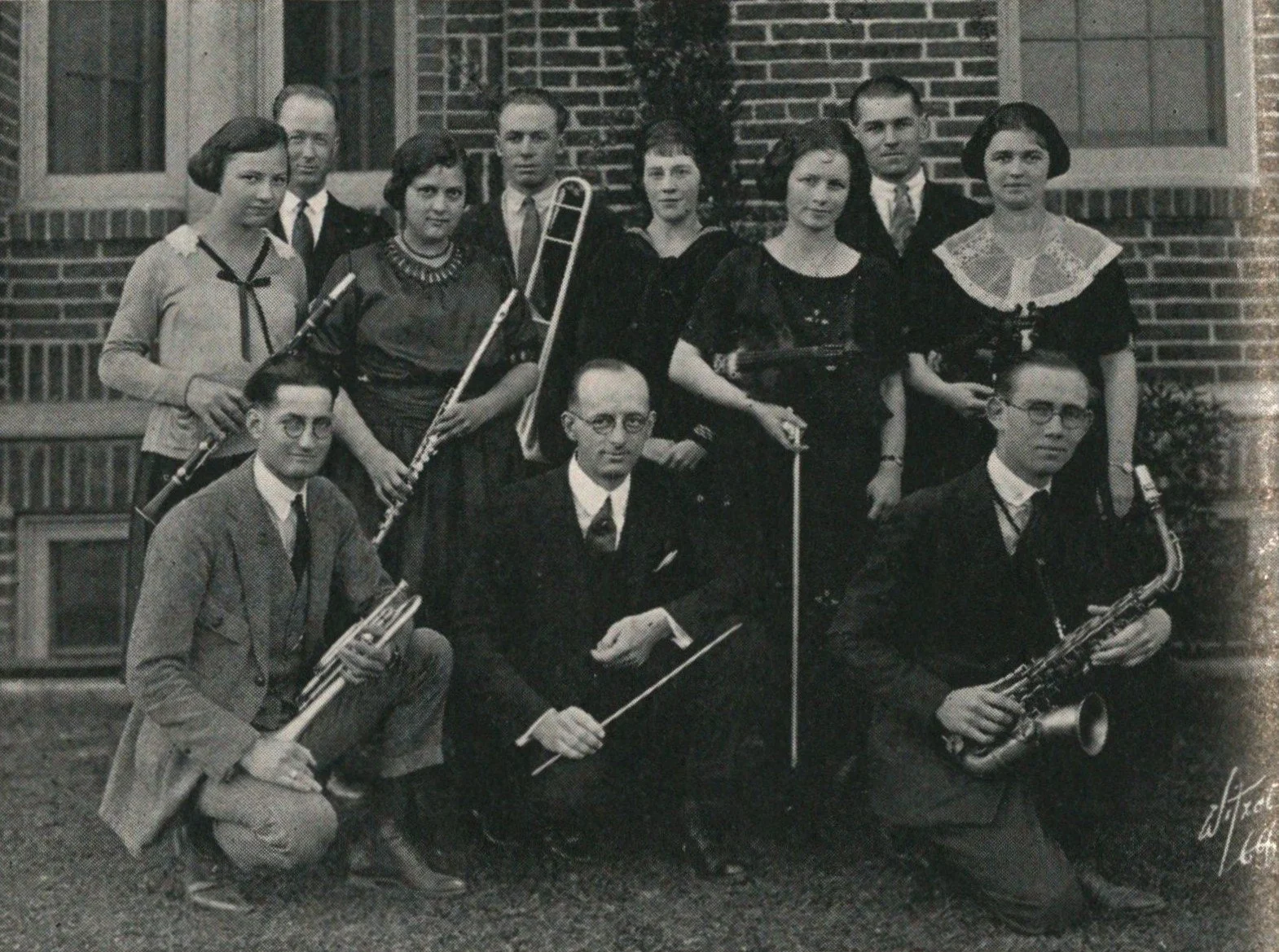
Symphony Ensemble (1923); Photo courtesy of Chapman Special Collections and Archives
Ceer Yearbook 1922-1923
“The orchestra was organized in late Fall 1922. It hopes to become a symphony orchestra, playing as it does now even the highest type of music,” according to the Ceer ‘22-23 yearbook.
While still at its beginning, the orchestra held strong ambitions to become something bigger than it originally was. Today, The Chapman Orchestra (TCO) became just that, an award-winning symphony orchestra playing repertoire that its predecessors could only dream of. Recent repertoire ranging from Mahler and Dvořák symphonies, partnerships with dance companies and a performance of “Star Wars: A New Hope” live to screen only shows the diversity that music could become.
The Panther Newspaper 1928-1929
Also founded in 1923 was the Glee Club, a Boys’ and Girls’ choral singing group under the direction of F.J. Sucher. This year, they started their annual concert tour of Northern California. In former years, the Boys’ and Girls’ clubs had toured separately, but by then, the plan of combining the clubs had been instituted for funding purposes.
On Feb. 17, 1929, the group performed their annual home concert after traveling to the coast of Watsonville, California, and coming back the valley route. The concert program featured readings, piano solos and “quartette numbers,” according to the paper.
With an eight-person orchestra accompaniment, directed by Sucher, the small group was composed of a violin, second violin, cello, clarinet, trumpet, saxophone, trombone and piano.
“The orchestra was just organized this semester and it has done well in its short time,” Sucher told The Panther.
Glee Club pins were awarded to women participating in the group for three semesters, an incentive to help the ensemble survive, and still “our band needs support,” a member told The Panther (1929).
Ceer Yearbook 1931
The creation of the Cardinal Orchestra. This ensemble was composed chiefly of Glee Club men and student ministers, playing late-jazz hits and concert waltzes.
The Harmony Honeys were another ensemble that formed. It was a women’s trio that contributed to Glee Club concerts, women's formals and alumni banquets. These groups were directed by Herbert C. Tovey.
Ceer Yearbook 1932
The women’s vocal trio, Triple-C Singers, and Cardinal Male Quartet, were created, but there were no further signs of orchestra ensemble performances or information.
The Panther Newspaper 1932-1933
Music remained an important part of campus, despite the hardship of the Great Depression. Marguerita LeGrand, a student pianist, began her annual piano recitals.
The Panther reads: “Marguerita LeGrand Receives Return Engagement for Entire Piano Recital.” Performing a Liszt A Major Concerto along with organ accompanist Alexander Schreiner, LeGrand was then requested to play at the Royce Auditorium in the University of California, Los Angeles (UCLA).
“None of us are music critics, but the whole student body appreciates great music,” The Panther (1933) said.
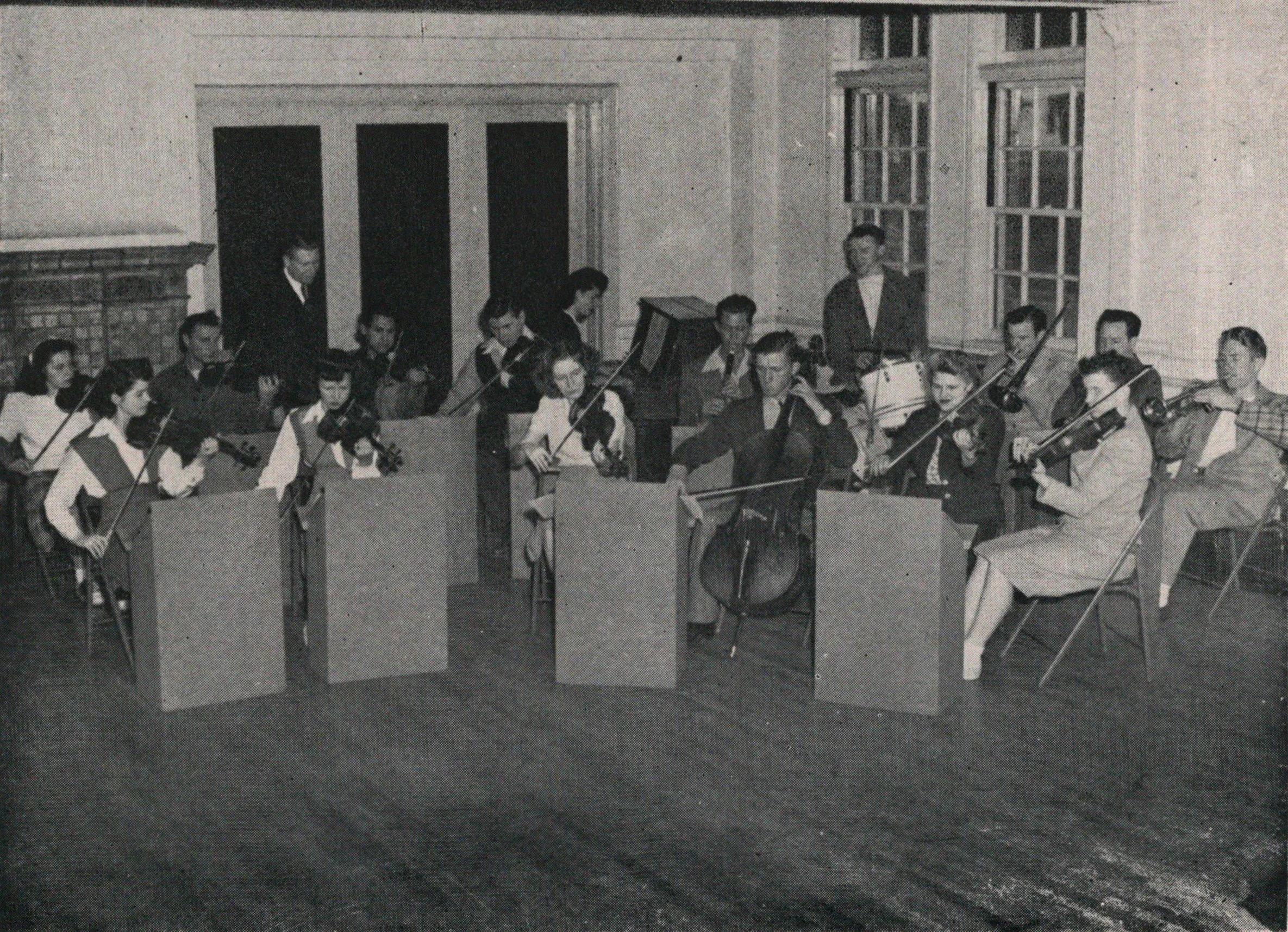
The Chapman Orchestra (1947); Photo courtesy of Chapman Special Collections and Archives
Ceer Yearbook 1947
This year was the creation of The Chapman Symphonic Choir, under the leadership of John Browning. They sang both secular and religious numbers.
The creation of The Pep Band, organized and led by Robert Warringer, provided music and spirit for basketball games.
The creation of The Chapman Orchestra, a newly organized group on campus, composed of 15 members, was directed by Browning. Rehearsals were held twice weekly and the repertoire steadily increased. It was a big year for music organizations on campus in 1947.
In the 1980s, The Chapman Symphony, The Chamber Orchestra and the OC Youth Symphony were established. In 1979 and 1980, they received national recognition, with the American Society of Composters, Authors and Publishers (ASCAP) award. In addition, the chamber orchestra received national recognition for its three-week European concert tour conducted by John Koshak.
Soon after, students could choose a Bachelor of Arts in music, a Bachelor of Music in composition or conducting, music education and performance. Areas of study have only grown today to include concentrations such as the music industry and production.
The Chapman University music scene continues to flourish and grow today. Due to the ambition and passion musicians had on campus starting in the 1920s, we have today a thriving community of musicians who continue to make history for future generations.