
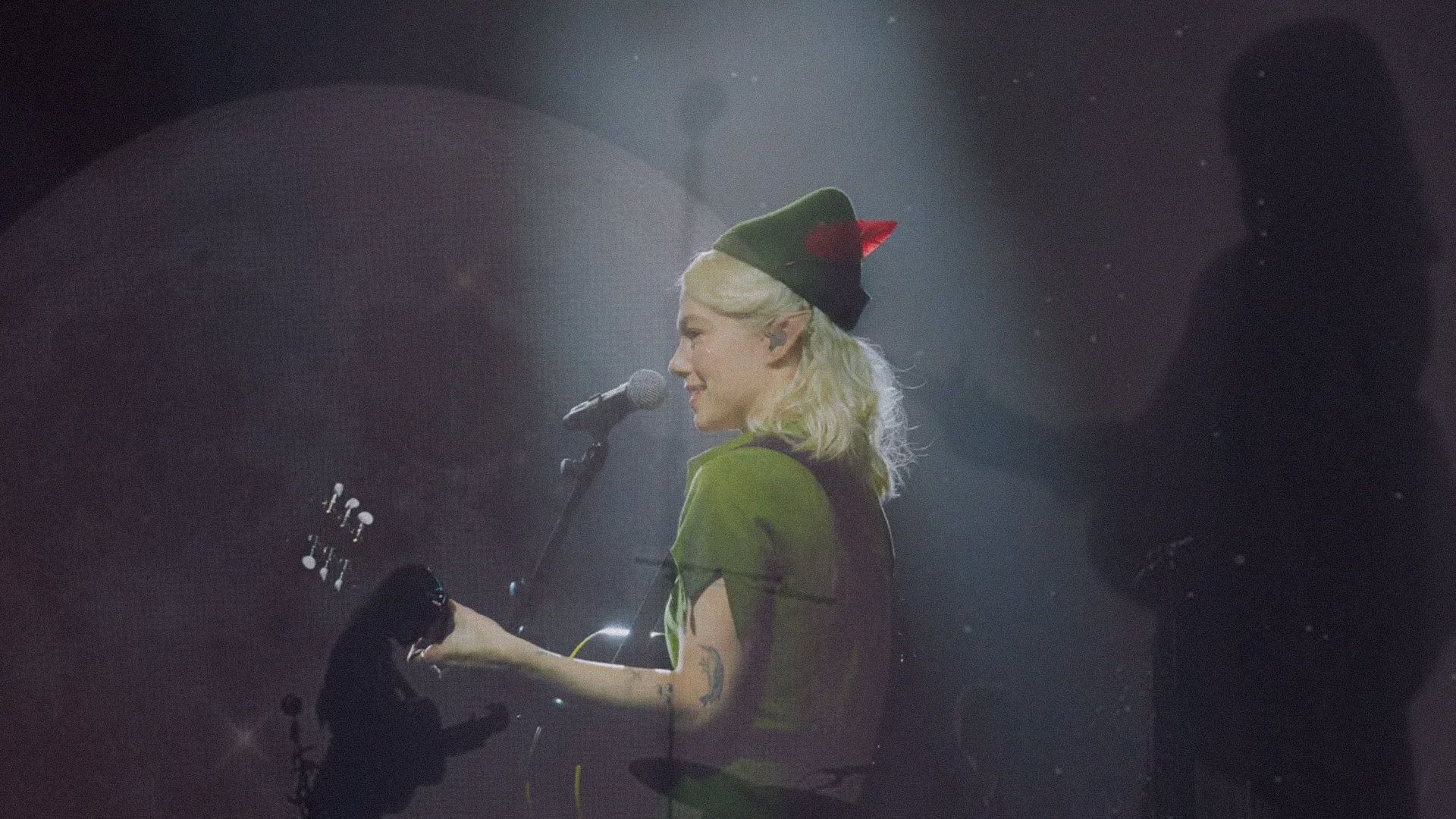
Collage by Riley LeBlanc, Photographer.
You’re squished in a concert pit and your favorite artist walks on stage. Upon their entrance, thousands of phone screens rise, completely blocking your view. Forced to watch the performance through the screen of the stranger in front of you, you notice that they forgot to press record.
This is the modern concert experience.
Phoebe Bridgers’ The Lost Tour wrapped up its LA leg at the Intuit Dome on Halloween weekend, or commonly referred to by fans as “Phoebe-ween.” On Oct. 31, fans dressed up in costume, explored photo ops and then said goodbye to their phones for what may have seemed like forever.
Implementing a strict no-phone policy during her concerts — the phones locked in Yondr pouches upon entry kind of strict — Bridgers intended for fans to not only be present, but also let the emotionality and vulnerability of her music become a private shared experience.
Other artists have had no-phone policies, but they have been more suggestive. Florence Welch, lead singer of Florence and the Machine, often says her concerts are rituals and phones interfere with its fruition. Especially during “Dog Days are Over,” one of her most well-known songs, she tells everyone to put their phones away to live in the moment.
Along with Bridgers, Bob Dylan has also used the Yondr pouch during his shows. The no-phone policy has been a trend with Jack White, Radiohead and Alicia Keys.
For Bridgers’ concerts, this policy has added a mystical and mysterious atmosphere around the production design and surprise special guests that she brings out. It turns into an experience that only the audience can take with them and no longer share with others on social media.
As a result, reposting and sharing becomes word of mouth.
At the Halloween show, Bridgers brought out Boygenius members Lucy Dacus and Julien Baker. The night before, she brought out Billie Eilish, saying: “Ha ha, you don’t have your phones.”
“During the concert, I do wish that I got some videos of certain songs, but overall I was forced to just be in the moment rather than looking at my phone or wondering who is texting me or what I was gonna post,” said concertgoer and Chapman junior violin performance major Lucia Maynard. “I could just immerse myself in the experience and forget about being productive for a second.”
During the show, the energy in the crowd felt attentive and connected. Whether literally connected with string lights a fan had brought that tethered some audience members together, holding up lighters or the quiet acknowledgement that this was a special moment, it felt like an incredibly immersive evening.
“I thought that the energy was much more collective than I’ve experienced at other concerts I’ve been to,” said concertgoer and Chapman senior communications major Maddie Ishii. “I think that the collective focus on the art and on each other put everyone in the moment so much more since attention wasn’t really diverted to anything external.”
Bridgers’ opener, Alex G, stood in a smaller stage in the middle of the arena. The music was brought to life by projections and light effects that went to the beat of his music. It was a combination of a light show and a cataclysmic-like color explosion that felt both surreal and otherworldly.
Without the extra “light pollution” from the phone screens, the venue had some more leeway in making the visuals their own accompaniment to the music.
“In relation to the concert culture, I think that the implementation of a no-phone policy would help to reinstate a vital component of the culture which is connection. Not only to one another, but also to the art itself,” said Ishii. “Technology has the ability to take us out of the present and in an art space it’s especially important to let yourself become immersed and witness something real, especially considering the rise of AI in art.”
Soon, Phoebe and her band emerged from a large dome, herself projected on the curtain behind them along with cosmic-aesthetic visuals.
“I've never been to a no phones concert before, but I felt like I wanted to implement that just for myself honestly for concerts, because I often find myself two places at once when I'm listening to something; not having the option of being somewhere else or talking to other people forced me to have deeper conversations with people around me,” said Maynard. “It also forced me to interact with the music in a more meaningful way because I felt I had to savor the moment.”
People are actively looking for desperate measures to break their phone addictions. While a no-phone concert policy may ultimately be an unlikely fix for the global problem, it gives concertgoers a reminder to not live through a screen.
“There's no way to tell someone that I was there,” said Maynard. “I just have to really remember it.”
Perhaps moving towards a better direction against the technology apocalypse begins with the smaller initiatives we can take at the community level.
“I have so much respect for Phoebe Bridgers and her team for making the decision to implement this policy,” said Ishii. “I hope its impact and success influences the future of concert production more frequently.”