
The professional artists navigating contemporary heritage
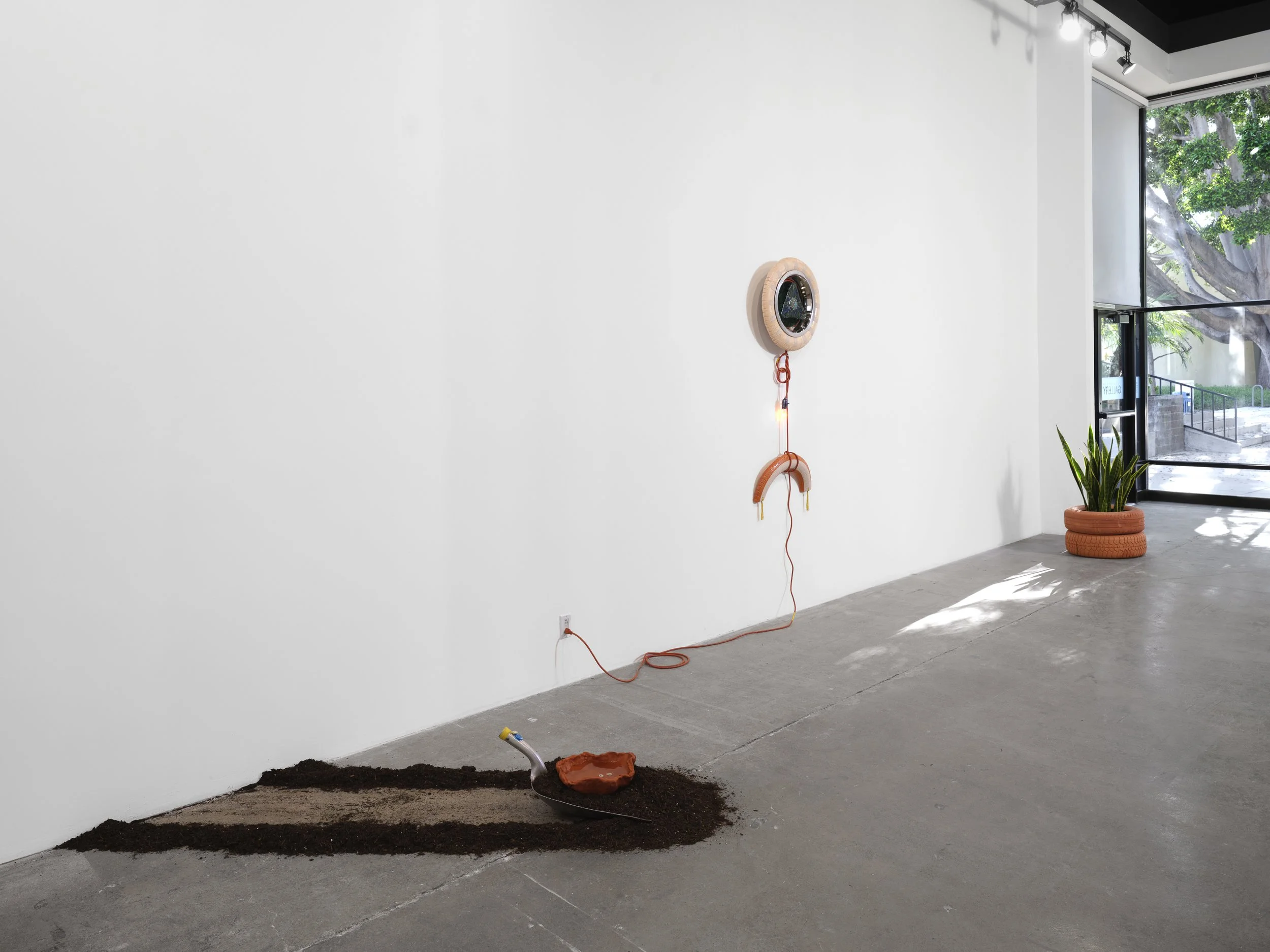
Installation view Echosystems: Resonant Practices by Artists of Crenshaw Dairy Mart. Photo by Elon Schoenholz and Angel Xotlanihua.
As you enter the Guggenheim Gallery, you’re greeted with one of the pieces in the exhibition, “Stacked tires,” by noé olivas. Sitting among the tire succulent sculpture is a tiny moving green speck. Upon closer inspection, it’s a live praying mantis.
No, it’s not part of the art piece. It has somehow snuck in and might have wanted to experience art as well. However, this unwelcome guest adds to the exhibition's consideration of cultural preservation and cultivation. “Echosystems: Resonant Practices by Artists of Crenshaw Dairy Mart” explores how memory and ancestry is carried through different forms.
With their work brought together for the first time in a shared space, The Crenshaw Dairy Mart is an abolitionist BIPOC art collective that organizes exhibitions at their location in Crenshaw.
“A lot of what they do is about reclaiming resources, agency and kind of thinking about how to live going forward,” said Guggenheim Gallery Director Marcus Herse. “So they're not just a protest group. They're very much actively trying to shape the environment and the community that they're part of.”
Their work focuses on abolition, social and racial justice, as well as the history of the places you inhabit with family. In highlighting the five artists, noé olivas, Patrisse Cullors, Ashley Blakeney, Oto-Abasi Attah and alexandre ali reza dorriz, each piece explores a different facet of these ideas, adding to a larger conversation.
noé olivas
noé olivas, a multidisciplinary artist and co-founder of the Crenshaw Dairy Mart, embodies what he calls the poetics of labor within his art, which speaks to where the embodied labor he was raised into and how it lives on.
His work transforms everyday materials, including tires, chords given to him by his father and other industrial objects through the Chicanx spirit of rasquachismo. Not only is his work giving new meaning to objects, but in doing so, is manifesting an understanding to our relationship to the environment.
“Stacked tires” (2021) is a living sculpture with snail shells, soil, rocks and a succulent, all housed within terracotta-coated tires.
“untitled, (spirit composition #1)” (2026) also uses tires, but constructs them in a way that conveys a personification of something, or a spiritual guide.
“There's an aliveness to it, but of course it's also ridiculous because it's these, you know, cast tires, just strange ingredients, such as this flickering light, or just a cable, but it all kind of decodes in ways,” said Herse.
According to Herse, both olivas and Cullors practice the Yoruba Ifá religion, which has influenced their work. For olivas’ piece, he incorporated clay that was used in Ifá ceremonies. Not only was he speaking to a capitalistic car culture, but also created a tether to the region with the terracotta.
“He also documents the kind of vernacular or benign and overlooked kind of visual landscape that LA is,” said Herse.
“untitled, (spirit composition #2)” (2026) is a shovel that has carved through a pile of dirt, and has scooped up a vessel holding water with some shells in it. Dandelion seeds were planted in the dirt, and while they did not sprout, some mushrooms had grown from under the shovel.
“One of the daily performances that we do is we spray (the dirt) with a liter of water so it doesn't turn into just powder,” said Herse. “So that's maintenance-slash-performance.”
Patrisse Cullors
Patrisse Cullors, co-founder of the Black Lives Matter (BLM) movement, creator of the #BlackLivesMatter hashtag in 2013 and co-founder of the Crenshaw Dairy Mart, uses art and language to reimagine current frameworks.
“DEI” (2026), composed of three 21-foot-tall embroidered fabric panels, creates the phrase "Don't Ever Integrate" side by side, which reimagines the acronym's original meaning: Diversity, Equity, Inclusion.
“As you can see, it breaks down into ‘Don't Ever Integrate,’ which has a long tradition in the African American intellectual community,” said Herse. “Malcolm X was one of the proponents of that kind of stance to say, well, think about what you're integrating into and who is putting that forth and what that actually means for our community, not meaning the black community. That's what this piece speaks to.”
The piece towers over and resides in the middle of the gallery, prompting an inescapable reflection on its very message.
Ashley Blakeney
Ashley Blakeney, an interdisciplinary artist and the executive director of the Crenshaw Dairy Mart since 2021, aims to bridge her arts healing facilitator work with her photography to create spaces of belonging.
“Ten Feet Tall” (2026) is a triptych of photography that is a collaboration between herself and the archive of her late great-uncle Reginald Jackson. His work as an active photographer captured World War II profilings to legendary jazz musicians. Blakeney explores themes of poetic grief using Jackson’s 1974 image and 52 years later returning to the photo’s presumed location of Connecticut to continue the artistic timeline.
A sonic accompaniment with headphones available for the viewers plays George Benson’s 1972 “White Rabbit” paired with Jackson’s photograph and Hiatus Kaiyote’s “White Rabbit” 2024 cover.
Creating a living memory, Blakeney’s immersive piece allows for the possibility of nature as a portal.
Oto-Abasi Attah
Oto-Abasi Attah, a multidisciplinary Nigerian-American artist works across painting, illustration and sculpture to explore heritage, identity and cultural transformation.
“How Far?” (2026) is a play on travel, asking “how far” do people need to migrate from home to feel and what makes them feel the need to leave home in the first place.
“The Man in the ‘Native’” (2026) conveys a traditional Nigerian outfit called a ‘native.’ Attah asks why it needs to be set apart from other suits. In other words, why does it need a quantifier to turn it into an outlier?
“Worth the Weight” (2026) conveys rings worn around a subject's neck, referencing a status symbol in some African cultures. In this acrylic painting, the illusions of status are brought to examination.
“Faith Favors the Frail” (2025) tackles spirituality versus natural science with a bird symbolism.
“His father came from Nigeria, so they have a really strong bond. He talks a lot to his dad about how it is in Nigeria, the cultural differences and kind of tries to navigate his own identity as a first generation Nigeria-American and makes amazing paintings,” said Herse.
alexandre ali reza dorriz
alexandra ali reza dorriz is a multidisciplinary artist and explores how legal and economic systems shape relationships between natural resources. Akin to found poetry, dorriz draws from legal doctrines and financial markets to reconsider landscapes as contested sites where cultural histories converge.
“Actor Playing the Director, Actor Playing the Interpreter, Actor Playing the Shepherd” (2026) is a multi-channel video installation and live website. It is a publicly-accessible, live-data tracking website of the U.S. Geological Survey (USGS) National Water Board on California groundwater levels running through the Central Valley.
Accompanied by a water pump that flows in circles between pipes, this sculptural element conveys the transportation of water.
According to Herse, dorriz has been investigating how water is treated in California for years.
“Let's say this is a river and there's a settler here, and they've been there for a long time, but they're just using the water to brush their teeth and cook their food,” said Herse. “But then there's someone upstream, and they divert large amounts of water. They have every right to do that. There's no kind of valve in place that would favor equity over this kind of first come, first serve kind of mentality. dorriz is using the language of contemporary art to allude to those situations.”
The Guggenheim Gallery is a space for students to experience professional artists and get the chance to have arts students see their own work up in the space during certain seasons.
"It's a campus gallery, so I see my mission in bringing work here that is inspiring to students and that has something to do with the current discourses on all sorts of things,” said Herse. “Often that will be work that is overlooked by the gallery system or by the institutional system.”