
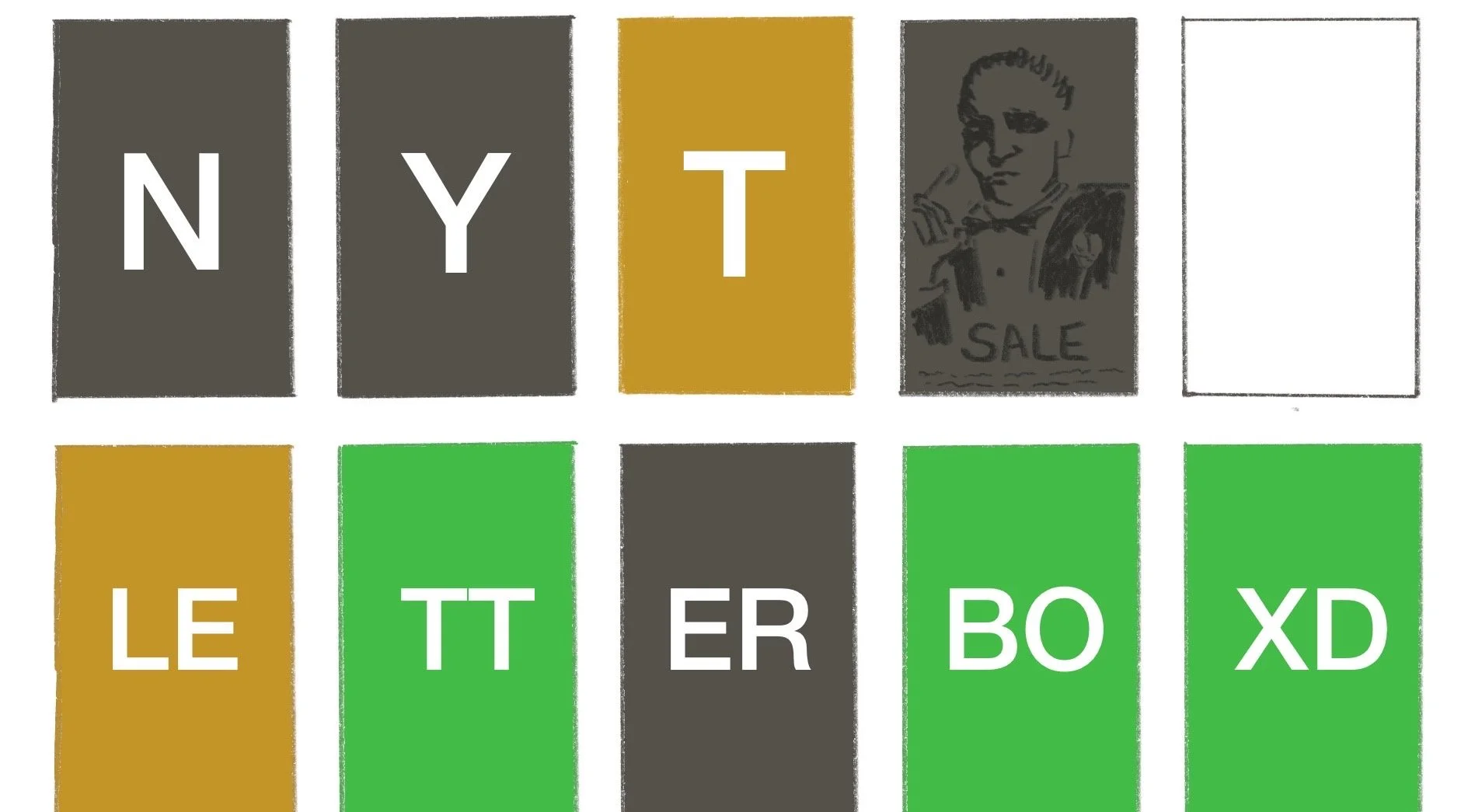
Illustration by Zoe Wren Arntsen, Illustrator.
At the tail end of the COVID-19 pandemic in 2021, Wordle was all the rage. Our general culture’s obsession with five-letter words has never been more pronounced. Yet, after The New York Times purchased the word puzzle game in 2022, it has since faded into a state of relative obscurity. While people still play the game, paywalls and increased advertisements have made it a mere shadow of the phenomenon it once was. Today, history seems to be repeating itself.
Following a bidding war between companies like Netflix and Sony, it was announced that The New York Times will be purchasing popular movie review site Letterboxd for a hefty $330 million price tag.
“When I first got Letterboxd, my taste in movies was completely different than it is now. Honestly, I would kind of attribute myself in 2020 to a film bro,” said junior strategic corporate communication major and the co-host of Letterboxd Wrapped on Chapman Radio, Varenna Morris. “I think Letterboxd has definitely opened my eyes to what else cinema has to offer, that it's not just this one genre — it has so much to offer. Letterboxd really lets people explore their options more with what they're viewing.”
For cinephile members of Gen Z, Letterboxd’s impact won’t come as a surprise. The app’s tidy design, enabling users to easily rate, review and create lists cataloguing their “life in movies,” has revolutionized the way that young people are watching movies. As of last year, Gen Z has become the highest filmgoing demographic, due in no small part to the social aspects of Letterboxd.
However, with news of the New York Times’s efforts to purchase Letterboxd, it can feel like this Gen Z cinephile community is up for sale.
“It’s a lot of mixed reactions immediately,” said senior theatre and French double major, Salvatore D'Agostino. “I am an avid reader of the New York Times … but at the same time, one of my biggest concerns is how they are going to attempt to monetize Letterboxd even further, just based on the amount of money that they're paying for [it]. It scares me in a way, because one of the things that I really liked about Letterboxd was that it was run by a small company in New Zealand who just had a passion for moves.”
Launched in 2011 by Matt Buchanan and Karl von Randow in New Zealand as a way to track the movies they watched, the company has maintained a small team with a deep passion for cinema in spite of the user base rapidly growing to 30 million registered users. Moving this small New Zealand company to an American media conglomerate poses many potential concerns.
“I think it’s been awesome for this huge thing to be based in Aotearoa because it’s bringing awareness to a small film scene that really does have a lot of gems,” said Emily Gunston, recent University of Auckland graduate and entertainment editor for Craccum Magazine. “I think it would be disappointing to see it move to the US, as it really feels that everything is based out there, and it’s been really special to have this thing that’s been a real turning point for the whole industry here. I think small Aotearoa filmmakers will likely go back to being overlooked without Letterboxd being a driving force behind the local film scene, but I know the creatives will keep making great art without that push.”
With the Skydance acquisition of Warner Bros. and early talks that Netflix might acquire NBCUniversal, the New York Times acquisition of Letterboxd comes at a tricky time where mergers andacquisitions are at the forefront of the entertainment industry. Specifically for a film review site, this sale might conjure memories of NBCUniversal’s 2016 acquisition of Rotten Tomatoes, a site which has since seemed to be relegated to near insignificance in relation to Letterboxd’s popularity.
“I see it as a much larger trend of media consolidation, and I'm not really convinced that's a great thing because we're seeing more of the entertainment and film criticism platforms becoming increasingly connected to the major media corporations,” said senior writing for film and television and strategic and corporate communication double major Danny Diamond. “I guess while that doesn't automatically mean these companies influence reviews, I think it raises important questions about how independence and potential conflicts of interest can come up … At what point does media consolidation begin to affect the way we evaluate films?”
Alongside general fears that are always associated with the acquisition of a smaller company, The New York Times raises specific concerns with their notoriety of pay walls. Since Letterboxd is currently free with the options to remove ads and add features like custom posters with Pro and Patron tiers, the base functions of the site are open and free to anyone. Without this accessibility, much of the “social” aspects that have popularized the site are at risk.
“I wonder what they're going to take away from the free tier (and) how it's going to affect all the users,” said D'Agostino. “It sort of reminds me of when Meta took over Instagram, they monetized the hell out of it. There were more advertisements, more shit like that. I don't think that it's healthy for Letterboxd to go through that transformation; I think it'll take away a lot of what people like about it.”
But, perhaps the sale isn’t all doom and gloom. While the small company feel is part of what makes Letterboxd so refreshing, improved features and a smoother interface also become possible under the ownership of the Times.
“I'm not happy in general that it's being acquired because I feel like it might change the foundation of what the app is all about, but I have faith that the workers at Letterboxd are solid enough in their values that it's not going to change too much,” said Morris. “If anything, I think with it being bought by the New York Times, it's going to give them more resources, more visibility … I think it's going to bring some good, it's going to bring some bad, but overall, I'm honestly not too upset about it as opposed to what our other options were.”
With other companies such as A24, Netflix and Paramount were in the running to purchase the social cinephile site, the New York Times was one of the few options removed from the movie-making business.
For now, Letterboxd remains one of the lynchpins of modern film discourse. While it's primarily popular with Gen Z, many in the industry are using it to stay on top of media trends. At Chapman, film professors are no strangers to plugging their Letterboxd usernames and frequenting the site.
“I don't think of Letterboxd as a social media platform, really. For me, it's a way to make lists and keep track,” said film and media arts lecturer and screenwriter John Mattson. “All of the lists I now make in Letterboxd were things I used to do using Excel, and before Excel they were handwritten in notebooks. I do like being able to find people who like what I like. That's a great way to find new things to love. It's not so much about meeting new people as it is about meeting new movies.”
While the sale still hasn’t officially gone through, it has entered its final stages and looks to solidify in the coming months. Although the future of Letterboxd remains unstable, no matter what policies its new owners enact, the impact on the film fan community is undeniable and lasting.
“I think you aren’t getting the same community from other platforms, and that’s what draws me to it the most,” said Gunston. “I think we just are currently in a world where those middle companies aren’t able to survive as the wealth gap is growing across the board. It's a real shame and a big worry to see our media landscape growing more and more homogeneous, with less room for different opinions.”