
Hashing It Out: Does ‘The Drama’ shoot itself in the foot?
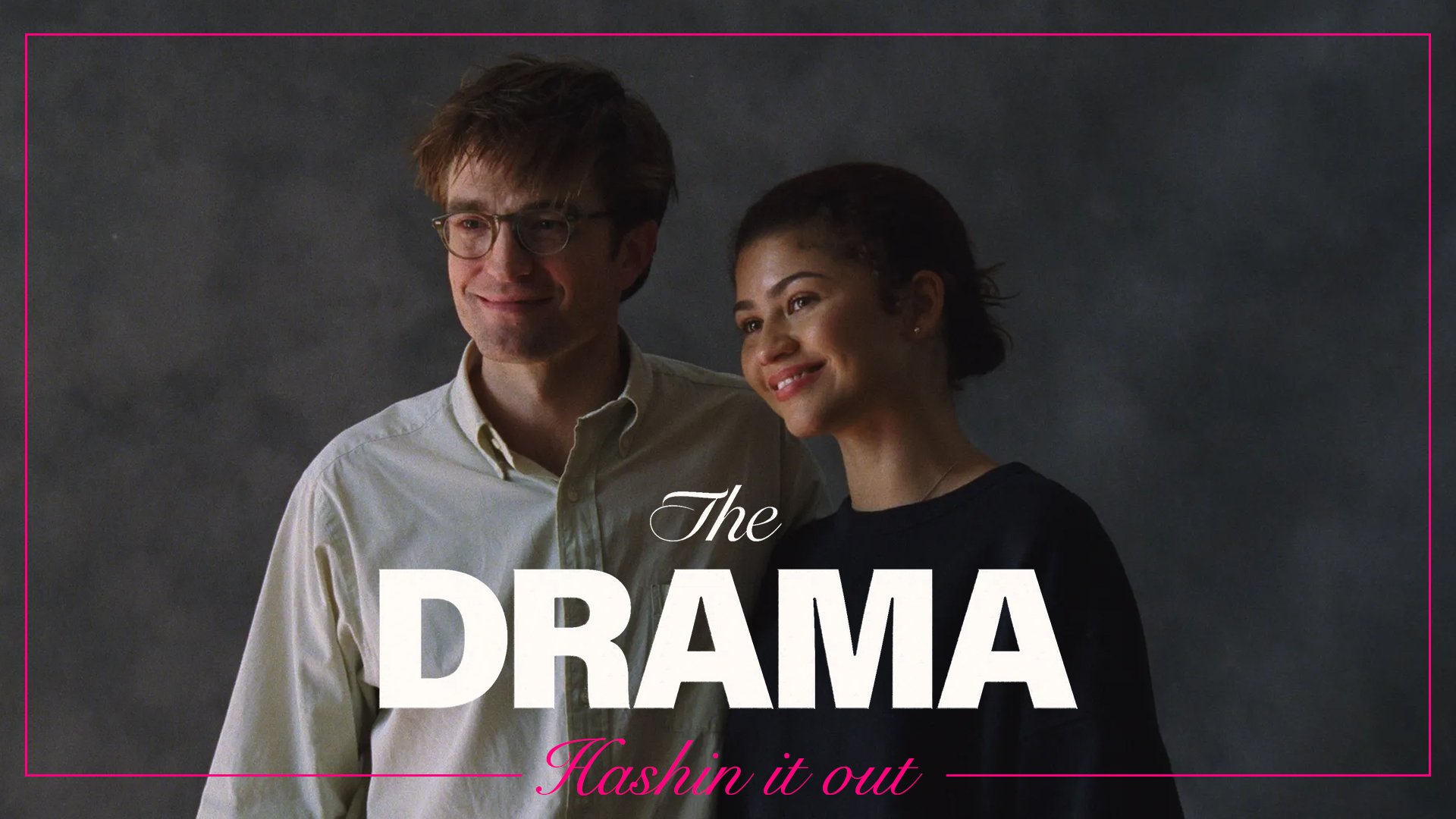
Collage by Easton Clark, Photo Editor
Spoiler alert: this article contains spoilers for “The Drama.”
Even though it only released last week, it feels like we’ve been talking about Kristoffer Borgli’s “The Drama” for years. With its hot-button political topics — and even hotter stars — it’s a film that unquestionably speaks to our current moment.
Starring Zendaya and Robert Pattinson, it was only inevitable for buzz to build up around this film from the days of its early production. A24’s choice to hide the reveal that the titular “drama” is an attempted school shooting by Emma (Zendaya) has stirred up controversy surrounding the film. Taking on one of the most pressing American issues, which stirs up deep trauma in many, does “The Drama” succeed in its confrontation of these themes, or does it struggle to approach the controversial topic?
The Panther’s features and entertainment editor Ben Price and reporter Celine Schuneman sat down to “hash it out” with their varying opinions on the film’s approach.
Celine: I feel like a lot of our conversation is naturally going to surround the marketing, because the secrecy around “The Drama” is kind of the whole selling point for this movie. It's being billed as a rom-com with two of Hollywood's biggest stars working today, and the secret is revealed very quickly in the movie — within 10 minutes. My primary concern is that I think treating the mass shooting reveal as a “twist” despite being a central part of the film feels like a tone-deaf spectacularization of a very real issue. It'll be interesting to see how this ages beyond that marketing tactic.
Ben: A24 is running into something now where the Herculean task of selling people on an original movie with movie stars can undercut the authenticity of the movie they're trying to sell. I know many people who saw “Marty Supreme” and felt that they had been kind of led astray by the marketing as to what the movie really was, and I think the same is true of “Materialists.” But, frankly, I'm of the opinion that if you can trick someone into buying a ticket, all is well by me.
Celine: To me, that's the issue, the fact that it has to be a “trick” to talk about gun violence. While there are windows and opportunities for this to be an interesting satire on American gun culture, it is too often used as the butt of the joke or just a plot device that offers no nuance on the situation, only desensitizing this issue.
Ben: One, I think you're right. Two, the movie premises itself upon the idea that Zendaya almost shot up a school and uses that as a rift to explore the nature of a relationship, and how two people relate to each other. The movie is ultimately significantly more interested in that than having any grander statement on mental health or toxic online communities and gun violence. Maybe that makes me a bad viewer or a bad person, but ultimately, I was really in on the exploration of this relationship. I appreciate that the movie has ideas, but rarely yells them in your face. I think this is a relationship drama in satirical clothing.
Celine: It’s maybe a better approach to a satire than something like “Don’t Look Up,” so I agree with your point there. To me, the most obvious reason that wants to say more as a satire is Ari Aster's involvement. He's a producer on this, and it feels very in line with his work on “Eddington” or producing “Bugonia.” So I think that there is that intentionality.
Ben: It's interesting you note that, because I feel like “Eddington” never saying Trump by name is like “The Drama” never explicitly saying Columbine. I think that it trusts the audience to have enough familiarity with the concepts it's dealing with that it doesn't need to fully spell them out in the world of the movie. I think it's partially because it’s a movie dealing with a thing that didn't happen. It’s a real, all too frequent phenomenon, but only conceptually. Everyone in the movie is dealing with it in their own way.
Celine: I feel like, in a lot of ways, the fact that the shooting didn't happen discredits some of the social realities of gun violence. There is the shooting that does happen at the mall, dissuading Zendaya’s character from shooting up her school, but she never fully processes that, and I think that's the core flaw with her character. To me, the interesting part of her backstory is, how did she get out of this internet gun culture and into spaces of activism? That's only presented through this one short, almost throwaway, scene where she's being reached out to. So, sure, maybe this is trying to say something about how community is how we stop gun violence, but it’s not entirely presented as a tangible or thoughtful solution.
Ben: I think you can see this as a feature or a bug. Ultimately, it comes back to how this movie is far more about these two people and “the drama” between them than anything else. I think this is not a movie that is interested in any kind of message outside of the complexity that you can't know from a person you love. This is not a movie that is really interested in speaking to anything larger than that. By the end of it, I felt it had become the movie it was interested in being from the beginning. Maybe it’s a little cheap to use something that is real and has taken its toll in a real way to get there. But by the end, I personally wasn't bothered, I think because it’s interesting to see us as a culture learning to process these events beyond them happening. It’s the idea that we can go beyond recounting to think about them and the impact they have on a generation, and you see that in a very real way.
Celine: That's a good point, and I will concede that I think the ending scene in the diner is incredibly strong. But I think that if we're going off this idea that it's more about the central relationship than these larger themes around it, the core flaw in that becomes how rushed Charlie’s (Pattinson’s) affair feels. It just kind of appears in the third act right before the wedding, making his cheating the catalyst for the violent chaos that ensues at the wedding banquet. I think that choice decenters anything else that happens preceding it, I don't know what your opinions are on this…
Ben: I'm very pro-cheating. I think it's good. There's a moment earlier on where Charlie makes eyes at the photographer that I think I read a little too much into. Because I was like, “I think he's probably gonna cheat.” I think it speaks a lot to the character. I think Pattinson is good at it, because even someone that looks like Robert Pattinson can make having an affair look supremely unsexy and enormously morally questionable. I really admire the movie for that. That it wasn't erotic. Even if it's really messy and hard to watch, then the end of the movie is, “Will her love for him survive?” And, apparently, the answer is “Yes.”
Celine: This is maybe a good point to pivot to discuss Rachel (Alana Haim) a bit, because I do think she is one of the most interesting characters in the movie, though I will not be defending her by any means.
Ben: I think that's the movie's ideological ejector seat. I think, no matter how you feel about this movie, its contents or its subject matter, the moment she turns, you are not in on this person. I also just think it's interesting to me that she embodies a really potent idea within the movie; it's a lot easier to spout rhetoric of support than actually embodying an openness towards people in your life. To say “I'm here for you, I see you, I hear you, I'm with you,” until you actually see a wound or a crack. She just immediately is not prepared to deal with the reality of that.
Celine: I do think it is fundamentally a film about empathy. It’s very overt. They say that over and over again at that photo shoot scene. Yet, even in this satirical sense, I just wish the film itself had an ounce of the empathy it critiques its characters for lacking. I feel like the film itself is positioned like one of its characters in that it never takes initiative or the opportunity to get to know people beyond the face value of horrible things about them.
Ben: I think that's the power of the ending, in that it's these people agreeing that they finally know each other in this way that they didn't before. I think the ending does have a lot of empathy for both of them by the time we get there. I think the movie is a tad flippant with the subject matter, but I don't question the recipe because I like the results.
Celine: I also want to touch on Rachel’s cousin (Anna Baryshnikov). I think I would have personally appreciated a little bit more of her perspective as someone with direct experience surviving gun violence. Overall, I suppose a lot of the ideas here would have worked better if the film was more of an ensemble piece. I think focusing more on that outer social bubble with a larger swath of reactions to this fallout would have been able to boost some of the ideas here.
Ben: I think that's fair, and I think that may have made certain elements of the broader commentary stronger, beyond just the relationship. I do think that the other couple is like an angel and the devil on their shoulder. You have Mike (Mamoudou Athie), who's hanging in there and ultimately on their side, and then Rachel is just wrath; she's so fucking pissed.
Celine: Overall, I don’t think this is by any means the worst movie of the year, or a bad movie. I think it’s very entertaining and that there are some dynamics that work particularly well. But when all is said and done, it’s a film that’s too frivolous with the approach to its central sociopolitical themes and can’t commit to any commentary beyond a general point and look mentality. Mass shooting narratives are already so hyper-stigmatized and hard to come by in media, and for a film with a platform like this to approach it… I just would have liked to see a lot more care put into handling a topic that leads to so much death and strife across the country.
Ben: It’s been good to actually talk about this because most of the people I’ve engaged with this movie about are just over the moon about the Pattinson-Zendaya of it all. I’m always for movie stars looking pretty and behaving badly in a way that gets people talking, and we’re talking right now. I think, in that way, I was pretty satisfied with this movie and the reactions it provoked.
Editor’s Note: A previous version of this article incorrectly labeled Anna Barynshnikov’s character as Rachel’s sister, not cousin.