
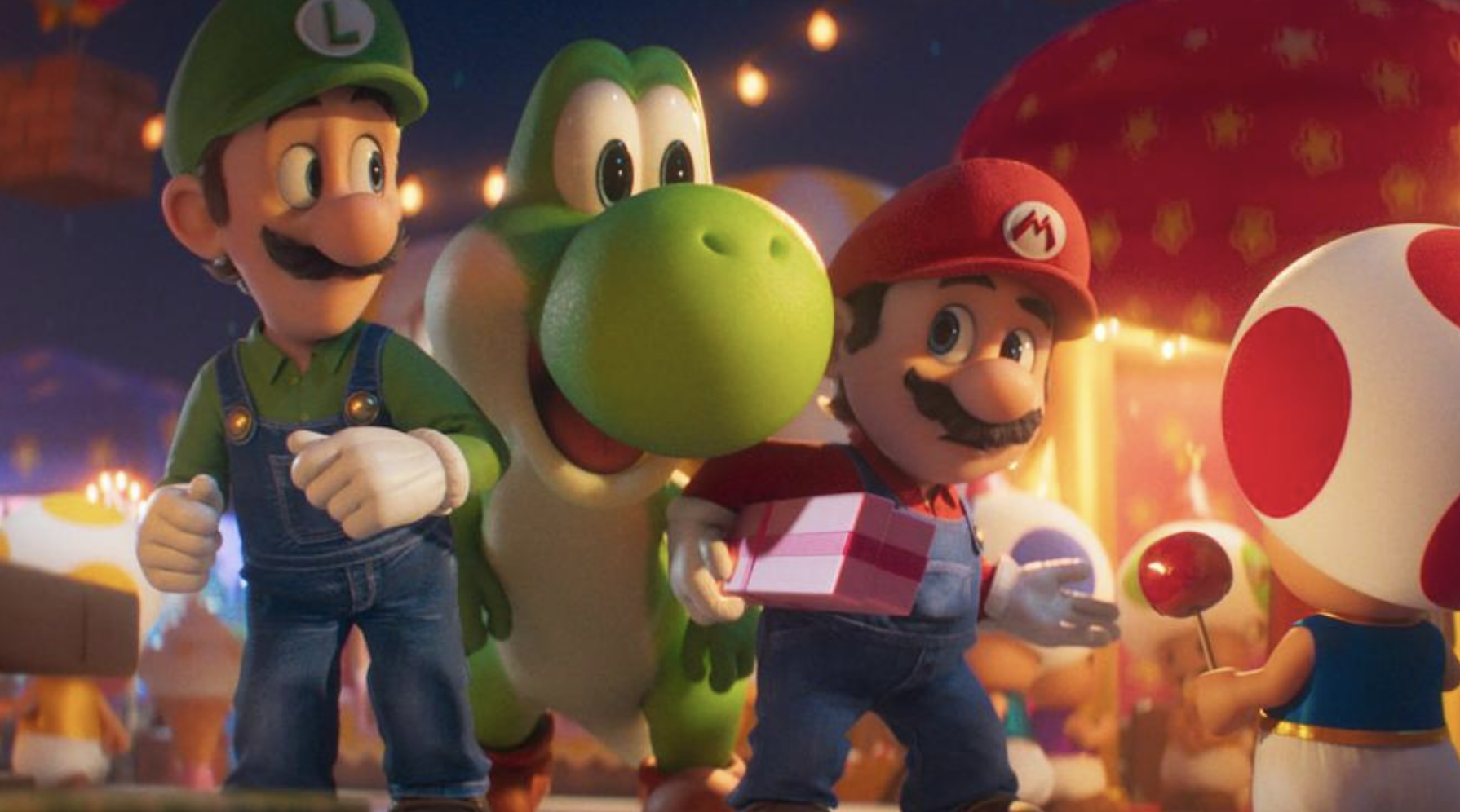
Photo courtesy of Universal Pictures
If you haven’t heard anything good about “The Super Mario Galaxy Movie,” it’s because babies can’t write movie reviews and are unbothered by the constraints of a politically correct zeitgeist; but not this baby.
Undoubtedly, fans of the original film may not be pleased to find that in their second animated outing of the 2020s, the brothers plumb, Mario and Luigi (played expertly by beloved public figures Chris Pratt and Charlie Day) are sidelined in favor of world-building.
Yes, it may be hard for die-hards to swallow, but the filmmakers take the title’s “Galaxy” to heart and cast their net into the heavens of Nintendo intellectual property. We’ve already met our intrepid plumbers, now it’s time to meet their environment, friends and enemies.
The exploratory ends of this sequel are made clear early on when the brothers answer a mysterious call that leads them to the discovery of the film’s real star: Yoshi, brought to monepic life by the usually talented Donald Glover. And put simply, if you, as an audience member, don’t believe a plushy dinosaur with a one-word vocabulary can serve as a load-bearing main character in a 90-minute children’s flick, I don’t think this movie is for you.
Similarly, if Jack Black’s humiliatingly well-cast turn as Bowser was your favorite part of the original film, be prepared for his snotty son Bowser Junior, brought to life by actor and filmmaker Benny Safdie, to take center stage as big-bad in this installment.
Indeed, the biggest complaint theatergoers continue to lodge against this film is its overindulgent use of Nintendo’s intellectual property to fill out the runtime, relying on hokey introductions of beloved characters to avoid considered plot advancement emerging from the original film — but this is simply missing the forest for the trees. I really am sorry, but it’s “The Super Mario Galaxy Movie,” guys.
A useful comparison here is “Wreck It Ralph,” which soberly frames its candy-colored, hyper-indulgent venture into video game aesthetics within the context of an aging arcade pulling the plug one game at a time.
For “The Super Mario Galaxy Movie,” there is no such useful framing device to imbue its story with extratextual meaning because Nintendo is a massive, multinational corporation that between the “Mario,” “Pokemon” and “Super Smash Bros.” properties, does not have to lean on nostalgia for any previous era of gaming to entertain the parents in the audience.
In simpler terms: this movie is for Generation Alpha and their parents, the millennials, who already spent their childhoods glued to Gameboys and early DS models and are thus eager to transfer their love of the rounded-edge Nintendo aesthetic to their Switch and iPad-toting tots.
Beyond this, to be indignant about the storytelling nuance of “The Super Mario Galaxy Movie” is to be completely blind to the limits of film as a medium. Not only is it obvious that slick screenwriting doesn’t earn points with toddlers, but it’s not like there is an especially deep well of Mario universe storytelling to draw from. It can’t be held against the filmmakers that the work doesn’t lend itself to dinner party conversation.
If you are buying a $15 ticket to see “The Super Mario Galaxy Movie” and are leaving the theater disappointed by the level of insight, boy, is there a rude awakening in your future about the actual utility of moviegoing and the use of your time on this earth. The amount of money and power required to make a movie on such a grand scale as to get it internationally released in chain theaters for more than a month will always be more than enough to morally bankrupt whatever the film is saying, even if it is only a plea for kindness between toddlers.
To counter this with a plea for higher quality children’s entertainment from multinational corporations is to misunderstand the motivations of such corporations. One has to wonder if the illusion of choice afforded to gamers by video game developers has poisoned their ability to enjoy something that exists and operates independent from their controllers and identities, for better or worse.
The film’s strongest moments were thus the ones that shed all pretense of plot and instead indulged in sheer visual entertainment. There are frames of kinetic, CGI action that, I dare say, could be horizontally compared to the work of experimental filmmakers like Stan Brakage and Phil Solomon, who sought to constantly reveal film form to be nothing more than the celebration of shapes, colors and movement. It is easy to imagine that most animators feel this way as well so it is freeing to see them go ham in the moments of intense action.
None of this is to suggest the film is still anything but a studio movie, and old industry habits impede on the colorful experience in the most annoying of ways. In an animated film about an already-animated cast of characters, the need for hyperreal, familiar textures feels very misplaced.
A defining moment of the film is when all of the main characters except Yoshi are turned into babies and the wordless dinosaur is tasked with saving everyone from a real-life Tyrannosaurus rex. It’s a nice metaphor for the ideal viewing experience: if you are not reduced to a giggling baby by the escapism of these shapes and colors, you are not the audience of this film.
Everything in this film is optimized so that BABIES CAN UNDERSTAND. I REPEAT, YOU MUST BE OR BE OK WITH RETURNING TO BEING A BABY FOR THIS MOVIE TO WORK ON YOU.
THIS ALSO MEANS YOU CANNOT COMPLAIN ABOUT IT UNLESS YOU’RE A BABY — and an unpretentious baby at that.
