Review | ‘The Secret Agent’ finds relevance in ‘70s aesthetics
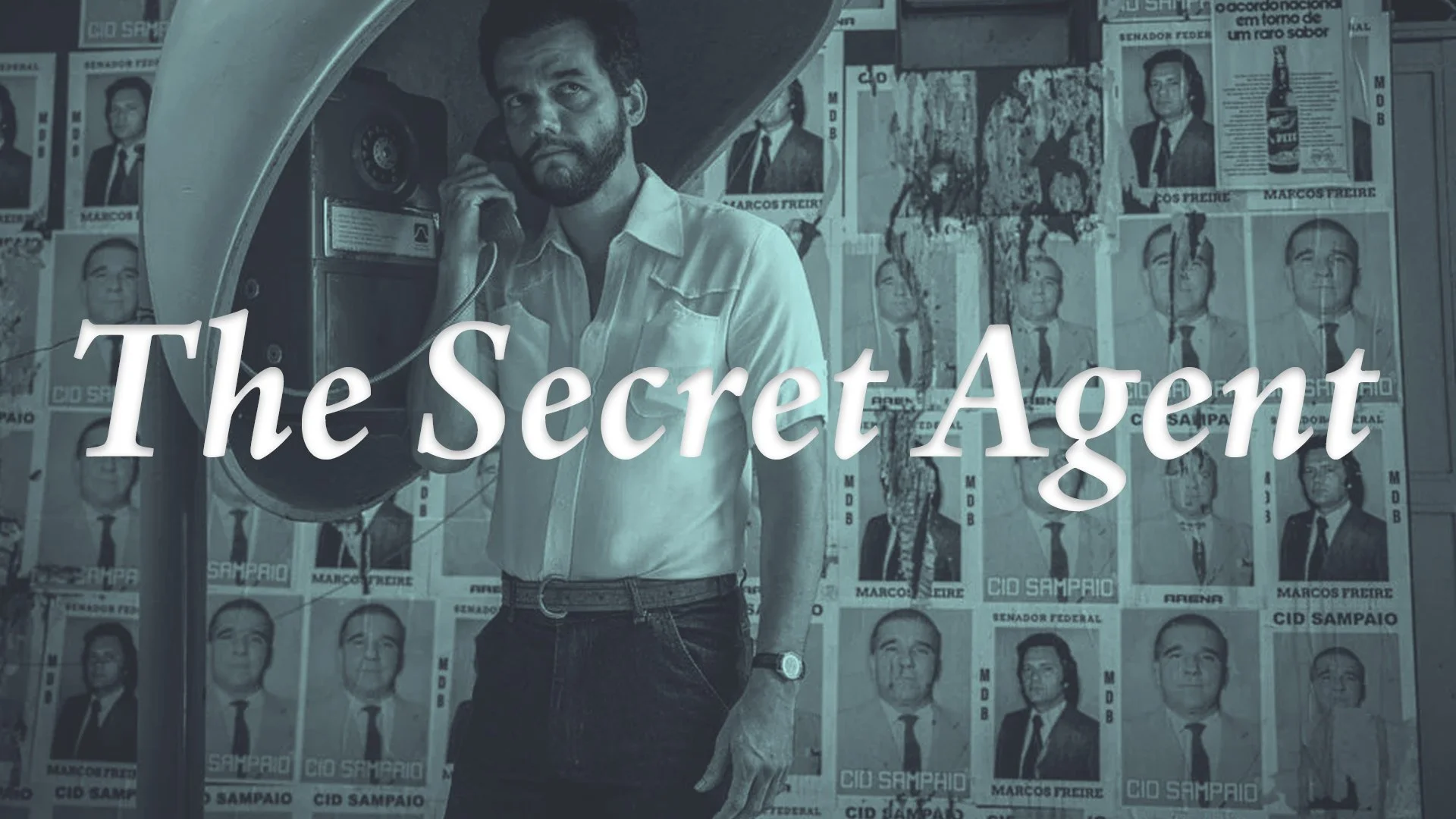
Graphic by Easton Clark, Photo Editor
While it’s not without its flaws, “The Secret Agent” thrives through its use of nostalgic aesthetics to cultivate an open discussion about corrupt government policies.
The film won best actor and best director at the Cannes Film Festival last May, and the audience outside the Newport Beach Film Festival’s premiere was buzzing with excitement. As the festival’s Brazilian spotlight, the screening attracted film fans and those with ties to Brazilian culture alike.
Written, directed and produced by Kleber Mendonça Filho, the film feels like a passion project as vibrant colors and dazzling set pieces paint a pastiche of ‘70s cultural staples. Yet, while the film lives firmly in the past, the encroaching themes of oppressive government regimes and ostracized citizens lead the way for a contemporary conversation about the looming threat of intercultural and intergenerational fascist institutions.
The film opens at a quiet rural gas station outside of the city of Recife as Armando (Wagner Moura)’s bright yellow car slowly rolls in. While this long shot sets the pace of a generally slow movie, it also leaves time for the audience to observe a dead body covered by a scrap piece of cardboard. Armando is stopped at the gas station for a trivial check by the police, which immediately establishes the satirical tone of “The Secret Agent” as law enforcement refuses to acknowledge the dead body, which omnipresently rests at the corner of the screen.
From here, Armando enters the city in the midst of Carnaval, where he reunites with his son and begins living with other political refugees. While Armando’s political past isn’t explicitly revealed for most of the film, the elements of a political thriller linger through the film’s drastic tonal shifts.
Rather than the campy spy story that the title and visual aesthetics would suggest, the film serves to more aptly highlight Wagner Moura’s performance in the lead role. Even when the film slows down to focus on seemingly small details, Moura’s subtle displays of emotions anchor its drastic tonal shifts towards a greater sense of realism.
Beyond Moura, the supporting cast does an excellent job of selling the film’s tricky tonal balancing act. The sheltered refugees present an ensemble of intriguing characters who are each deserving of a film of their own. Tânia Maria steals nearly every scene she’s in as an old woman sheltering the politically persecuted bunch. Even when the film doesn’t explicitly lay out the methods of the government’s oppressive structure, these supporting dynamics act as a form of rebellion against Brazil’s 1970s regime that — in many ways — mirrors the increasingly corrupt police state in the U.S.
The approach to fascist regimes in the film is complicated by moments of surrealism and absurdism that craft an intersecting history of political persecution. While this perspective of fascism as a cross-cultural and intergenerational institution is interesting, the shifting tone and hyper-aestheticization tended to detract from the weight of this message.
With a run time of nearly three hours and heavy themes throughout, this isn’t an easy watch. While the slow and meandering pace enables elements like Moura’s subtle performance to shine, it also loses some of its poignancy with entire sequences that feel inessential to the film’s grander narrative.
Despite those flaws, “The Secret Agent” is a prime example of a new wave of Brazilian cinema that is taking shape. Following last year’s surprise breakout hit and awards darling, “I’m Still Here,” this newfound interest in presenting Brazil’s 1970s military dictatorship on film is a notable trend.
Although “The Secret Agent” doesn’t quite reach the thematic heights that it promises, the vibrant set-pieces, strong performances and political relevance make this one of 2025’s most interesting films.