
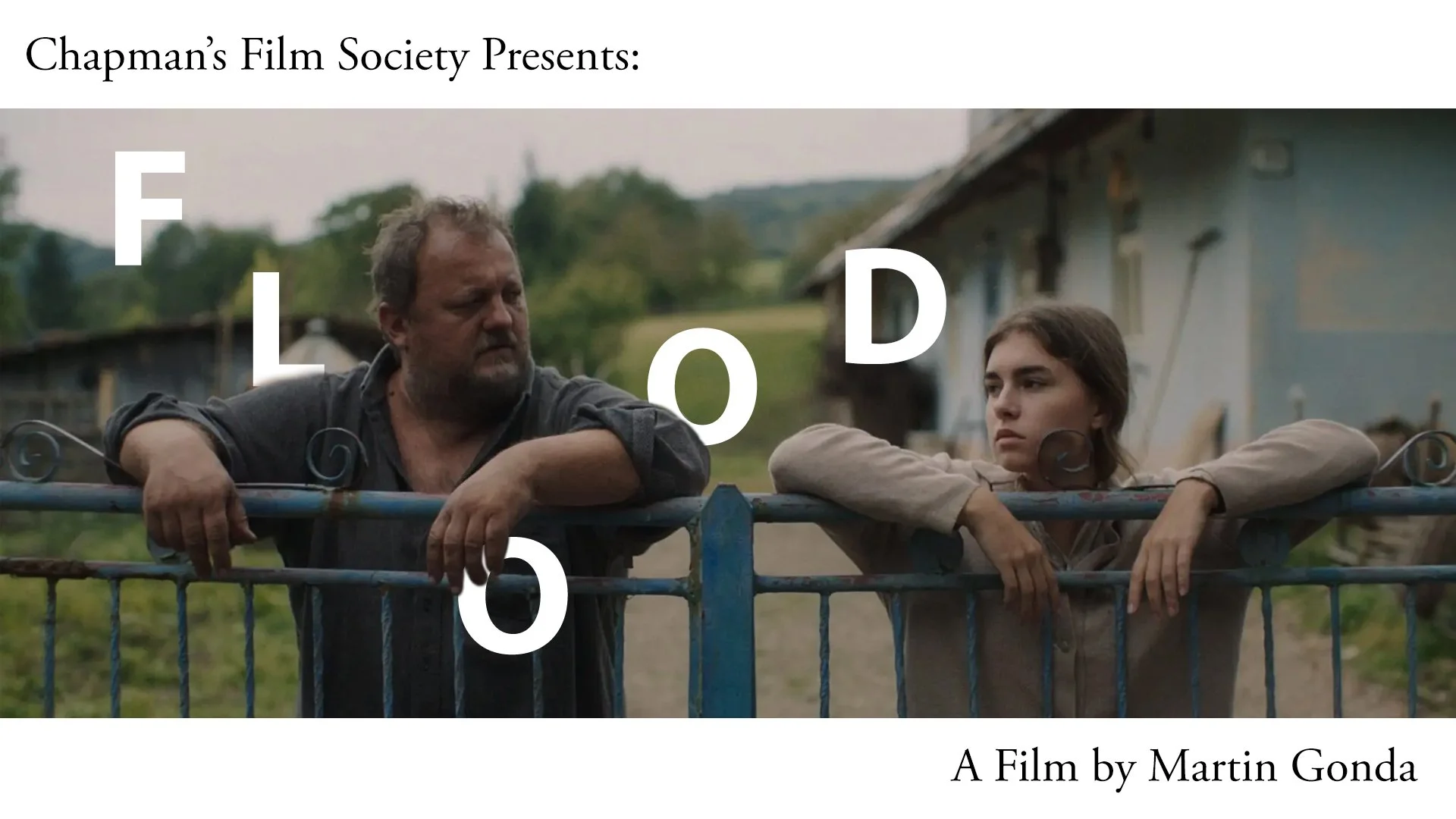
Graphic by Matias Pacheco-Ramirez.
When Dodge College announces that celebrities like The Rock, Ariana Grande or Miles Teller are coming to Folino Theater for master classes, students might camp out in line overnight in hopes of being in the same room as the A-listers. But when a potential Oscar contender is screened in Folino, joined by the director, one of the producers and two of the main actors in the film, far fewer Chapman students attended.
“Flood” is a Slovakian film released in 2025 that is now currently on an Oscar campaign in the United States. The film has been selected as Slovakia’s entry for Best International Picture for the upcoming 99th Academy Awards.
“Flood” marks director Martin Gonda’s first feature-length film, having only released one film before it. Gonda’s first film was the short film “Pura Vida” released in 2019, which was shown at the Cannes Film Festival that year.
“Flood” is still seeking distribution for the United States, but has premiered in a few cities around the country as they have begun their Oscar campaign.
Although the turnout for the screening did not have as many students as Dodge’s typical master class or film screening events, the audience had many questions for the guests following the Q&A section moderated by The Film Society’s president Emma Harvie.
While The Film Society has done Q&As with film directors before, the interviews are typically conducted online and recorded to show club members. With the stakes high moderating a “Flood” Q&A in Folino in front of a live audience, Harvie stayed cool under pressure. She asked the filmmakers a range of questions about the creation and reception of the film, notably what the process was like, considering the film was a feature-length debut for a large part of the crew.
“I think it's really good to learn from the people who are getting their boots on the ground first and hearing from people who are doing their first feature film, rather than extremely well-versed stars that have been in the industry for years and can't really give you that much advice,” senior film and media studies major Harvie said.
The film centers around a 15-year-old Mara, played by Sara Chripakova, living in her village Ruské in Slovakia who dreams of becoming a pilot, but has to deal with conflict between her and her father as well as the hard reality of her people needing to evacuate their village.
“Flood” is based on the real events of the construction of the Starina water reservoir in Slovakia, where the Slovenian government forced the Rusyn people to leave their homes.
The Rusyns are a minority Slavic group in eastern Europe, such as in Slovakia, and whose stories are widely unknown.
“You probably don't know much about Rusyn people, but even a lot of Slovak people don't know a lot about this minority. So for me, it was very interesting to actually tell a story about an unknown part of our history which happened,” producer Katarina Krnacova said.
“Flood” is the first feature film to primarily be spoken in the Rusyn language, along with the Slovakian actors speaking Slovakian, though the decision to make the film in Rusyn wasn’t to “be a statistic,” Gonda said, but rather to highlight the real stories of the Rusyn people.
Lead actress Chripakova and Vladimír Cema, one of the film’s other main actors, joined the director and the producer at the screening in Folino, where they shared their experiences filming the movie, including speaking their lines in the Rusyn language.
“I have about six or seven films and the films I was acting in; Polish language, in Serbian language, in Czech language and I think one film, in Slovak language, only one film. And this is mine, this is my Rusyn language,” Cema said. “It’s my mother language, and it's my culture, and for me, it was beautiful that I could be in the film, and this film is about my culture, about my childhood.”
Authenticity was a major factor in all aspects of the film’s production, from only hiring Rusyn people to act as the Rusyns in the movie, talking with locals to hear first-hand accounts of the real events and using sets and props directly from the era.
“We really tried to find locations which would be conserved in time, so they wouldn't change in the last 40 years or 50 years since that period, since the ‘80s. So we're trying to look to find the buildings, the houses, the interiors, which would be attached to that time,” said Krnacova. “We put a call into local radio, local magazines, local papers, that if you have anything in your storage or after your grandparents and costumes or any furniture or anything like that, we would come and collect it and possibly use it in our film. So that really helped us and really, I would say, majority of costumes and props and settings which you see in the film are from real people, from those villages around, from that region.”
For half a year, The Film Society was unable to put together any film screenings due to legality issues and rules through Chapman’s administration.
“If it can't be like what they call a ‘teaching opportunity,’ like an official class or a professor who is approved to show something…we can't screen stuff as a club,” Harvie said. “And then this opportunity was the first thing we had so far to be an official Film Society event because the screening was approved by the administration and the director.”
Following this decision, The Film Society was unable to put on film screenings until Harvie was reached out to by one of Dodge College’s associate deans, Pavel Jech, who informed her about the opportunity for The Film Society to officially put together the screening. The international film falls right into the types of films The Film Society typically highlights.
“The films that we typically try to screen are movies that are either underseen or underground art films, global cinema,” Harvie said. “We also watch popular movies too, and we obviously aren't biased to that, but we try to curate it so it's definitely more underrepresented.”
Next semester, The Film Society will transition into an official class, Film Society Workshop, that any student at Chapman can take. The class will operate similarly to Chapman Radio, where there is a designated class period, but it will still function like a club for the executive board to operate alongside advisor and associate film and media studies professor, Jacob Bohrod.
The class will be an experimental film and television course for one credit, and although seats are filled up for the class, The Film Society hopes the course can carry on in the future for more students to get the opportunity to take.