
The ‘Good (Omens),’ the bad and the confused
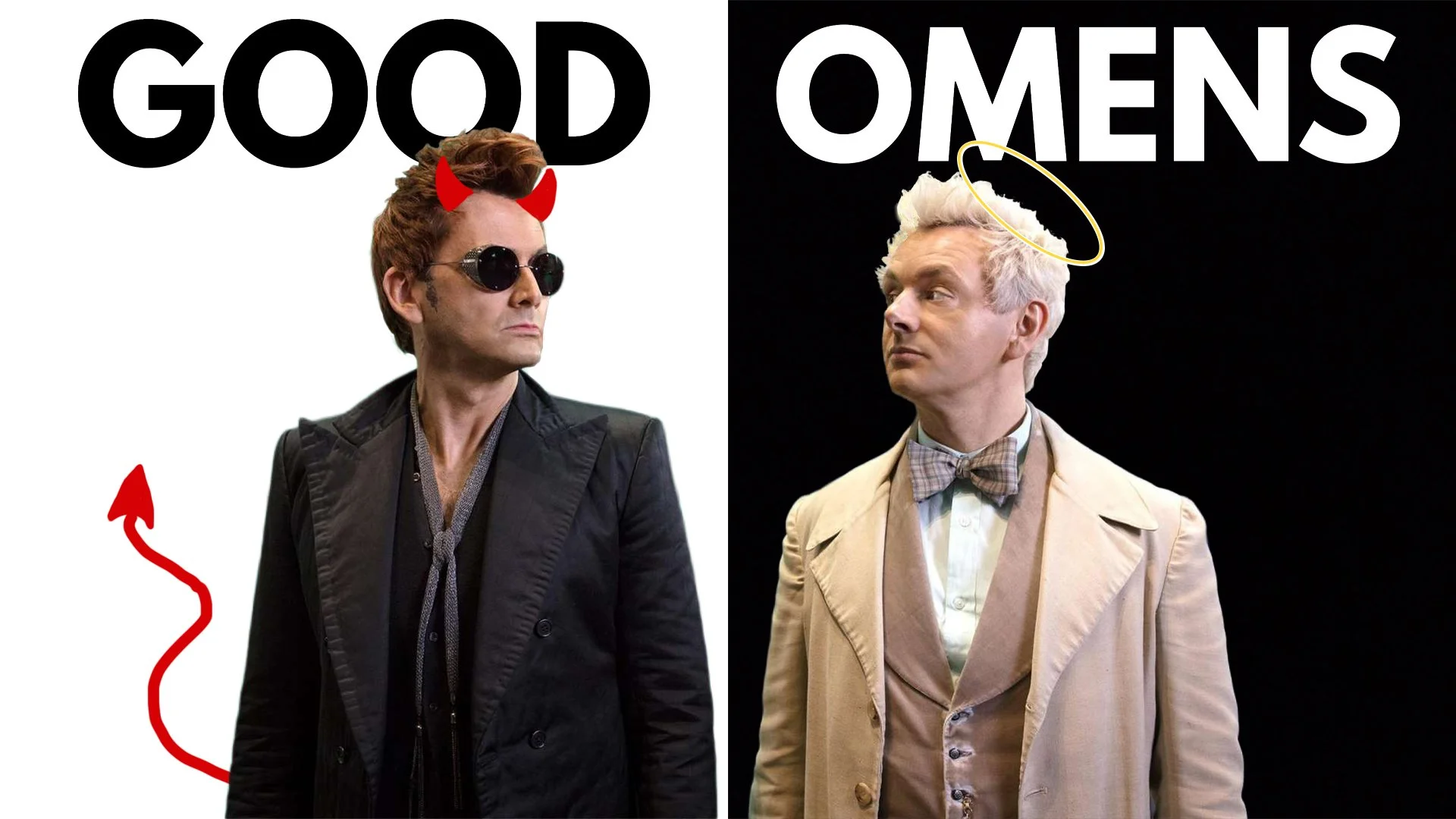
Collage by Trinity Johnson, Photographer
“I can't trust myself to be normal about it,” said senior film and media studies student, Mel Brisky. “There was definitely a lapse after (the Neil Gaiman allegations) where I was like, ‘Okay, I'm not going to think about ‘Good Omens’ anymore.’ But once I heard that the third one was coming out, I was so excited and equally terrified.”
Seven years after the first season premiered, Amazon Prime’s series based on Neil Gaiman and Terry Pratchett’s 1990 book, “Good Omens,” has come to a close. But the path towards the third installment has been anything but straightforward.
The conclusion of the fantasy series about the close relationship between polite angel Aziraphale (Michael Sheen) and handsome demon Crowley (David Tennant), was put in doubt after Neil Gaiman was accused of severe sexual misconduct. Gaiman was quickly removed from involvement in the finale, putting production on hold shortly before filming was set to begin.
Nevertheless, fans rallied around the beloved series. After a year of uncertainty, Amazon Prime Video announced that the originally planned six-episode series would be condensed into a 90-minute special wrapping up the story. As a result, fans have had bittersweet reactions to the show's end.
“I really have loved this show, and all the pain aside, I'm really glad that we did get some kind of closure,” said University of Southern California graduate student and “Good Omens” fandom expert Alex Welch. “I do think that not having given us any kind of ending would have felt like punishing the fans in a way, too.”
As a whole, the finale has received mixed reception. With many criticizing the rushed nature of “Good Omens 3” and fans uncertain about how Crowley and Aziraphale’s romance concluded, the 90-minute special received a 32% audience score on Rotten Tomatoes. This is a significant drop from the 93% score for season one and the 94% score for season two.
“It's kind of the same feeling as when I saw the ‘Five Nights at Freddy's’ movie,” said junior film and television production major Daniel Baron. “Because, as a fan, it's perfect. But also, as a film student, it's like, ‘Okay, what could we have done better?’ It was one of those things where I wasn't fully immersed for a lot of it until the very end.”
While the fandom has been split about the episode’s quality, most are in agreement that the full six-episode series would have likely been a more appropriate conclusion for these characters. Yet, in the light of Neil Gaiman’s alleged horrific actions, it’s difficult to discern where to draw the line on holding him accountable. While separating Gaiman from the project was absolutely the right decision, this also left countless cast and crew members out of work.
“The vast majority of (the cast and crew) had no idea about anything that Neil Gaiman was doing, and they had no involvement in any of it,” said Welch. “The most important thing is definitely to stop giving (Gaiman) a platform and stop giving predators an opportunity to continue to profit off of their art. This is genuinely a tragic situation for the hundreds of innocent people who signed up for this show thinking that they were going to have months of steady employment, and were slashed to probably a couple of weeks.”
“Good Omens” isn’t alone in this dilemma of separating art from the artist. In the wake of the #MeToo movement and cancel culture, countless beloved books, shows and movies have been reevaluated by fan bases. While it’s easy to paint this as a reactionary push to erase meaningful stories, it can also become a generative form of new media production as fan culture has become a defining feature of 21st-century media.
“It felt like I was watching fan fiction,” said Brisky. “I know this is fan service. I'm a fan. This is servicing me. And I'm still enjoying it … but I'm still kind of upset about it.”
Fan fiction has been a defining feature of “Good Omens” as the fandom exploded with content following the first season’s release. While Terry Pratchett and Neil Gaiman only wrote the book that was later adapted into season one, the overwhelming positive reactions are what likely pushed Amazon Prime to greenlight a second season in 2021.
The relationship between Aziraphale and Crowley, within the fandom: the “Ineffable Husbands,” has quickly become one of the most popular fan fiction franchises online. With nearly 64,000 stories written about Aziraphale and Crowley’s relationship on Archive of Our Own, a prominent fan fiction website, the community thrives in these spaces of generative and reinventive fandom.
“I personally have spent a lot of time reading and writing ‘Good Omens’ fan fiction. For me, that's something that really helped solidify my love for it,” said Welch. “Seeing this fan response probably motivated folks on the studio end to think that it would be viable to produce more. Especially given how much of the fandom revolved around shipping culture and wanting to see these two characters together romantically, it told them that there was going to be an audience if they did take the leap and make that romantic relationship explicit on screen.”
The overt queerness in online fandom spaces is an essential piece of their generative nature. In the face of bigotry from their creators, being able to revise stories beyond the artist's control has become a way to engage with beloved properties without directly supporting the creators. This struggle is also prevalent in the “Harry Potter” fandom as the new HBO Max series has been met with backlash in response to J.K. Rowling’s aggressive transphobia.
Yet, there are often still pieces of these stories that resonate with queer communities. Whether it’s relating to Harry Potter’s ostracization or connecting to the queer romances of “Good Omens,” the solution to creators’ bigotry isn’t always as simple as trying to forget about the franchises altogether. These stories still leave real and lasting impressions.
“Every background character and side character (in ‘Good Omens’) is like, ‘I have a gay husband’ and ‘this is my lesbian wife,’” said Brisky. “It’s awesome just to see those casual little things dropped in there, especially growing up in a place that was super Christian, where I was bullied for being gay. ‘Good Omens’ was such a breath of fresh air for me.”
In the face of increased bigotry, online fandoms like that of “Good Omens” have become safe spaces for many to express themselves and feel comfortable in their identities. While Gaiman’s actions and the finale’s mixed reception are disappointing for a multitude of reasons, fandoms have found undeniable passion and community within the story.
In these spaces of transformative fan culture, the centuries-long ineffable romance between an angel and a demon has the power to live on beyond this rushed 90-minute finale.