
Tom Casciato’s talking head: Truth Without Vérite
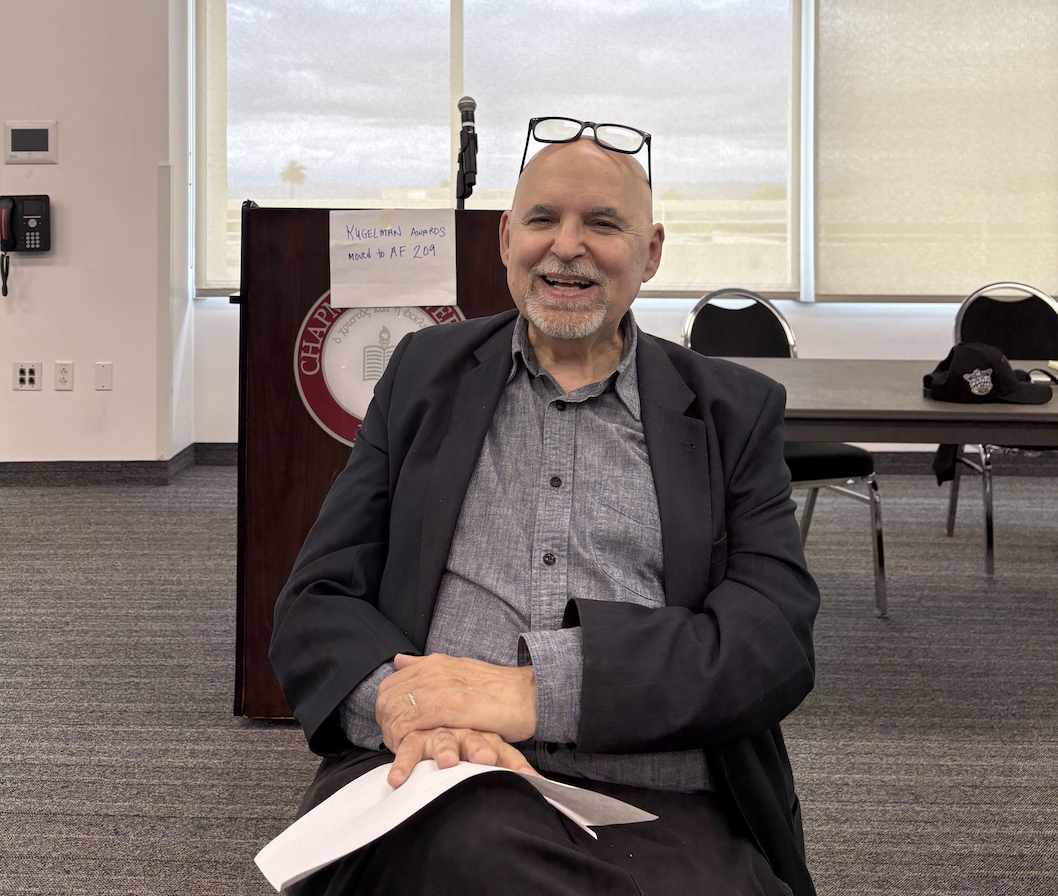
Photo by Kiera Nusbaum, Features and Entertainment Reporter
In a talking head, Tom Casciato’s lower third might read journalist, filmmaker, producer or podcast host; but he would consider himself simply a seeker of truth. On May 4, Casciato visited Chapman to share the professional wisdom acquired after a decade-spanning tenure.
Casciato’s work is informed by the traditional journalistic values of his early career. He explores pressing current affairs as well as long-term conflicts as they unfold, through his work on the television show “Frontline,” including the 40-year-long project “Two American Families: 1991-2024.”
With the rising capabilities of distribution over time, digital journalism’s spotlight on its subjects only shines brighter and brighter. The media landscape’s economic prowess and societal influence has strengthened, leaving documentaries in a gray area between objective journalism and subjective filmmaking.
“I never thought what I was doing wasn't journalism. But a lot of people who go into the business really look at documentaries purely as an art form,” Casciato said. “They look at journalism as something with a whole other set of rules, regulations and ethics that they don't have to follow because they're artists.”
With the incomprehensible power that journalism has on our current society, journalists wield the power of influence. And when reporting brings people to their reckoning, journalists are often seen as the ones responsible. As Casciato put it, “Truth got itself a bad name.”
Casciato’s talk rang with the open-ended question: “How can journalists tell the truth?”
He takes a stab at answering this question through his podcast. Succinctly titled “The Thousand Roads,” Casciato explains his position on the matter with David Crosby’s lyrics, “There’s a thousand roads up this mountain.” Rather than telling us which road to climb, Casciato simply offers a map.
Casciato spoke of the documentary “Who Killed Vincent Chin?” about two white auto-workers who were never incarcerated after murdering a Chinese-American man in the early 1980s. The documentary took a traditional approach, simply sharing the information rather than taking a direct stance. The filmmaker simply let the story tell itself, even including testimonies from the murderers.
“When we were coming up, objectivity was a goal. You would try to take yourself out of the story as much as you possibly could,” Casciato said, explaining the film’s vérite approach.
This traditional form of storytelling from a bird’s eye view has since been subverted, as an objective voice in storytelling became perceived as the cowardly road when exploring ethical issues.
“Now, nobody thinks you can do that because there's no true object,” Casciato said. “You are subjective. You are the one making the choices. You're the one asking questions, you're the one evaluating it.”
One film that refused to shy away from subjective storytelling was “Hazing,” where the filmmaker Byron Hurt explored the institutional danger of toxic masculinity in fraternities. His personal involvement in the making of the film, including personal stories from his time at Northeastern University and input from the subjects, created a new code of documentary ethics.
“What got lost in the whole conversation of objectivity is the idea of judgement,” Casciato said. “But if we're gonna make these things, you are using judgement. You are making decisions. You are trying to be as reasonable as possible to get as much information as you can to analyze it.”
As filmmakers get more comfortable with getting their hands dirty in a story, more questions arise surrounding the proper portrayal of subjects.
Casciato cited an episode from his friend Bill Moyers’ documentary series, titled “Rosedale: The Way It Is.” Moyers showcased the blatant, outspoken racism of the almost entirely white community of Queens, New York in 1974. The film is a time capsule that summarizes how willingly subjects would talk to the camera when they didn’t fear who was behind it. As documentary filmmaking grew more driven by subjectivity, the role of the subject grew riskier.
Since then, people’s perspectives of the role of documentary subjects have greatly shifted. While people were once unafraid to share any number of controversial opinions, the subject has now become a vulnerable position to be in. Many worry that their story and likeness itself could be shown in a bad light.
This was explored in the documentary “Subject,” where filmmakers Camilla Hall and Jennifer Tiexiera reported on the profound, oftentimes negative effects of famous documentaries’ success on their subjects.
However, documentaries such as “Tongues Untied” prove that subjects’ personal struggles can be shared in a sensitive and impactful way. Through the use of testimonies, poetry andmonologues Marlon Rigg crafted a subjective narrative that tackled the issue of racial and sexual invisibility. The film was provocative, while still yielding positive benefits for the subjects it portrayed by offering a sense of community.
Now, documentaries are suggested to abide by a new ethical code that attempts to navigate the gray area of situational reporting. It addresses how to properly compensate subjects without “buying” the story, the idea of “continuous consent” — where a subject can revoke their participation in the project at any point throughout production — and properly portraying both sides of an issue.
But Casciato warns filmmakers not to let a strict code slow down their search for the truth.
“It’s not entirely defensible, philosophically. But it is defensible creatively,” Casciato said. “These true stories are not just the truth of the filmmakers. Rather than getting bogged down in an intellectual exercise of trying to decide whether or not objectivity is possible … Go tell true stories, because they’re out there.”
Ultimately, Casciato said it’s up to the individual filmmaker to decide on their own personal, general code of ethics that can then be applied to their art. He offered the rule of thumb that filmmakers should be proud to take credit for their work.
“If we're going to live in a world where we're making our own ethics as we go, whatever you do, you want to be able to defend it,” Casciato said. “If I do something, I want to say: ‘I’m Tom Casciato, and I did that’ … If (you’re) afraid to say it publicly, it's probably not something that you want to do.”
No matter which road a journalist takes up the mountain, the destination should be the truth.
“The writer comes to a conclusion,” Casciato said. “We might present (information) in a way that is very presentational, or we might actually write narration that says exactly how we feel. One way or the other, though, we're coming to conclusions. And I think you shouldn't be afraid of it.”