
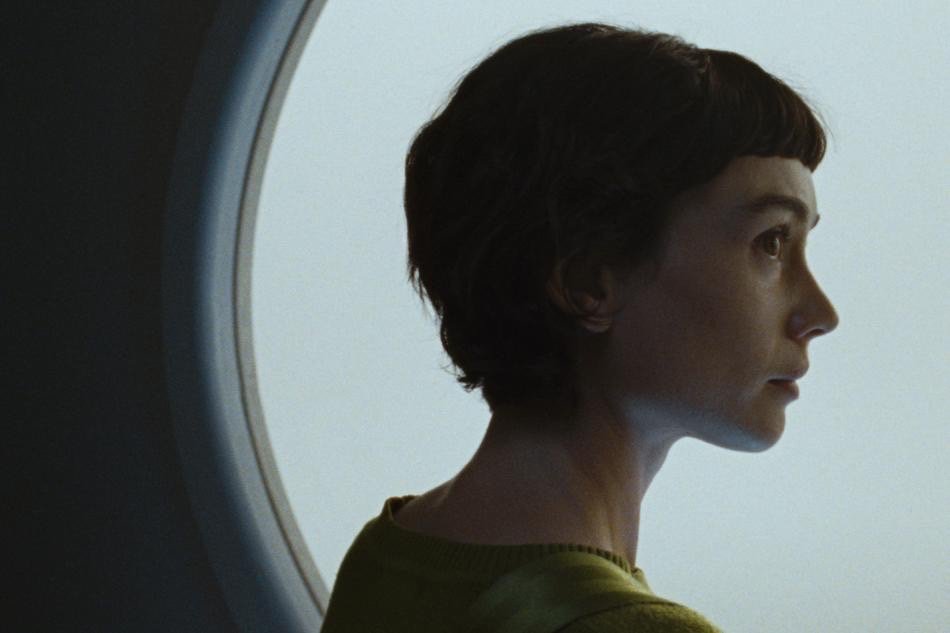
Photo Courtesy of Anima.
If you could burn your consciousness onto a CD, what songs would it play? “Anima” tackles the timeless complications of legacy through a timely sci-fi concept. I scored a seat in the third row from the screen at the film’s packed Newport Beach Film Fest screening.
A struggling art graduate (Sydney Chandler) chauffeurs a terminally ill and tremendously wealthy recluse (Takehiro Hira) to an experimental operation that will preserve his likeness in a virtually simulated hologram after death. Even though the film is based on the hypothetical technological advancements of a near-future, the film displays humanity’s endless desire to be remembered. Over the course of the journey, the pair unravel their individually complicated relationships with memory, regret and fatherhood, resulting in a tender sci-fi drama.
Director Brian Tetsuro Ivie was asked if we could ever truly untangle our memories, and he answered by explaining the film’s running motif of buttons. The secluded aristocrat Paul made his fortune through a button manufacturing business, a detail based on the director’s own uncle. He commented that he didn’t understand the importance until he lost one off his favorite coat, and it was all he could think about. That anecdote made it into the movie’s dialogue, efficiently summing up the film’s perspective on the small moments that compose the soul, and the lengths one might go to retain those moments.
Tetsuro Ivie also rooted the story in the parable of the rich fool, in which a dying farmer realizes he’s spent more time focusing on his material riches than his soul. Paul’s pursuit of a physical legacy through reallocating his wealth cannot preserve him in the same way that vesting his emotional energy might have. The film’s fascination with recording on tangible media, in and behind the scenes, demonstrates humanity’s inclination towards materializing memories, almost as much as the simulated hologram of deceased loved ones.
“Anima” was Tetsuro Ivie’s first experience as a writer-director, a personal and bold leap from his history as a documentarian into the “sci-feelings” genre.
“As a documentarian, you don't get to use your imagination very much, so I love that about it,” said Tetsuro Ivie. “(But) when you make documentaries, you can hide a lot more easily behind the subjects. It’s not about you. It shouldn't be. This was very personal.”
Exploring such a rich concept required a new sense of vulnerability from the director. He threaded many personal details into the story, even describing the film’s mix of Japanese and American music as the “soundtrack of his life.” But the vulnerability that the story demanded is what allowed it to resonate with audiences and connect to the cast. Sending Hira the soundtrack on a CD alongside the script was what convinced the Emmy-nominated actor to take on the role.
“As I read the script and listened to the CD, I was like, ‘I have to be in this,’” said Hira. “I came to the states about seven years ago, and when I read that script, I (felt) like, this is the reason I came here.”
Hira shared his extreme preparation for his first independent film, eating only soup for dinner for two months to take on the role of someone with a terminal illness. He also brought forth personal struggles in his relationship with his own father to inform his performance with Paul’s abandoned son, Ryan. In fact, the first time Paul meets Ryan was the first time Hira met his scene partner, Maximillian Lee Piazza.
“Ryan’s the type of person who doesn't say what he's truly feeling — he carries it. I try to focus less on what he says and more on what he’s trying to hide emotionally,” Lee Piazza shared.
The 17-year-old actor’s performance included a miraculously-timed, accidental nose bleed during the pivotal scene between father and son.
“I was panicking in the middle of the take,” he said, before realizing the take had made it into the final cut. “That moment taught me that the most unexpected moments can lead to the most real and honest moments.”
Furthermore, the most pivotal shot of the scene was reshot due to a “scheduling miracle” and seamlessly spliced together. The modest budget called for many on-set solutions that gave the film character, yet never would have surfaced in the frictionless environment of a studio production. Tetsuro Ivie said these restrictions made the film a “road movie first, sci-fi second.” While visual sci-fi elements such as glass panels and heavy technological exposition had to be cut from the script for budgeting purposes, it allowed the film the opportunity to focus on its emotional core.
“I like that the sci-fi is just one flower coming up in the sidewalk, opposed to the whole world,” said Tetsuro Ivie. “In the age of digital moving faster and faster, we're going to go the other way, (making) sure that the process feels human and the outcome is human.”
“Anima” was shot fully analog. Production company Kebrado’s celluloid-only commitment supported the movie’s thematic core and shone light on the film’s charming intimate details.
Referring to a light leak in an emotional scene, Tetsuro Ivie said, “It’s almost subconscious or subliminal, but it reminds you that all of this is real and it's a chemical miracle.”
Tetsuro Ivie teased an upcoming film about a group of brain-chip hackers. He hopes a higher budget will allow him to put more of the world’s technology on display, but promised to keep the same grounded emotions that made “Anima” such a touching viewing experience.