
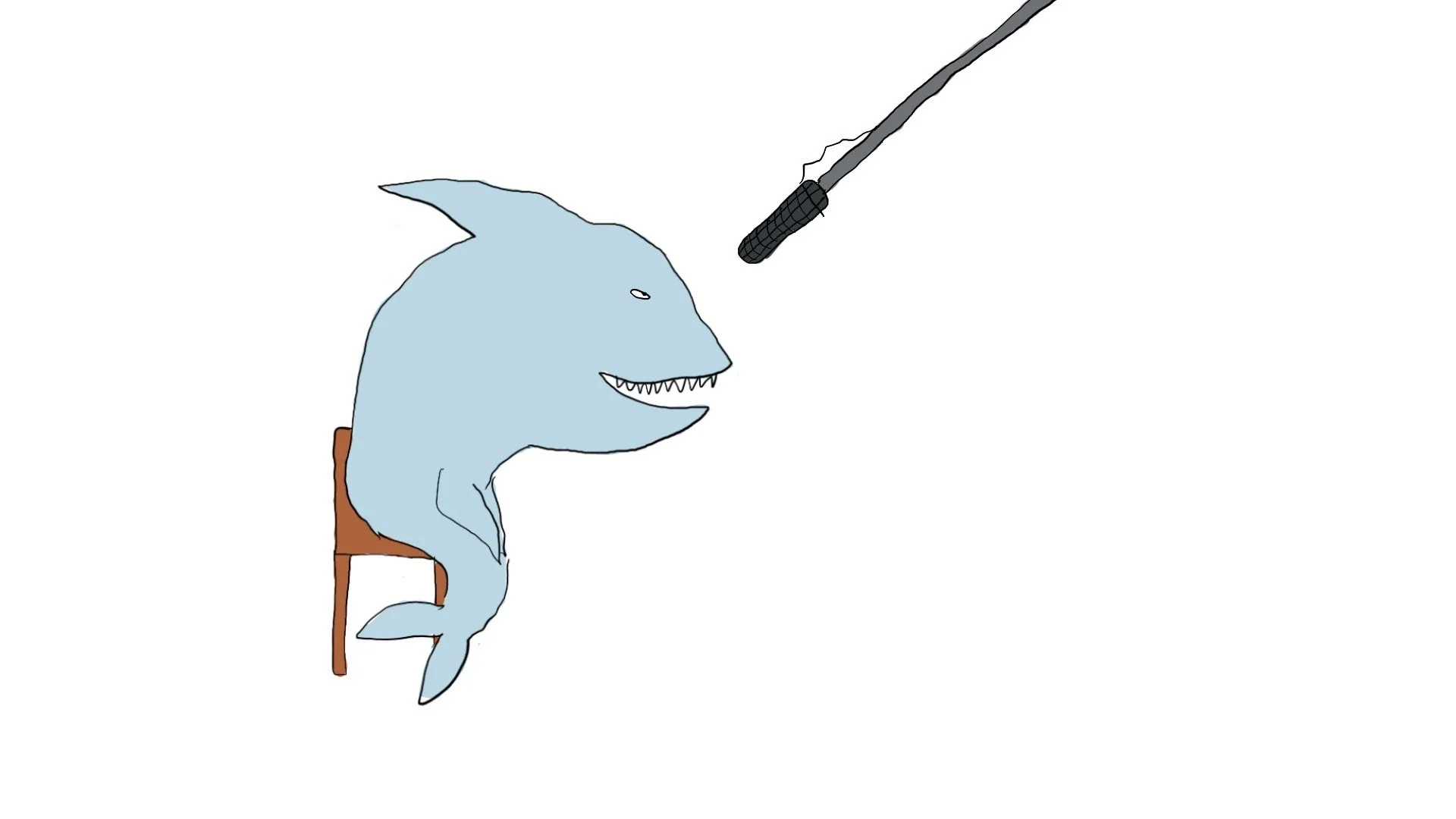
Illustration by Sami Seyedhosseini, Cartoonist
Have you ever had a million dollar idea? Has your neighbor? Have all your neighbors? Or, does today’s million dollar idea simply have more in common with yesterday’s thousand dollar idea, only adjusted for inflation? Let us answer with an even bigger question: who’s buying?
On April 10, “Shark Tank”’s casting director Mindy Zemrak scanned the lobby of Chapman University’s Leatherby Center for Entrepreneurship and Business Ethics with an eye out for the inventor of the next Scrub Daddy or Squatty Potty. Within the week she had held casting calls at both USC and UCLA, but this was “Shark Tank”’s first time at Chapman.
“This year, specifically, we really ramped up our footprint within college communities because we know that so much innovation is happening with student startups,” said Zemrak. “Chapman has exceeded our expectations with the amount of sign-ups. They are pulling in double the amount that other universities did.”
The event was organized by the Leatherby Center after a cold email from “Shark Tank”’s casting department and drew over 70 applicants on a bright April afternoon to pitch their products in offices scattered around the building.
"We have everyone signed up for 10-minute slots,” said Leatherby Center Project Manager Kiara Hastings. "It’s one-on-one with the casting rep: they make their pitch, then the casting rep asks them questions to understand the business. They show their prototype if they have samples, and then that’s it."
For most of the applicants, this casting call will not be their ticket to the annals of TV history. Pitching to “Shark Tank” can be a years-long process. But the allure of being publicly rewarded for one’s persistence draws returning entrepreneurs every year.
“I pitched to ‘Shark Tank’ two other times and got callbacks both times. Sometimes people have to pitch 12 times,” said former Chapman employee and Orange local Sandra Robbie. “You never know what the producers are looking for. I just hope this year I’ve got the magic.”
As the casting call was not exclusive to just students but also faculty and alumni, Robbie was presenting her prototype for a sunglasses clip.
“You take your glasses off, clip them to your shirt, and then, when you lean over at Coachella dancing the night away, you don’t lose your glasses."
Indeed, the innovations on display run the gamut of utility, ranging from mildly convenient to totally indulgent. Amidst various herbal teas, energy drinks and BDE-conscious boxer briefs, it was easy to spot the Pedego Electric Bikes team with their “three-wheel electric autocycle,” a futuristic vehicle straight out of “The Jetsons.”
“It goes 65 miles an hour and they go 250 miles on a charge. It’s got air conditioning, windshield wipers, you can even get airbags and seatbelts. There is no motorcycle license requirement and it’s very inexpensive insurance,” said CEO Don DiCostanzo, eager to practice his upcoming pitch, though it is also not his first swim around the proverbial tank.
“We did pitch and did get to a couple of different levels before, but then my partner was not available to take the phone call the day they called so we got eighty-sixed,” said DiCostanzo. “They left a message and said sorry. They’ve got 40,000 people applying and they can’t waste their time with us, so I learned my lesson: From now on, we’re going to leave our phones on.”
Behind glass doors and plastic tables, casting producers waited for Zemrak and her assistants to bring them applicants. They stayed hydrated between pitches by sampling from a small flight of loose-leaf teas and cold-pressed juices, provided by student-run company Aurelia Tea Experiences — present at the casting call not to pitch but to simply showcase their products and network.
The producers were warm, letting applicants choose between pitching or merely having a conversation about their product — understanding that for many of those in attendance, it is only a first step into the world of entrepreneurship.
Repeating the same casting circuit every season, it is normal for these casting producers to recognize the faces of returning entrepreneurs. This can sometimes result in a volatile relationship between the casting department and the more particularly dedicated participants. Representing, as they do, a system that rewards persistence, it’s not unreasonable to imagine how, after years, a stiff casting director’s smile would start to seem like a Sisyphean joke. But that might be on the contestants.
Applying reality TV’s casting process to an entrepreneurship competition necessitates that the branding of these products precede their actual utility and quality. Those who move on to the next round, after all, must be charismatic enough not to melt under the bright lights of ABC’s Culver City sound stages.
The way in which “Shark Tank” has gamified the lifestyle of American entrepreneurship darkly suggests that being an inventor has become a means of getting on TV, rather an end in and of itself.
Put another way, you will not see cancer cures or renewable energy on “Shark Tank” any time soon. It is a space for brightly-colored Amazon wishlist items, potential landfill fodder and TV-ready personalities.
Hearing the contestants eagerly practice their affected pitch-speak to each other in the Leatherby Center’s lobby, one has to wonder if an inventor’s time might not be better spent in their workshop, bent over a new gadget or, at the very least, gizmo.