
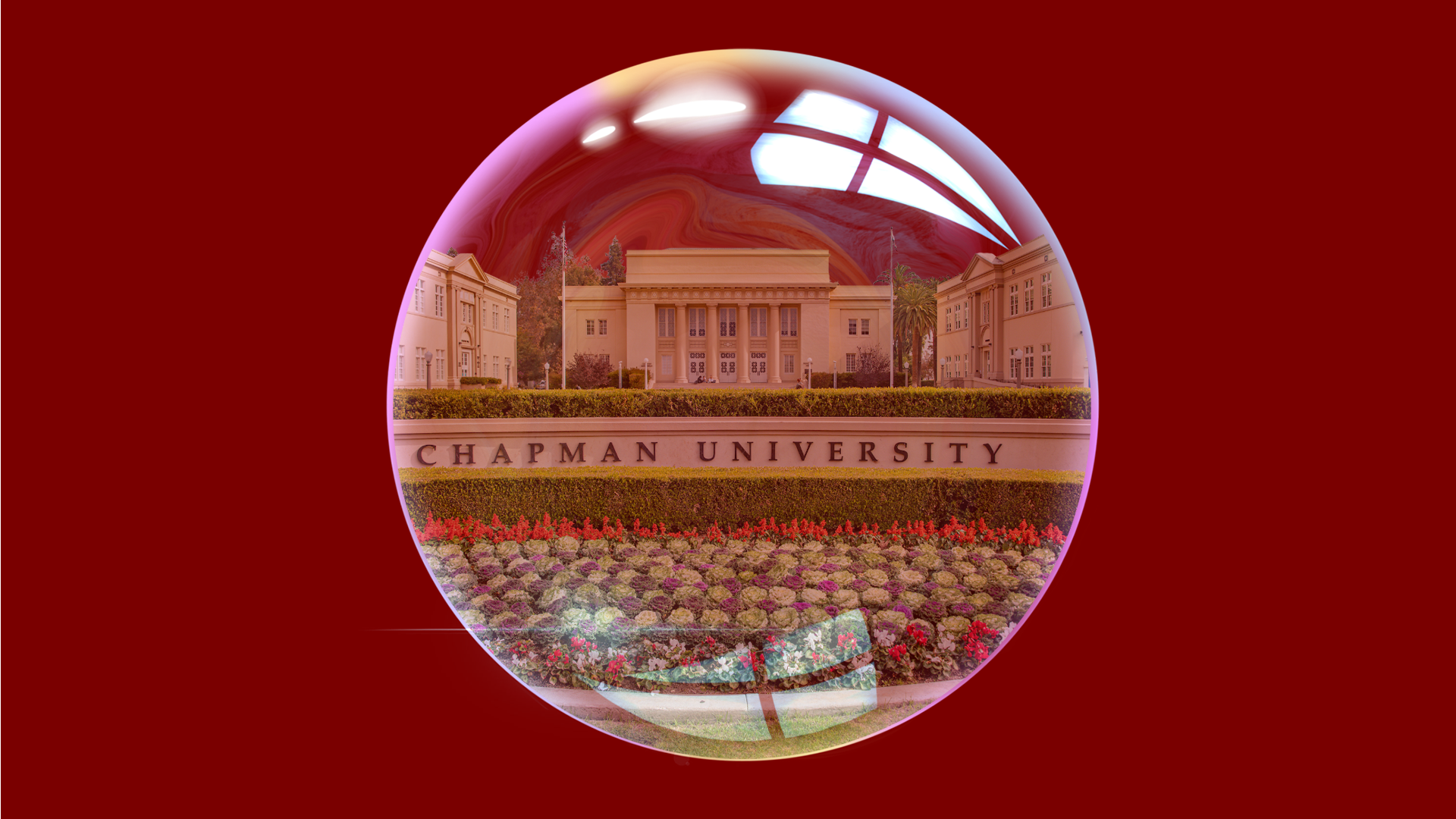
Graphic by Riley LeBlanc, Photographer.
When attending a school where the totality of social life is within a 15-minute radius, it’s hard to walk across campus without running into someone you know. For some students, that familiarity creates a close-knit community filled with familiar faces and predictable routines. For others, it can feel like living in a fishbowl where everyone knows everyone.
While attending a small university has its perks, such as small classes and strong community, it also can raise the question: When does a close-knit community start to feel too close?
“I think attending a smaller college makes it harder to break into social circles, because it seems people have pretty much found their friend group, and it shifts slightly through each semester depending on which classes you have with other students,” sophomore film and television production major Priyali Kulkarni said. “However, people are easy to talk to and very friendly here.”
Along with tight social circles, attending a small college can mean even the smallest moments leave lasting impressions. In a community where word travels quickly, a single interaction or mistake can shape how someone is perceived for years to come. This can make it difficult for students to reinvent themselves as they grow throughout college.
“I feel like, because I know a lot of people and a lot of people know me, I have to stick to one identity or one persona that I established last year or even this year,” sophomore theatre performance major Julia Sigmon said. “I feel like there's not really an opportunity for me to be somebody else or grow out of myself or find different people or different groups, and I just think it's isolating in the sense that I have to kind of live with the choices I've made last year, and I can't really break out and be somebody else.”
Although students are constantly surrounded by familiarity, being surrounded by friends and ice-broken classmates, although seemingly surrounded by socialization, can lead to students actually feeling more lonely.
“A small school creates many incredible and unique opportunities, although it also leaves fewer chances to meet new people and expand your social circle compared to larger schools, where new social opportunities are constant,” sophomore film and television production major Noa Malka said.
Along with social pressures to stay in the loop, students at small colleges grapple with the pressure of navigating personal and professional relationships in a community where everyone knows one another. With little anonymity, expressing honest opinions can be difficult with fear of words spreading beyond their intended audience.
“The lack of anonymity makes it difficult to be outspoken in an environment where everyone is considered to be a mix between a friend and colleague,” Kulkarni said. “There is chemistry between some people as friends but not necessarily (as) coworkers, and you don’t want to necessarily speak ill of a person’s image simply because there is a lack of chemistry in one of those regards. It could be difficult to maintain opinions or voice thoughts in certain situations when the fear is that the knowledge will become overtly public simply because everybody knows everybody.”
However, when it comes down to it, when students are at their home away from home it is a vital part of the community to have a chosen support group. Between bonding over 10 p.m. classes, running into a friend at Starbucks and doordashing Bruxie during a break in class, this close-knit community can become a chosen family.
“Something good about attending a small school that I wouldn't have if I attended a larger university is just that sense of community,” Sigmon said. “Especially doing the arts, like having an established group of people that I can collaborate with, whether it's creatively or knowing a bunch of people that are doing films that ask me to be in their films. I think it's super good for networking that I wouldn't receive in a bigger school.”
As prospective students rip their hair out attempting to choose their four-year sleepaway camp, finding a place that feels like home can be the make or break to how the student responds to the environment.
“I think a positive thing about attending a smaller university is seeing familiar faces around very often and feeling at home,” Kulkarni said. “I love walking around campus and realizing I know at least a few people around me, which is a feeling you don’t get often at a larger university.”
A perk of being in a small environment means constant opportunity to make a friend, or catch up with a classmate.
“For me, I feel like it's a lot easier to obtain meaningful relationships and find closer friends because, like I said previously, I'm constantly running into people on campus and I'm constantly seeing them studying, and it's a lot easier to form connections because everyone is so close. And I feel like once you make a friend, you typically already know that you already know their friends.”
At Chapman, a familiar face is never far away. Whether it’s a quick conversation on the way to class or a reunion at Einstein Bros. Bagels, the closeness that can make campus feel like a fishbowl can also make it feel like home. While knowing everyone's business and reputations spreading further may not be ideal, knowing there's always someone to sit with in the caf or the shuttle and to wave to across campus can make the difficulties worthwhile.