
Photo courtesy of Kate Trumbull-LaValle
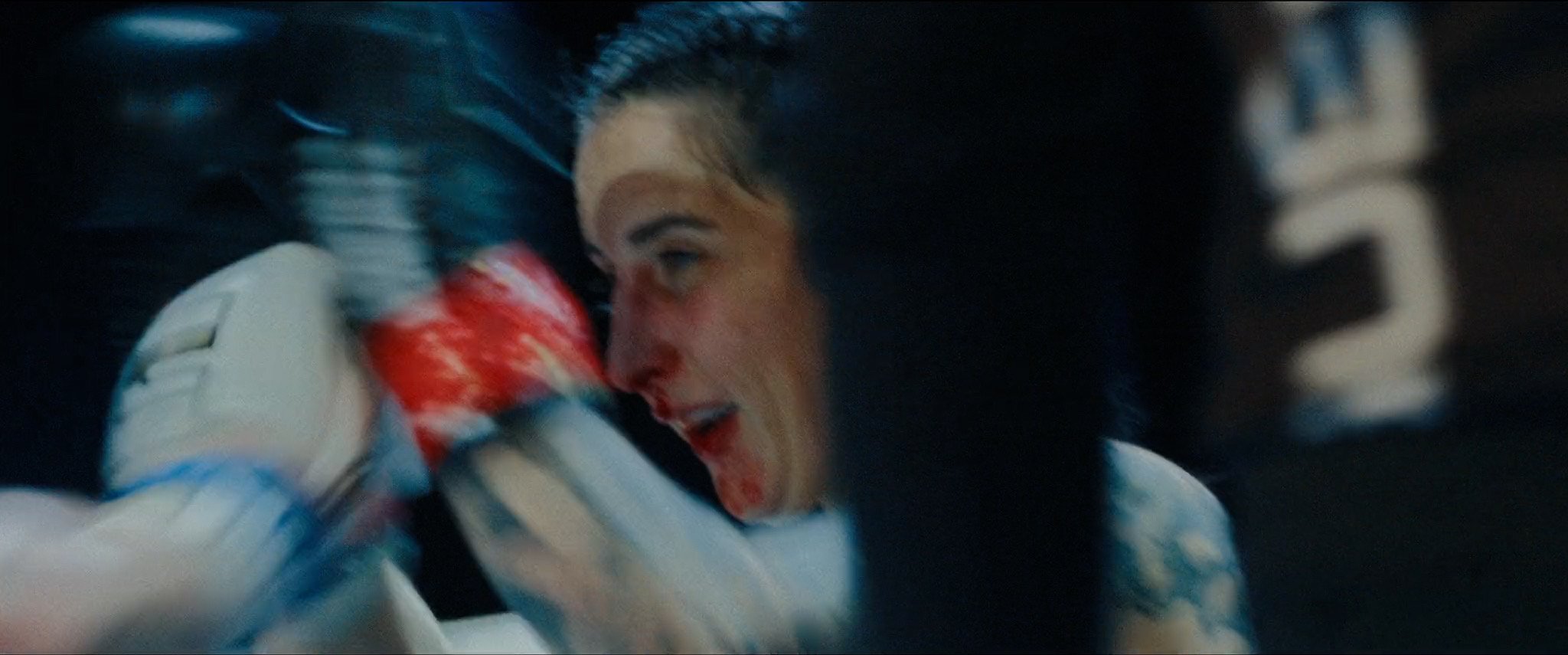
With no voiceover, barely any dialogue and a sound mix that makes you feel like you are inside the subject’s body, “KILLFACE” is a truly immersive experience.
Chapman assistant professor of broadcast journalism and documentary, Kate Trumbull-LaValle, had rules for the score of the experimental short documentary film she directed and produced. No instruments was a big one.
“We used breath, and (Jimmy LaValle) just played with the … reverberations, echo and delays. And then he used all of the percussive sounds of the gym,” said Trumbull-LaValle.
The culmination of all these elements creates a viewing experience that is an exploration of the human senses. Throughout the film, the camera constantly sways back and forth in an extremely tight shot, trying to center featherweight Muay Thai champion Natalie “Kill Face” Morgan, and the sound design creates a constant tension that transports the viewer into her mind as she partakes in fight camp training.
“It was really an opportunity for me to explore how to create a nonfiction film that was not about biography, and asked an audience to kind of land with, without explanation, into a woman's experience of power and building power,” said Trumbull-LaValle.
The 16-minute film about Morgan came from Trumbull-LaValle’s desire to experiment as a nonfiction storyteller after the “golden age” of documentary films that sparked a large commercialization of the genre. How they met, however, came from Trumbull-LaValle’s exposure to The Yard Muay Thai gym herself, not as a filmmaker but as a student.
“I would go on a Friday, you know, to take a class,” said Trumbull LaValle. “As a woman, I'd never fought anything. I never beat something up … I'd never experienced my body that way. And so, it was kind of thrilling to punch as hard as you could.”
Her husband Jimmy LaValle, who also composed “KILLFACE,” urged Trumbull-LaValle to pay attention to the Muay Thai fighter, and from there on she watched her train and approached Morgan, this time as a filmmaker.
“It was really fun to watch her train. It was really fun to watch her do everything. She was so powerful,” said Trumbull-LaValle. “The pandemic hit, so it made that process a lot slower but eventually we just sort of had conversations. I filmed with her, but pre-pandemic, just like a test shoot. And anyway, it was on my mind when everything shut down. And so as soon as it was safe to film, I brought in my friend and cinematographer, Helki (Frantzen).”
The cinematography is a large part of what makes “KILLFACE” so deeply immersive; the film is mostly held in very tight shots and almost feels like focusing your eyes.
“The goal was to not lose her, which also felt like fighting, because Helki was in so much movement, and you're so tight, you eventually lose (Morgan). So a lot of the film is trying to find the frame, find Natalie's eyes. And that became, especially with my editor, Helena (Rodriguez), part of the beauty of the film, this shifting of perspective at times you're with Natalie, observing Natalie and then at times you're almost like Natalie, you know, searching,” said Trumbull-LaValle.
The film was originally intended to be a standalone documentary, but the more Trumbull-LaValle considered all the elements, she realized it had the potential to become a physical installation.
“I thought about different ways to pitch the film. It could be a single projection, on loop. But I also imagined it being kind of even more immersive,” said Trumbull-LaValle.
The film has screened as an art installation in three locations, first at the Mimesis Documentary Festival, where it was shown in a gallery space, playing on three screens in a loop. Then, at Central Server Works, a gallery in downtown Los Angeles, Trumbull-LaValle collaborated with her mom, Sylvia Trumbull, a ceramicist, to make a heavy bag out of clay to accompany it. And lastly, at The Yard Muay Thai gym, where the fighters train.
For Trumbull-LaValle, this film was a way to step aside from the commercial documentary space and create a film about women that broke the norm of what a female-driven story could look like.
“Sometimes in work about women, we fall into these tropes where women need to have an obstacle in order to prove the reason that they're going to fight,” said Trumbull-LaValle. “The reason that they're going to win or the reason that they are so strong or so irreverent or so unapologetic is because of some past trauma, some past history, and 'KILLFACE' is sort of, in some ways, just an avatar for all of that struggle, and we don't need to explain it. We can experience what someone does when they want to become strong through practice and through perseverance.”
“KILLFACE” is not currently available for viewing, but may have more installations in the future.