
That’s no moon, it’s the Lucas Museum of Narrative Art
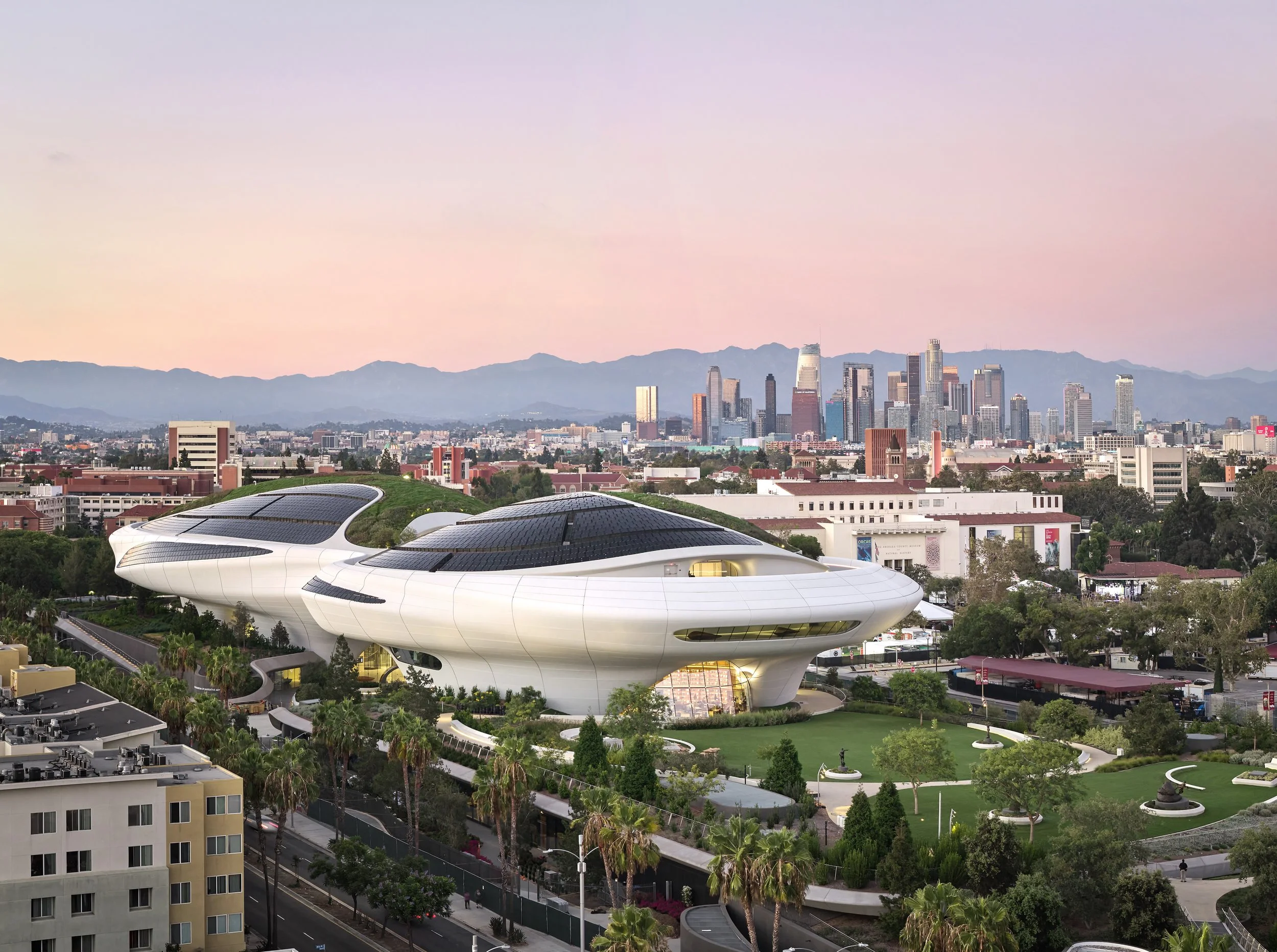
Photo courtesy of Lucas Museum of Narrative Art
Many will understandably flock to the Lucas Museum expecting a trove of props and characters from a galaxy far, far away to greet them, given its namesake and its origins as the passion project of the man behind “Star Wars,” George Lucas. But from Frida Kahlo pieces to ‘80s fantasy paintings, the Lucas Museum of Narrative Art presents a unique, unpredictable blend of art. This is a museum of contradictions that nevertheless finds coherence in creating conversation between the disparate pieces in the narrative arc of narrative art it displays.
The Panther got to attend a Community Preview day, just weeks before the museum opens on Sept. 22. Located right next to the University of Southern California campus, the Lucas Museum has already become a massively popular attraction, with tickets sold out for the foreseeable future. After walking through the museum, it’s not hard to see why.
One of the most valuable, and long-term contributions the museum will provide is its libraries, located directly across from the main museum, which will be open to all upon the museum’s opening, with or without a ticket. The Panther stopped in for a moment after admiring the N-1 Starfighter (with R2D2 in tow!) on display in the lobby and would’ve luxuriated in its cozy, tranquil interior for longer, but the rest of the Lucas awaited (as tempting as the coffee table book full of X-Men comics was).
Years in the works, the museum has gone through several iterations, with initial plans dating back as far as 2014. Today, the museum is a one-of-a-kind building stretching over a city block, with a stark, white exterior that looks like a spaceship, straight out of “Star Wars” and primed for launch. It’s remarkable how astonishing the lobby is when you first walk in; that feeling of walking into a spaceship persists, a museum of the future. The first thing you’ll see when entering is a central set of Charlie and the Chocolate Factory-esque elevators that will take you up to the galleries, one floor dedicated to a combination of classical art and movie props, another dedicated solely to murals.
One must also stop at either of the two theaters on the Lucas’ ground floor, both of which have calibrated programming running all day, aligned with the museum’s emphasis on celebrating the breadth of narrative art. That same reverence extends to the visual storytelling it’s selected to run. The Robert Flaherty Theater shows only documentaries, meant to celebrate, but also demystify the creative process by honing in on artists like Maurice Sendak and Norman Rockwell — both of whose work is housed within the museum’s collection.
Then, on the other side of the lobby is the Slavko Vorkapich Theater, which shows short films deemed significant in pushing the bounds of what cinema can achieve. This includes foundational classics like “Steamboat Willie” and “A Trip to the Moon,” but The Panther also sat in on deeper cuts like “60 Cycles,” a riveting, abstract, nearly narration-less documentary short chronicling a bike race in Quebec.
Whereas most museums refine a singular aesthetic focus, the Lucas Museum puts a multitude of forms of narrative art into conversation with one another. While more traditional art is present, the collection of props, comic book covers and statues makes the Lucas Museum stand apart from other, more focused museums. Many may be quick to compare it to other recent museums such as the Academy Museum in the sense that the Lucas Museum is paced and organized with modern museum-goers in mind.
There is unsurprisingly a hub for “Star Wars,” located rather centrally within the floor of galleries. That said, this is no Galaxy’s Edge. It’s not overdone; John Williams isn’t playing through the speakers to transport you to the cockpit of the Millennium Falcon. Fans of the prequel trilogy have much to look forward to in terms of what's on display, whether it's General Grievous’ bike, a speeder from “Attack of the Clones,” or pods from the pod race in “The Phantom Menace.”
Surely no one was as fit to do it as well as he did, but it’s impressive how Lucas has tied the galactic saga into the larger thread of narrative art. When you see gunslingers and then courageous knights and then sketches of a fantastical life amidst the cosmos, you see how such a cultural phenomenon creatively took shape. It doesn’t hurt to be walking through Lucas’ brain, or at least a billion-dollar museum equivalent (with a sculpture garden to boot!), but it’s still striking as a culmination of the museum’s thesis of how interconnected so much of its collection is. Not to mention, some of the concept art by Ralph McQuarrie and others practically gave me goosebumps.
Outside of a statue of Indiana Jones that will no doubt become a hot spot for selfies, that’s where the inclusion of Lucas’ own work ends. This is not a monument to his own achievements, but a love letter to the work that informed them.
Another thing that separates the museum from pretty much every other museum is its lack of hand-holding in the complete omission of informational cards, beside any of the works displayed. Some in the art world have understandably taken issue with this disinterest in attempting to contextualize the work and its significance to Lucas or the wider collection. As an attendee, it created a completely free-flowing experience that felt unlike the traditional museum experience, more like a lazy river of artistry. A trip to the Lucas is defined primarily by curiosity and almost entirely by what draws your eye. Sometimes Pikachu in the style of Vincent Van Gogh just speaks to you and that moment with the art is all you need. By virtue of choices like the aforementioned eclectic pop culturisms and its organization — a wide, largely open circular floor — one can be overwhelmed by the sprawl of the collection and trying to check off what you’ve seen along with what you haven’t.
While we’re talking flaws, the only piece of the museum that feels entirely out of sync with what it's trying to build is “The History of Narrative Art: Heroes · Myths · The Sacred.” It’s a smaller , awkwardly placed exhibit, quite literally hidden in the back corner of the ground floor of the museum like it thought you wouldn’t notice it. It contains some incredible sights like the inside of the Sistine Chapel, but by design, only as a digital image. Many such wonders follow, but delivered in the same bland format. The exhibit’s a glaring inclusion in the framework of the museum, certainly not at the same level of intention or enthusiasm as the rest of what’s offered. Part of me hopes it becomes a rotating space for temporary exhibits with more flair to them, but we shall see.
While walking through the halls of the Lucas Museum of Narrative Art provides one with that signature George Lucas space age feel, it perhaps more aptly reflects a scene straight out of “Ready Player One.” In that book and film, the enigmatic billionaire James Halliday, who created the unbelievably popular virtual reality platform the Oasis, has archived all of his personal history and deepest pop cultural favorites in a museum for the game’s players to explore.
In the Lucas Museum of Narrative Art, it’s hard not to feel like that fictional construct has been brought to life courtesy of Lucas and his wife, Melody Hobson, who co-founded the museum. At first glance and off a single trip, above all, it’s a celebration of art in all its forms, particularly those that have spoken to an undeniably important artist and storyteller of the 20th century, even if its mélange of modes can overwhelm.