
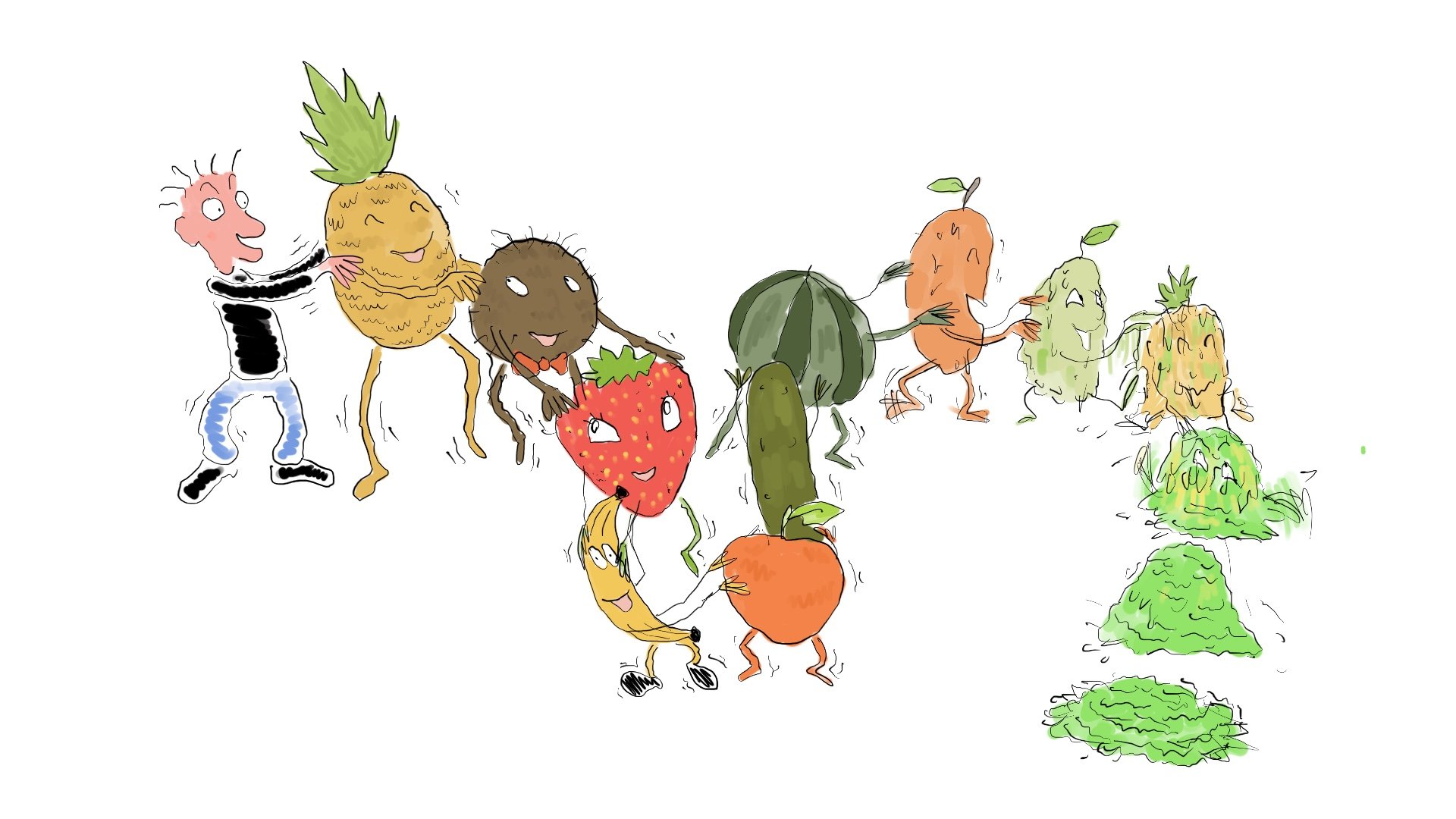
Illustration by Sami Seyedhosseini, Cartoonist
“Welcome to Fruit Love Island,” says a horrific anthropomorphic kiwi fruit as she walks towards the camera, "where eight single fruits are about to flirt and fight. And trust, things get messy fast."
No, this isn’t a scene from a feverish nightmare; this is the opening to the enormously popular breakout TikTok series, “AI Fruit Love Island.” The series isn’t doing anything particularly new, but as an amalgamation of AI trends and reality TV tropes, its success has been impossible to deny.
Taking the format of “Love Island,” the series of shorts features AI-generated fruit characters in steamy romantic entanglements with new episodes every day. Gaining 3 million followers in just nine days, the series has become the fastest-growing TikTok account in the platform’s history.
“I honestly could not tell you why (my friends) find it so enjoyable,” said junior film and media studies student Margarette Quiambao. “They will not stop sending it to me. But I think, in a way, it's because it uses that familiar recipe of like reality TV messiness and the drama of ‘Love Island,’ and then combines it with the absurdity of fruit as people.”
AI-generated videos, called “slop” by many users, have steadily risen in popularity over the last few years. With technology advancing from the early days of deepfakes and videos of Will Smith eating spaghetti, AI-generated videos have become easier to produce and more convincing. Taking over algorithmic feeds, these easily-digestible and hyper-derivative AI videos are perfectly suited for addictive short-form platforms. With “AI Fruit Love Island,” the episodic nature of this “slop” content has spurred increased engagement.
“I understand that it's kind of an offshoot of the microdrama genre that has taken off in social media over the last two years,” said associate film and media studies professor Jake Bohrod. “You have these recurring characters and archetypes related to that drama. It's very colorful and absurd, and I can see why this channel is popular, because it's taking a very popular trend and automating it … and that’s what social media is all about, especially when it comes to AI.”
In spite of intense backlash for the series’s AI use, a fan base quickly sprang up surrounding the show. With users posting genuinely impassioned reactions to the daily release of episodes, “AI Fruit Love Island” blurs the lines between ironic reactions to “slop” and authentic emotional investment.
For many, the blurring of these lines is a sign of the larger harms AI has spawned. Familiar and derivative content, inherent to AI video’s very nature, leaves a lasting impression on how we interact with media.
“It's easy. It doesn't make your brain think. Whether or not it's bad is a different conversation, but it’s a plot that is served to you, force-fed sometimes,” said film and media studies junior Annie Pasmann. “It’s quick and consumable, and then you can move about your day. There’s some sort of brain-dead satisfaction from it, that you consumed some form of content that distracted you from your own life for a second, and then it's over, and you're fine.”
Like many other AI slop videos, “AI Fruit Love Island” is marked by exaggerated emotions and hyper-sexualization. These issues are also obviously present in human-made reality TV, but when “AI Fruit Love Island” applies this fetishization to animated Pixar-like aesthetics, it becomes unclear who this is for. While its content is clearly aimed at adult humor, the bright colors have made this a particular hit among Gen Alpha. For many, the sexualization of anthropomorphic fruit popularized among children is deeply concerning.
“It almost feels like these are the kind of cliched and pastiche-laden lines that you would find in a Super Mario Bros. movie or a billion-dollar product; it sounds quite similar to those of any Pixar movie,” said Bohrod. “(These videos) are pretty much just distilling the normative, mediated values of American society into short video content that can be consumed by folks that grew up in that environment. In order for the process of fetishizing to take place, there's a process of displacing your pleasure onto the object, basically, but also an extreme level of familiarity.”
The familiarity of “AI Fruit Love Island” also affects its popularity. With the blatant connections to “Love Island,” which many tout as “trashy TV,” the TikTok series becomes a derivative of slop. Nevertheless, there are glimmers of humanism within even the most plastic of human-made reality TV series, as a sense of authenticity peeks out from the facade of models and steamy romances in “Love Island.” Meanwhile, critics note that “AI Fruit Love Island” exists solely in the trashy slop-sphere, diminishing artistic means of expression to regurgitated content.
“I think at the time and age that we are in right now, people are more and more willing to decenter human art and human experience, because so much of this art is based off of personality, trauma and your own expression as a human being,” said Quiambao. “There's been so much oppression and limitations of what people can be, or can express themselves to be. Because instead of allowing people to express themselves, their struggles or the way that they feel through their own art, people are making AI slop to cover that up. The spectacle of AI slop is making it all mush.”
This mushy spectacle-based success was short-lived, though, as “AI Fruit Love Island” quickly received several copyright strikes, leading to video takedowns, lessened follower counts and even an unprecedented crash out from the runner of the account. AI copyright legislation and enforcement is still a fairly ambiguous field. As AI training models take directly from pre-existing art, often without the artist’s consent, we’re starting to redefine what “original art” really means. At the end of the day, AI is a tool for mass production rather than intent or artistic quality.
“I do have a firm belief that artists will create art regardless of what the algorithm is feeding us,” said Pasmann. “But as far as taking focus goes or owning the spotlight a little bit, it’s really interesting that (AI-generated content is all) at a point where we are all questioning news outlets, news sources and our government in general. That is when we see the surge of AI-generated content, because it's quick and it's fast.”
Yet, this business model of rapid reproduction is by no means stable. As many critics have argued, the extreme value placed on AI companies has created an “AI Bubble” that could lead to devastating economic results.
Most recently, Opan AI’s Sora video-generating platform shut down, with the company canceling its billion-dollar deal with Disney. While this AI content is increasingly visible on social media platforms with hits like “AI Fruit Love Island,” perhaps the business models behind these AI companies were always destined to fail. When companies prioritize a pure profit model, pushback and resistance are inevitable.
“I think it’s trying to fulfill the dream of media capital,” said Bohrod. “Not necessarily (for) those individual companies, but their parent companies, who are openly resentful of the creative industry and creative labor, because they demand living wages and they're human beings, they need healthcare.”
Despite the rapid success of “AI Fruit Love Island” and other AI trends like Italian brainrot or sad cat videos, an increasing majority disapproves of how artificial intelligence has been used. With thousands of employees replaced by automation and environmental harms from using more water than the entire water bottle industry, these AI companies are only garnering intense resentment and distrust.
While “AI Fruit Love Island” may just be a tiny pawn in these larger systems reshaping our media landscape, the fervent rise and equally destructive fall of the series prove that AI slop might not entirely be the apple of the internet’s eye.