
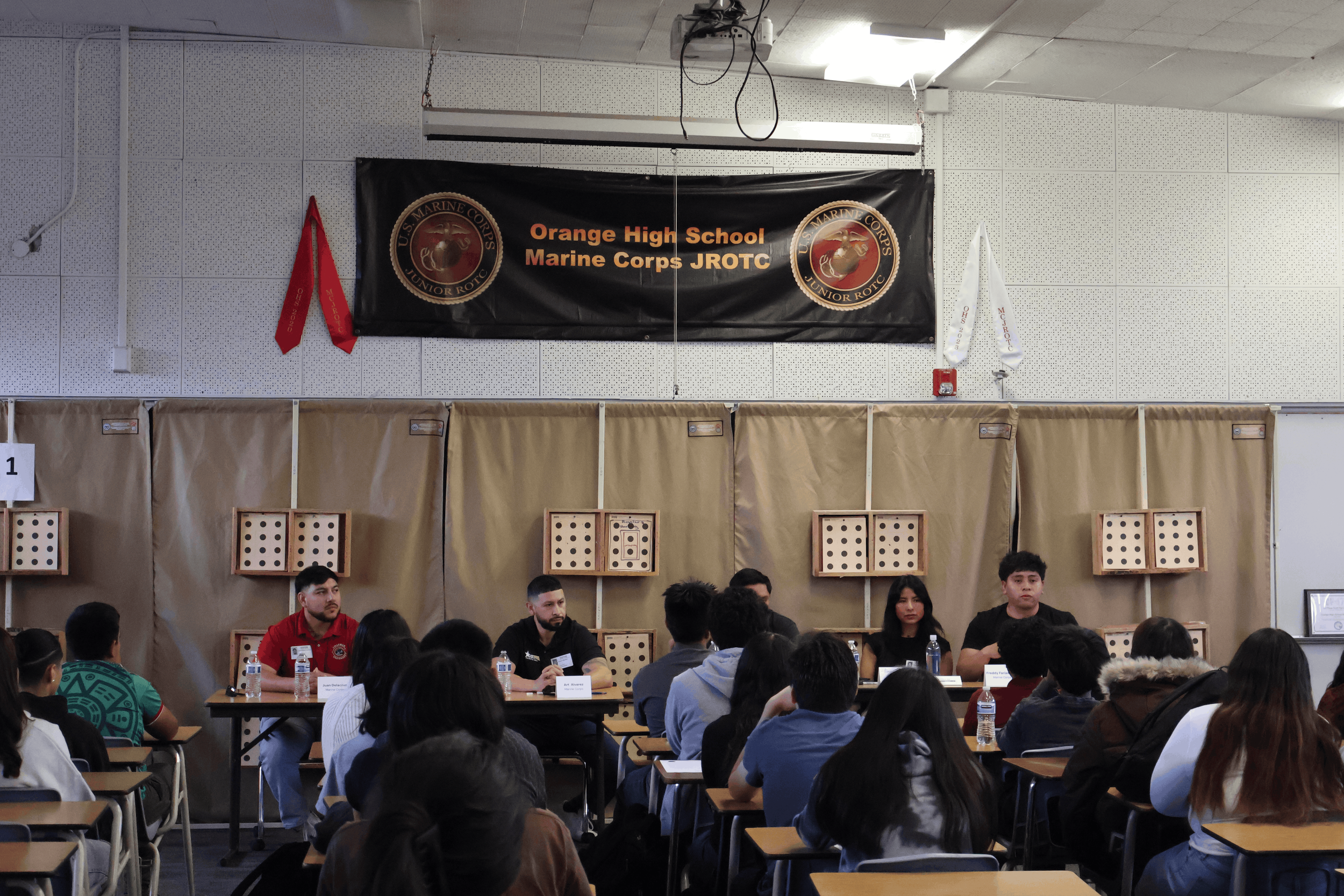
Photo by Ella Spanier, Staff News Reporter
“A lot of these kids are hungry for knowledge but may be scared to ask,” said Juan Delacruz, a Marine Corps veteran and Chapman psychology major. “They are afraid of the unknown, and rightfully so.”
Delacruz was one of five veterans who joined Chapman’s Veterans and Military Connected Club for a panel discussion with Orange High School’s Junior Reserve Officers’ Training Corps (JROTC) students on Friday, Oct. 23.
The conversation went beyond the basics of military service, addressing everything from educational benefits and career opportunities to the physical and personal sacrifices that come with enlistment.
As a chapter of Student Veterans of America, Chapman University’s Veterans Club supports, advocates and provides networking with student veterans, military and veteran dependents, active-duty military students, Reserve and National Guard, ROTC and other military-connected students.
“It’s super important to stay connected with the local community, especially with the close proximity to Orange High School,” said Kaya Ketter, vice president of marketing for the Chapman Veterans and Military Connected Club.
Orange High School (OHS) has the only JROTC program in all of Orange County. This program develops the cadets’ leadership skills, self-discipline and physical fitness through academic instruction, physical drills and uniform inspections.
Participation in the program does not require students to enlist in the military, and it is not a military recruiting tool. Instead, the program seeks to develop character and set students up for success in any career path.
However, cadets who choose to enlist in the military after high school can receive an advanced promotion at the end of recruit training because of their participation in the JROTC program.
According to the OHS JROTC website, “There is no cost to participate in JROTC. All uniforms are issued free of charge, and all cadet trips and other activities are fully funded.”
“The OHS JROTC provides young men and women the opportunity to grow in ways that are not available elsewhere,” said Colonel Mark Tull, a retired United States Marine Corps officer and senior marine instructor for OHS JROTC. “Every cadet will leave our program stronger than they came”
Tull was approached by the Veterans and Military Connected Club this summer and was asked if there was any support they could provide. Tull suggested that a panel of veterans could be an enriching experience for his students.
This panel included Athalia Jorden, a Navy veteran majoring in communication studies, Freddy Farias Solis, a Marine Corps veteran majoring in accounting, Juan Delacruz, a Marine Corps veteran majoring in psychology and Anthony Fuentes, an Army veteran majoring in business administration. The panel also included Art Alvarez, a Marine Corps Veteran who is not a Chapman student.
For Fuentes, vice president of the Veterans Club, military service was also connected to his family’s immigration experience.
“I'm the son of two immigrants,” Fuentes said. “They both came over illegally, so my whole life kind of grew up, kind of scared of the government.”
In California public schools, about 44% of students come from immigrant households. Fuentes went on to say that his service directly helped expedite his parents’ citizenship status.
“We wanted to share this information as many are unaware of this program/benefit,” said Farias Solis, president of the Veterans and Military Connected Club. “Especially with the current events going on, this (the military) can be a way to safeguard their families”
Farias Solis asked the students to raise their hands if they knew that their military service could help pay for their college. A couple of hands were raised. He then asked if the students knew that service members could get a paycheck to help cover expenses while attending school. Not a single hand was raised.
“I believed that it (the military) was the only thing that was going to get me my education,” Fuentes said. “Fortunately, it did.”
Fuentes went on to clarify that this is not a free education.
“We pay for that with our service,” Fuentes said.
He discussed the physical toll of his time in the military, explaining that he continues to carry the physical pain with him every day, which is not standard for a 28-year-old.
“Nothing in life is free,” said Fuentes. “Everything gets paid for one way or another.”
Another important message the veterans wanted to communicate with the students is that the military can be a pathway to higher education, a career or a way out of a potentially tumultuous upbringing.
“You can break cycles,” said Jordan. “We tend to think that, because of the life that we're living, that's the only way so far, and that's not true.”
Tull told the students about his rough upbringing, explaining that he faced a high likelihood of joining a gang. He knew he had to leave to have a better life.
“Sometimes you might have to make that call, too,” said Tull. “It's not easy.”
Farias Solis also remarked on his experience growing up watching his friend group join gangs. He expressed that he had a desire to continue to be a part of that friend group; however, he had to make the right choice for himself. Now when he thinks about those friends and where they are now, he feels for them.
“The military can open doors they may not even consider,” said Jorden. “Sometimes we don’t realize how much our stories can influence someone else’s decisions.”
What made the panel unique was that it wasn’t a recruiting panel. Instead, it was an honest conversation with veterans about their service, what their service allowed them to accomplish and what challenges they had to overcome because of their service.
“We told them how it really is,” said Farias Solis.