
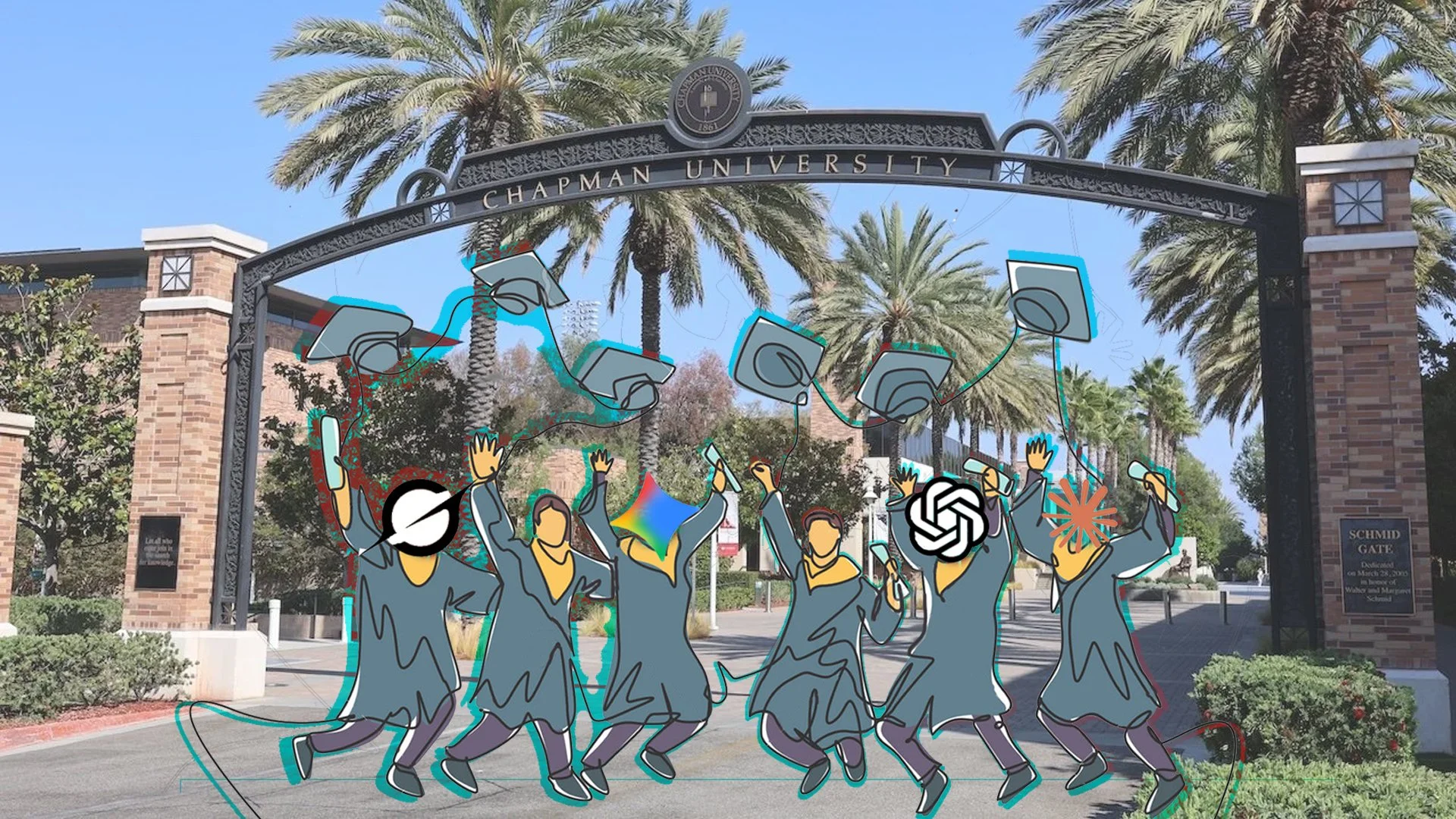
Graphic by Matias Pacheco-Ramirez, Photographer
As AI programs pop up at universities across the United States, such as Brown and USC, everyone is racing to play catch-up.
At Chapman University, artificial intelligence (AI) is becoming an increasingly interdisciplinary subject, raising questions about how students across majors can prepare for a workforce shaped by rapidly evolving technology.
‘Which jobs are actually safe from AI?’, ‘Will I be left behind if I don't use AI?’ and ‘Is my college degree still worth the financial investment?’ are some of the questions students raise when facing the unknown realm of AI.
This fall, Chapman introduced its 27-credit Minor in Collaborative Intelligence (COIN) through the School of Communication. The program is designed to help students understand how humans and artificial intelligence can work together across different fields, from business and communication to the sciences and humanities.
For Erik Linstead, professor of artificial and collaborative intelligence, the goal is to move beyond viewing AI solely as a technical discipline.
“Now I think people are finally trying to see it as something other than just a computer science subdiscipline,” Linstead said. “Where [Chapman’s] doing a really amazing job now is putting AI in different places.”
Linstead described COIN as an effort to address the “missing middle” between developing AI systems and applying uniquely human skills, such as critical thinking, communication and problem-solving.
Rather than focusing exclusively on coding or building algorithms, the minor encourages students to consider how AI can support their work while recognizing its limitations.
As AI tools become more common in professional environments, Linstead said students need more than basic familiarity with the technology.
“It’s no longer good just to be literate,” he said. “You actually need some comprehension or fluency in these technologies, and COIN provides that.”
However, learning to use AI effectively does not mean allowing it to replace independent thought. Linstead said one of the major challenges facing higher education is teaching students to make the most of AI without surrendering their critical thinking or decision-making abilities.
“We need to continue teaching students that they need to learn the foundations of their discipline and retain their agency, critical thinking and whatnot,” he said.
For students studying computer science and software engineering, the rapid development of AI is already changing how they approach coursework, internships and future careers.
Emma Kochenderfer, a junior studying computer science and technical theatre, said AI tools such as ChatGPT, Claude and Cursor are increasingly capable of generating code.
As a result, she expects computer science education to place greater emphasis on foundational concepts, such as data structures and algorithms, rather than solely on teaching students how to write code.
During her internships, Kochenderfer said employers provided access to AI tools and expected employees to use them. Although the expectation initially surprised her, she recognized that AI could increase productivity.
Still, she expressed concern about how AI is incorporated into classrooms. When students struggle with a concept, simply directing them to an AI tool may deprive them of an opportunity for meaningful learning.
“Obviously, it’s great to use your resources, but I don’t know, I think you should help people learn rather than just telling them, ‘Oh, go ask AI to explain it for you,’” Kochenderfer said.
Jerry Salas, a sophomore studying software engineering, also views AI as a useful tool, particularly when students need help understanding difficult programming concepts. Rather than asking AI to complete an entire assignment, Salas said he uses it to clarify confusing material, identify mistakes and explore alternative explanations.
In his courses, students are required to document whether they used AI in their projects and explain how they used it. He believes these practices can help establish boundaries while also allowing students to benefit from the technology.
Salas said AI is likely to become even more common in higher education, but students must continue to develop the skills to evaluate its output.
“AI does have a place in higher education,” Salas said. “It is a tool.”
At the same time, he acknowledged that AI is contributing to concerns about an increasingly competitive job market. While the technology allows businesses to complete tasks more quickly, it can also reduce the number of people needed to complete certain types of work.
Salas said students who understand both the technology and the fundamentals of their fields may be better positioned to adapt.
As Chapman expands its AI offerings, the possibility of developing a dedicated undergraduate major raises additional questions.
While Linstead confirmed that the university already offers AI-related coursework and is exploring interdisciplinary approaches, he also noted that the business school is working on a proposal for an undergraduate major focused on the business side of AI, following the launch of its master’s program in business analytics, designed around AI.
For Joshua Dowd, a sophomore majoring in computer science, the speed at which AI evolves could make a full major difficult to maintain.
Dowd said universities often take time to develop new programs, particularly while AI companies continuously introduce new tools and technologies. A curriculum built around specific platforms could quickly become outdated, and finding faculty with expertise in such a rapidly changing field presents another challenge.
“The field develops so rapidly that trying to have a major comes across the issue of not having professors who are extremely well-versed in it,” Dowd said. He added that even when professors have extensive knowledge, “the knowledge becomes outdated really fast.”
Dowd believes a focused minor, such as COIN, may be a practical way to introduce students to AI without requiring an entire degree program centered on the technology.
He also supports integrating AI with the humanities, arguing that students should learn to examine its ethical and social implications rather than approach it with an entirely positive or negative perspective.
Claire Gresham, a triple major in environmental science, political science and history, is concerned about the growing role of artificial intelligence in education and its potential consequences for learning as a humanities student.
“AI poses a threat to the value of human learning, especially for students in the humanities,” she said. “Fields like history and political science rely on critical thinking, interpretation and understanding human experiences, which are things that cannot simply be replicated by a machine.”
For Gresham, the issue extends beyond whether AI can complete academic tasks. She worries that relying too heavily on the technology could discourage students from developing independent ideas and engaging deeply with what they learn.
“As a student, I worry that the growing dependence on AI will discourage people from developing their own perspectives and weaken the skills that make education meaningful,” she said.
Despite disagreements over how or if AI should be used, Chapman’s new minor reflects a growing recognition that the technology extends beyond computer science. Its influence in the workplace means that students across many disciplines may need to understand how AI can support their careers, even if they do not intend to work directly in technology.