
Chapman students are getting real-world experience in these undergraduate research labs
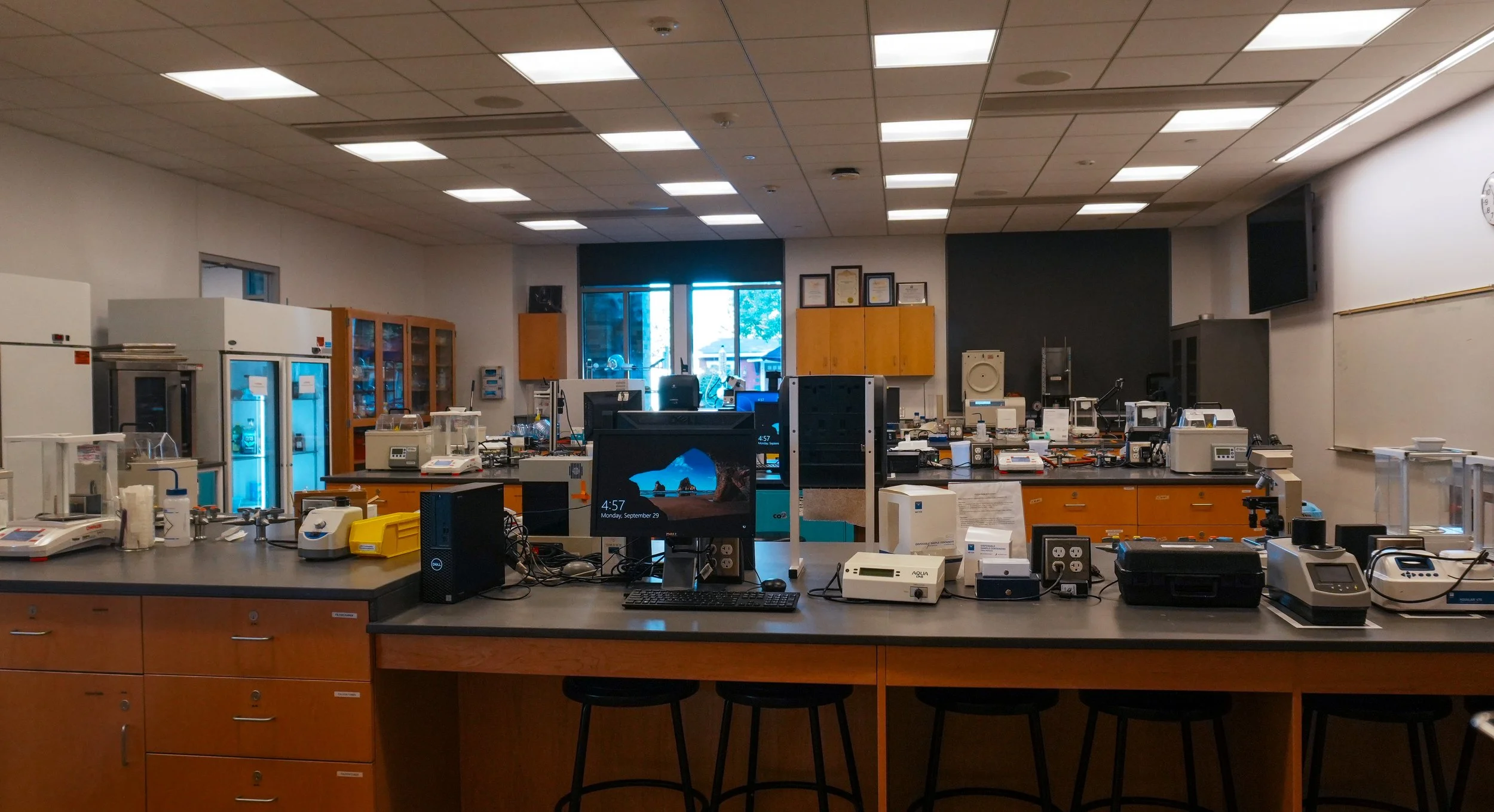
Photo by Sienna Lewis, Staff Photographer
Whether it’s studying flies or working with physical therapy patients, faculty and students at Chapman are driving innovation with research spanning across disciplines. As an R2 institution, the university is deepening its research efforts while offering students hands-on experience in labs and fieldwork.
Chapman first reached R2 designation in 2019 from the Carnegie Classification of Institutions of Higher Education and has maintained the status in recent evaluations. This ranking indicates that the university awards at least 20 research doctoral degrees annually and has a minimum of $5 million in total research expenditures.
While research isn’t limited to science, math and engineering, under former President Daniele Struppa’s leadership, these areas were expanded at Chapman. He oversaw the establishment of the Fowler School of Engineering and the opening of the Keck Center for Science and Engineering.
Even as a liberal arts college, Chapman aims to provide research opportunities for undergraduates, an experience unique to the university.
“We’re very undergrad-focused at Chapman,” said Josh Fisher, environmental science and policy professor. “The undergraduate students really get to partake in research in a way that’s different from other universities.”
As a climate scientist, Fisher focuses on satellite data and technology to look at various aspects of land. Using planet temperature data, Fisher and his research students are looking at different facets of climate, including how heat stress is affecting the water supply and, more recently, environmental justice issues.
Fisher previously worked with the National Aeronautics and Space Administration (NASA) at the Jet Propulsion Laboratory, leading a mission called Ecostress, which measures the temperature of the planet.
Despite having worked at NASA, Fisher said that being at Chapman has allowed him to go even further in his research.
“My ability to do amazing research is even better than it was at NASA,” Fisher told The Panther. “I’ve been able to broaden (my research) a lot more, and now I’ve got students and we can really explore new ideas while contributing to these projects.”
Junior environmental science and policy major, Ashley Agatep, has been working with Fisher since before her freshman year. Having had some experience with environmental research in high school, Agatep reached out during the summer, and Fisher put her to work right away.
Her projects mainly focus on environmental justice. Working with community groups in South Los Angeles, Agatep is looking at how excess air pollution, the presence of industries and underinvestment in the area are affecting health.
As part of the research, Agatep has gone on two trips to Costa Rica to do fieldwork in the jungle, giving her experience both in the lab and on-site.
“Classes are great, but the most important skills are learned through application,” she said. “I don’t have to wait to become a scientist until I get out (of college), I can do that now and make a difference in the community.”
A majority of Fisher’s research is funded by grants gifted by NASA, a luxury that not every professor on campus has.
The National Science Foundation often funds research for science and engineering, but with recent changes under the Trump administration, this cash avenue has become a hard source to come by, especially if research is related to any “buzzwords.”
Biology professor Rebecca Glineberg said that traditionally, she would apply for a grant from the National Science Foundation, but she currently sees the funding climate as weak.
“I’m interested in how today’s environment and climate impacts stress pathways, and I can’t explicitly say I’m studying this anymore in any federal grant because they don’t like that sort of thing,” she said. “Luckily, flies are cheap and cheap to keep alive, so our research is more financially feasible than a lot of other things out there.”
Glineberg is studying stress pathways, which are how cells and tissues respond to poor environments, like excessive temperatures or low oxygen levels. Her research team is mainly interested in how this relates to neurodegeneration and infertility, using Drosophila flies as a model organism to test this.
They currently have 200 flies in their lab, observing how the environment affects the genes and proteins.
“I’m really intrigued by these pathways because they’re getting more and more relevant with the global changes happening around us, like global warming,” Glineberg told The Panther.
Sophomore biology major Shira Ehrlich works in the lab dissecting fly ovaries. She had originally taken a biology class with Glineberg and knew that she wanted to get more connections and hands-on experience with her professor.
“Whenever I tell people what research I do, they are usually disgusted or intrigued or both,” Ehrlich said. “And I think it’s pretty cool to say that as a sophomore, I am doing research.”
Glineberg said that the equipment and independence within research opportunities are unlike anything she has seen at a university.
“The research opportunities at Chapman don’t compare to any other place I’ve been,” she said. “I went to a small liberal arts college and worked in R1 universities, but the experience students get here is far more advanced.”
While there are plenty of undergraduate research opportunities on Chapman’s Orange campus, there are also students working at the Rinker Health Science Campus.
Senior biology major Alejandro Aguirre Ramirez and junior applied human physiology major Evan Shrier work at a gait behavior lab on the Rinker campus with physical therapy professor Natalia Sanchez.
They are focused on looking at the factors that shape how and why people walk the way they do, specifically researching with the objective of helping people who have walking impairments, such as those who have suffered a stroke.
“When I was looking at research opportunities, this lab stood out to me because of the work that Dr. Sanchez did with stroke patients,” Shrier said. “My mom’s first job was working in an inpatient hospital with stroke survivors, so I was like, ‘Wow, it can’t be a coincidence.’”
There are different aspects to the research, but one specific project includes an early stage of an algorithm that identifies specific impairments based on a person’s walking patterns. Rather than listing what a patient needs to do to improve their walking, this approach would improve coordination and motor control.
Sanchez said much of their work is done in collaboration with patients in the community.
“I came to Chapman because the department of physical therapy has many outreach programs with the community where people with Parkinson’s disease or older adults can come and work with the physical therapy students,” she said.
Every year, the department hosts a Stroke Boot Camp, where post-stroke individuals can come for two weeks and work one-on-one with the physical therapy students. Participants also get to come into the lab and see the technology that is special to the Rinker lab.
Chapman is one of two places in Southern California that have a split treadmill that can be used at different speeds and measure weight and force applied while walking, said Sanchez. The other is at the Naval Research Center in San Diego.
“I didn’t know this type of research existed until I came to Chapman,” Ramirez said. “It’s a lot more interactive than I ever expected I would be doing.”
These interactive research opportunities are available across all disciplines at Chapman. The Center for Undergraduate Excellence has a comprehensive list of professors looking for students to be a part of their research and has also created a toolkit for students wanting to get involved.
“There are so many opportunities for mentorship and close connections here,” said Agatep. “All you have to do is reach out and be open to new experiences.”
Editor’s Note: In the original publication of this story, The Panther mistakenly referred to Josh Fisher as Jordan.