
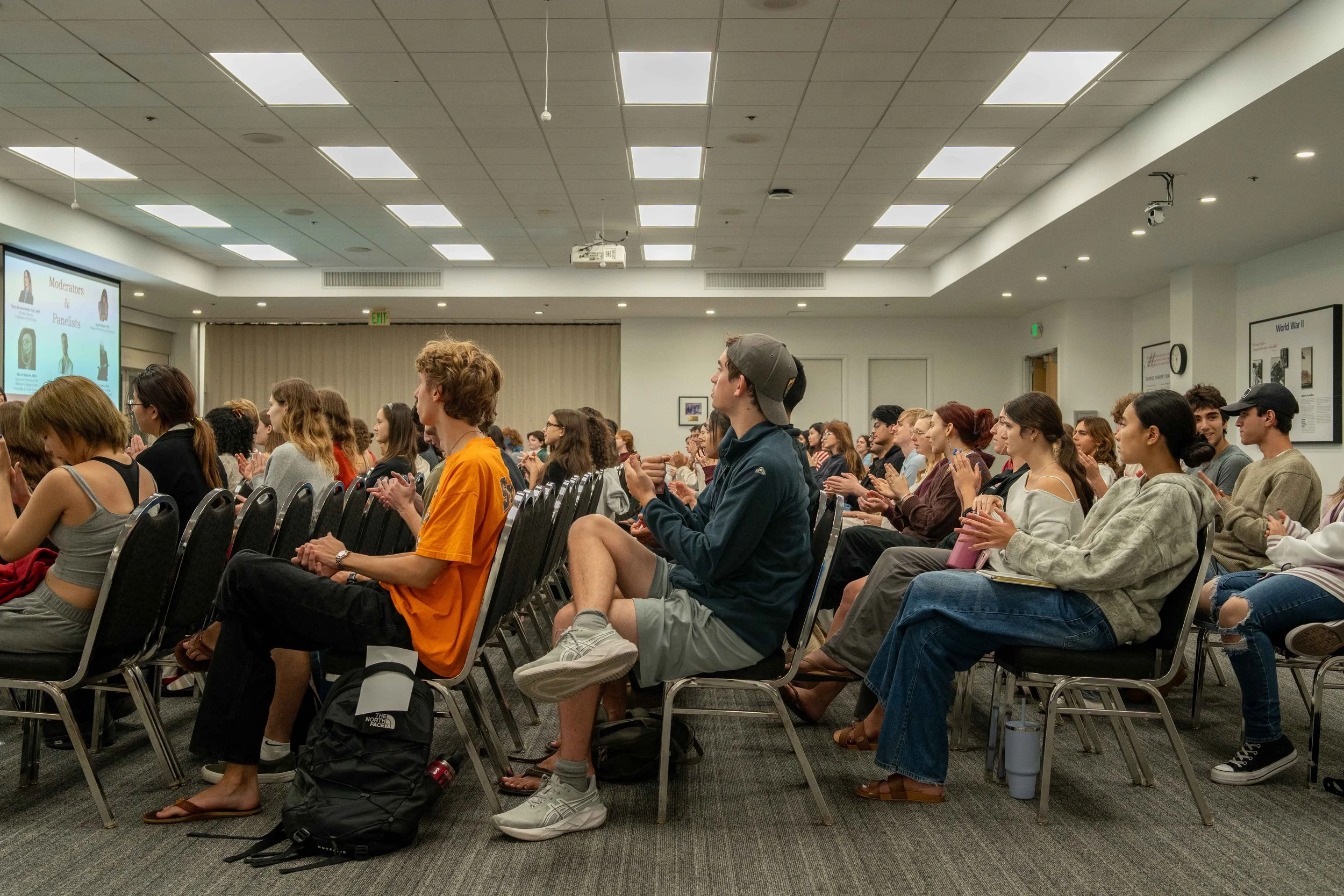
Photo by Sam Hall.
What happens when a museum curator, dance professor and art professor gather together to discuss the ways art can be used to enact positive social change? The Critical Conversations: Art as Advocacy event was hosted Nov. 3, giving audience members a chance to learn from some of Chapman’s most esteemed artistically inclined faculty members.
The event was moderated by Honors Program director and professor Tara Gruenewald and dance professor Arushi Singh. Escalette Collection director Fiona Shen, dance professor Kristopher Pourzal and art professor Micol Hebron gave short presentations and answered questions asked by the audience.
The first Critical Conversations Event took place on April 20, where several Chapman faculty members shared their opinions on the television series “Heated Rivalry.”
Gruenuwald used the first Critical Conversations event to experiment with its structure: Faculty gave short presentations and answered certain questions submitted by attendees in advance.
“I think we’re still learning what works,” Gruenuwald said. “This is a new series for us in terms of what the best scaffolding for bringing faculty together and also trying to elicit different perspectives.”
Gruenuwald describes the honors program as interdisciplinary and would like Critical Conversations events to reflect the diverse perspectives of various professors.
“Art becomes a universal language,” Gruenuwald said.
After Grunwald and Singh introduced the audience to this event, Shen talked about her involvement with the Escalette Permanent Art Collection and leading a first-year foundations (FFC) class where students help curate exhibitions. Shen said that this FFC class relates to Wilkinson College’s “Engaging the World” podcast.
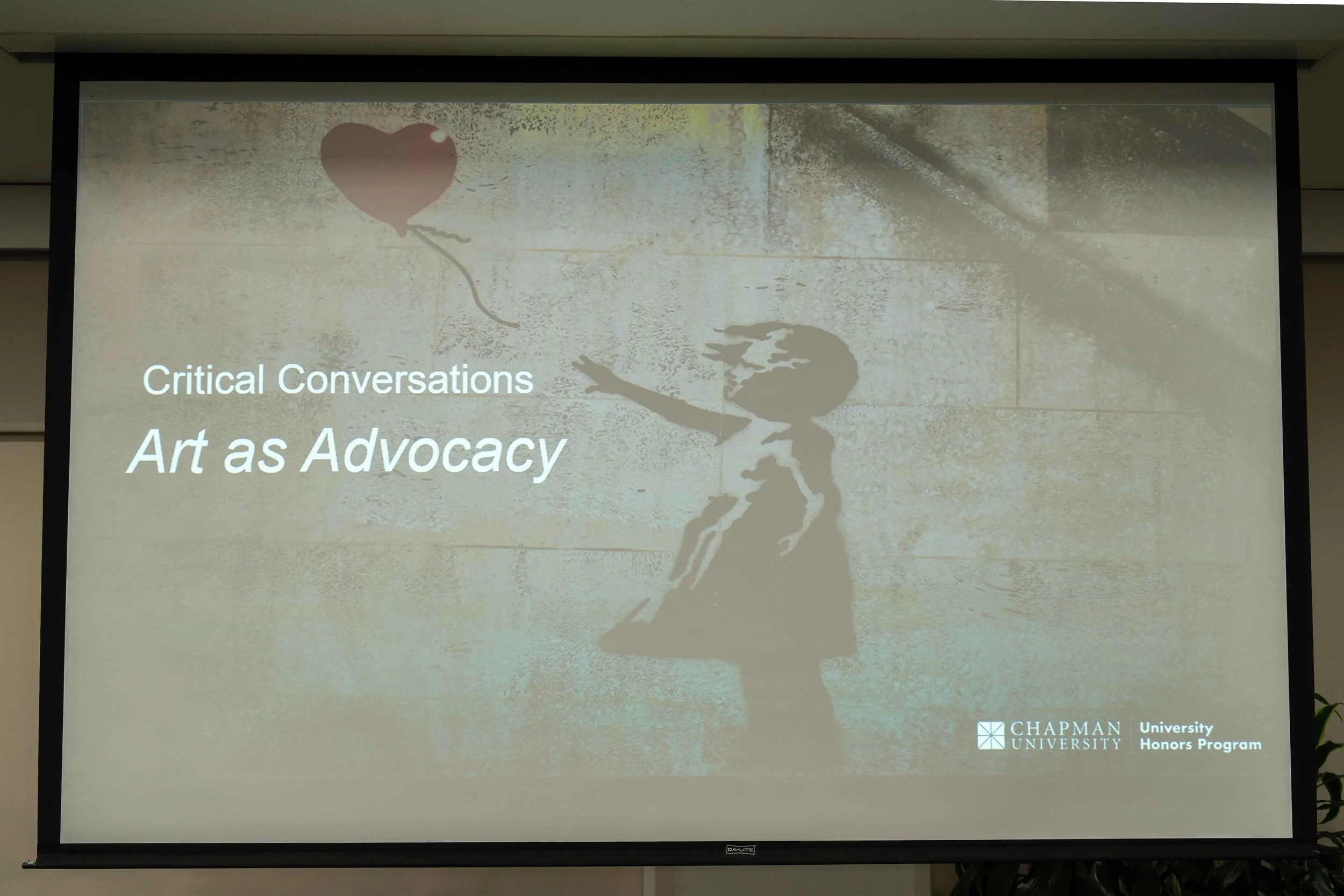
Photo by Sam Hall.
Shen also said that her work with BorderClick, a collection of artists who crossed the San Ysidro and Mexican border for a fair shot at an education, has given her empathy for those who may struggle to make ends meet. When BorderClick asked to purchase a license to feature their work in the Escalette Collection, Shen realized the importance of compensating artists for their work.
“Never ask an artist to do anything for free,” Shen said.
Shen is not the only faculty member dedicated to using creativity for social change.
In addition to teaching dance at the Sandi Simon Center for Dance, Pourzal has conducted extensive research on the Clark Center for the Performing Arts, which was founded as a studio space for the Alvin Ailey Modern Dance Company.
As a black and gay choreographer who revolutionized modern dance, Alvin Ailey was always an important figure to Pourzal.
“I feel a kinship with (Ailey) because I was born the year he died,” Pourzal said.
To help his research, Pourzal used Clark Center archives and interviewed people who were family members of some of the first Alvin Ailey dancers, including professional dancer and founding company member Ramona Candy.
Hebron started her presentation with a provocative question: Do women have to be naked to get into the MET museum?
According to a Guerrilla Girls display presented by Hebron, less than 4% of the artists in the MET museum’s Modern Art Section are female, yet 76% of the museum’s nudes are women.
Hebron uses this advertisement to discuss her own initiatives to recruit Chapman students and other community members to create data visualizations with similar statistics. Currently, 2,200 participants have been involved, and the initiative has seen over 600 posters.
“It relaunched the conversation about gender equality in the art world,” Hebron said.
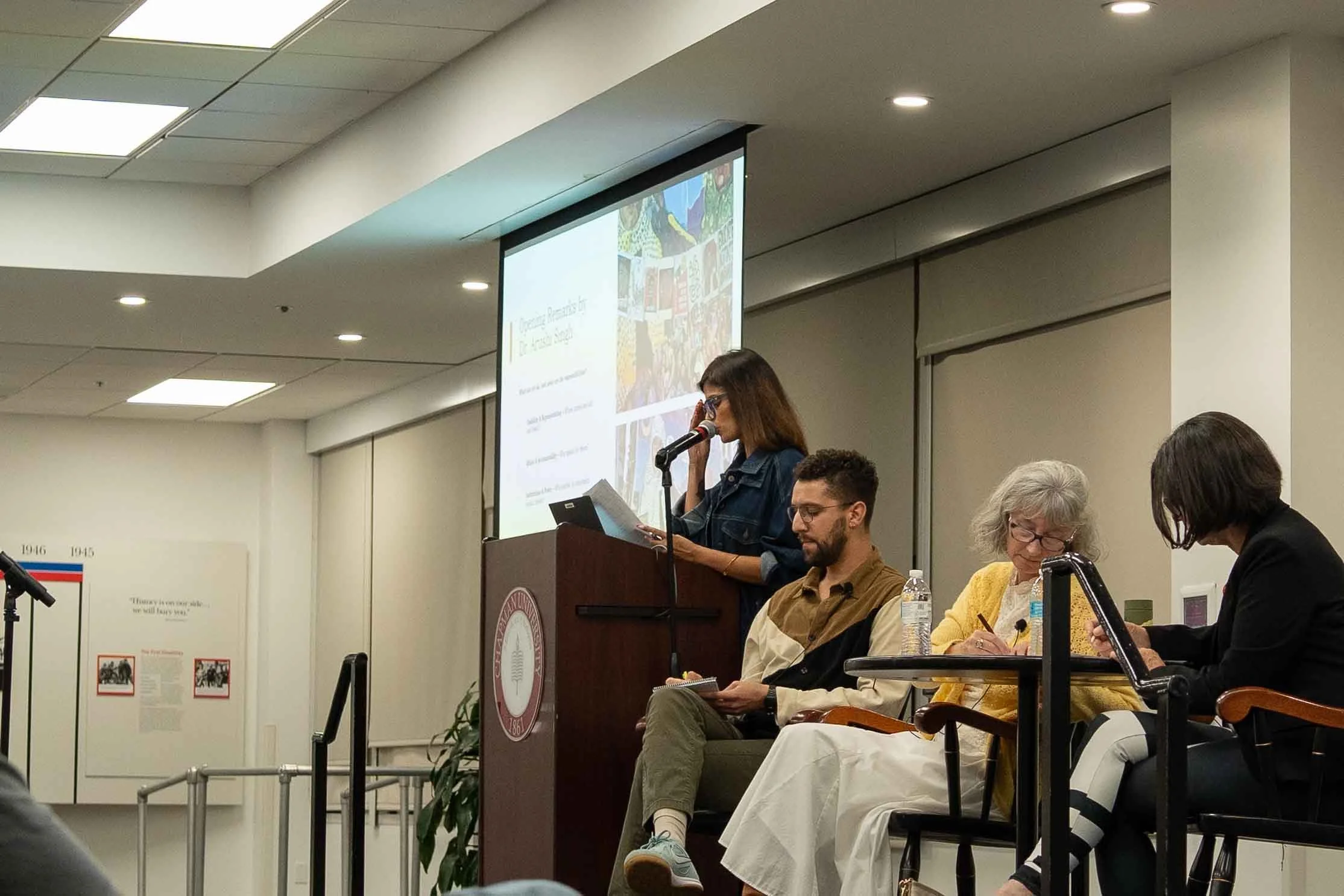
Photo by Sam Hall.
Hebron then said that she convinced her co-workers to attend a breast cancer awareness event topless. Unsurprisingly, an image that was posted on Facebook censored Hebron’s nipples but didn’t do the same for her male co-workers.
“I know my nipples aren’t gendered,” Hebron said.
In 2014, Hebron posted a tweet that called out Facebook for treating her nipples as inappropriate. One year later, several celebrities retweeted Hebron’s post, and it received 20 million shares in one week.
When faculty members answered questions from the audience at the end of the event, Shen gave advice to those who want to make a difference.
“Embrace your classrooms where there is space for critical dialogue,” Shen said. “You have to start somewhere, and the world is already happening to us.”