How do you talk about climate change?
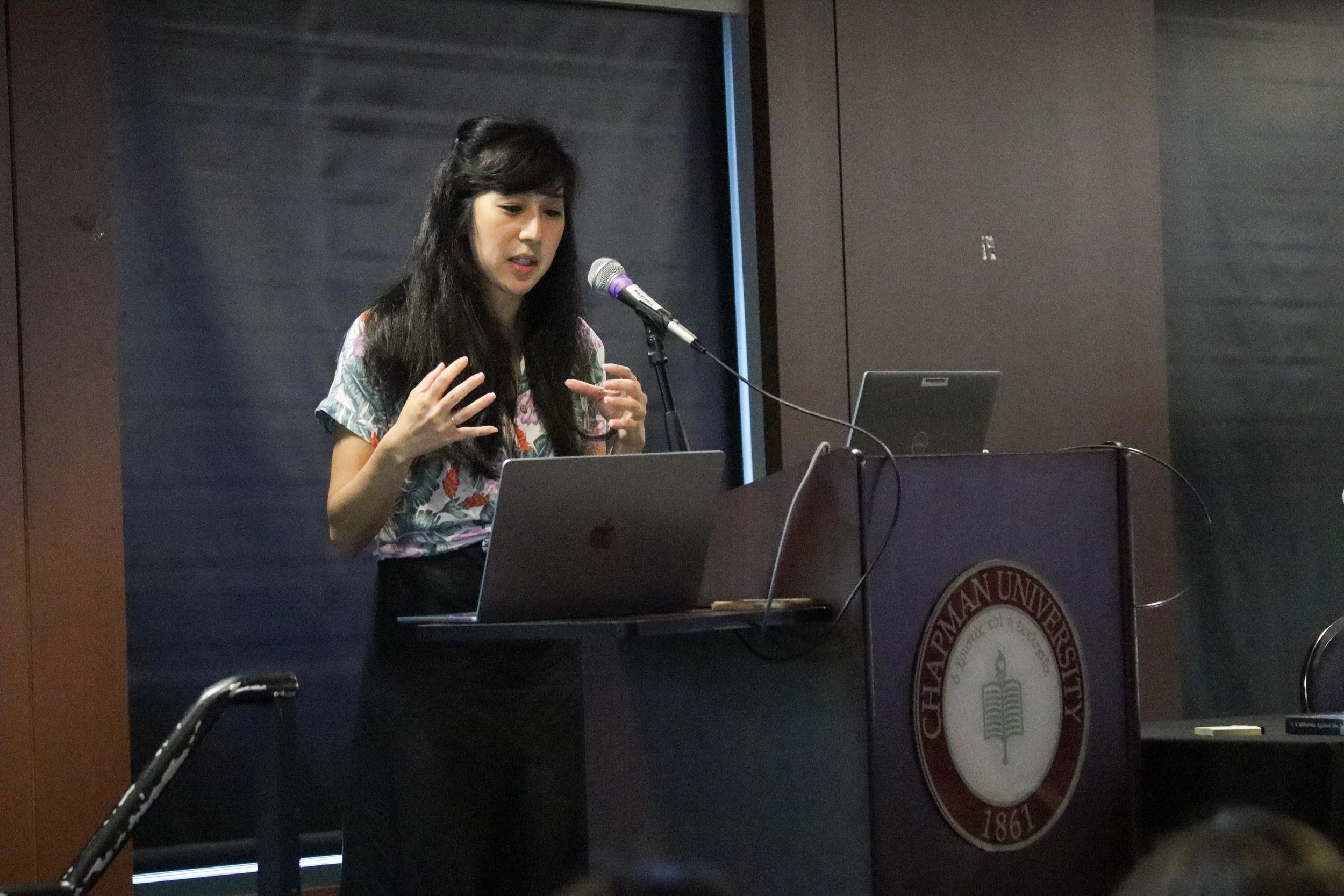
Photo courtesy of Ann Hoang
There aren’t many experiences more humbling and harrowing than having to walk through knee-deep water just to get to your house, parking your car a few miles away because it can’t get you any closer. But nobody wants to leave the place that they love.
This is the problem countless California residents face as climate change continues to rear its ugly head — having to reconcile their fears with their dreams for the future. Telling their stories is what Rosanna Xia has dedicated her career to.
The Los Angeles Times environmental reporter spoke at Chapman on the evening of Sept. 15 for an event put on by Wilkinson College of Arts, Humanities and Social Sciences. Xia is a Pulitzer Prize finalist and author of the 2023 book “California Against the Sea: Visions for our Vanishing Coastline,” which the talk was based on.
Xia has been up and down California, as her reporting is focused on the ocean and coastline. In doing so, she has spoken to everybody imaginable about the rising sea level’s impact on this state. She met very few climate deniers. Rather, her biggest challenge has been finding the best way to talk about an immensely divisive and personal topic.
“I learned that it’s so important to put yourself not just in someone else’s shoes, but also in their vulnerability,” Xia said.
She said that conversations about climate-related policies have often left little room for the emotions involved. And if you don’t honor someone’s feelings, they won’t be responsive to the potential solutions you are presenting.
Cold, hard facts, Xia said, are a very off-putting and oft-used way of presenting the problem at hand. To demonstrate this, she showed a slide during her presentation that labelled the worst-case scenario for California’s ecosystem:
Seven feet of sea level rise.
$370 billion of property damage due to flooding.
66% of California’s beaches will be completely gone.
All salt marshes will become extinct.
Xia would write an article about each new finding. It would be the main story on the LA Times’ website and would garner hundreds of thousands of views. But then, people forgot about it and moved on to the next thing. Over time, she learned a better way to get the point across: using empathy and compassion.
“People tend to remember how they feel when you’re sharing this information with them, rather than the facts that triggered those feelings,” Xia said.
She also said that you can’t just shout at people about pollution and climate change and automatically expect them to understand the direness of the situation. They need to see its impacts at a more micro level.
The most heated arguments Xia encountered were about policy decisions. When people’s livelihoods are at stake, no decision about the climate can be taken lightly. Sea level rise will have an impact on everybody in California; however, you can’t discount the specific needs of each city.
“Every community has its own set of histories and stories,” Xia said. “But ultimately, we are all interconnected by this ethos, which is the California identity.”
She said that every person has a story of the first time they saw the ocean or stepped onto the sand. There is a deep love for California all across the state, no matter what side of sea level rise debates people may fall on.
Her talk also focused on a common problem that plagues beach towns: many people see the beach as a never-changing entity.
“The coastline is not meant to be a fixed line in the sand,” Xia said. “The coast is a dynamic space.”
But the California government built the Surfliner train right along the ocean. Pacific Coast Highway is the same. There are houses and restaurants right by the sand. This is all that people know — this is how they have learned to live.
But how do you get the scientific community to understand the raw emotion behind that point of view? Xia tried to do it with her book. She said that it wasn’t about taking the reader on a purely intellectual journey, but on a philosophical and emotional one as well.
She gave an example about a middle-class woman who had saved up enough money to finally buy the beach house she always wanted. It was the ugliest one on the prettiest street in town. But soon after getting this fixer-upper house, the woman realized that certain climate policies could change her renovation plans and force her to refinance her mortgage. She wouldn’t be able to afford it.
You can’t simply throw those stories out the window when making policy decisions. That is part of the reason climate discussions are hard to have; the facts are enormously important, but so are lived experiences.
Xia said that her role as a reporter is to provide an empathetic starting point into the climate change conversation. Sometimes, this means doing nothing more than listening to the stories that people are desperate to tell — because many don’t know where to begin.
“It’s this all-consuming, ever-looming thing and it does touch every aspect of our lives,” Xia told The Panther. “I have recognized that it’s important for me to create space for all feelings and thoughts (on the issue).”
It can seem almost impossible to combat climate change, and Xia said she understands those frustrations. That’s because this is a systemic issue.
“You can’t recycle your way out of this problem,” she said. “But that also doesn’t let the individual off the hook. Be mindful of what you can do on an individual level, but also don’t be too hard on yourself.”
Her speech was part of Wilkinson’s series called “Engaging the World: Leading the Conversations.” Each talk is meant to create awareness, respect and stir up discussion at Chapman about the serious issues facing our world today — Xia’s exact goal.
“If people walking out of this room … continue thinking about the issue, then I’ve done my job.”