
Humanities programs stay steady at Chapman
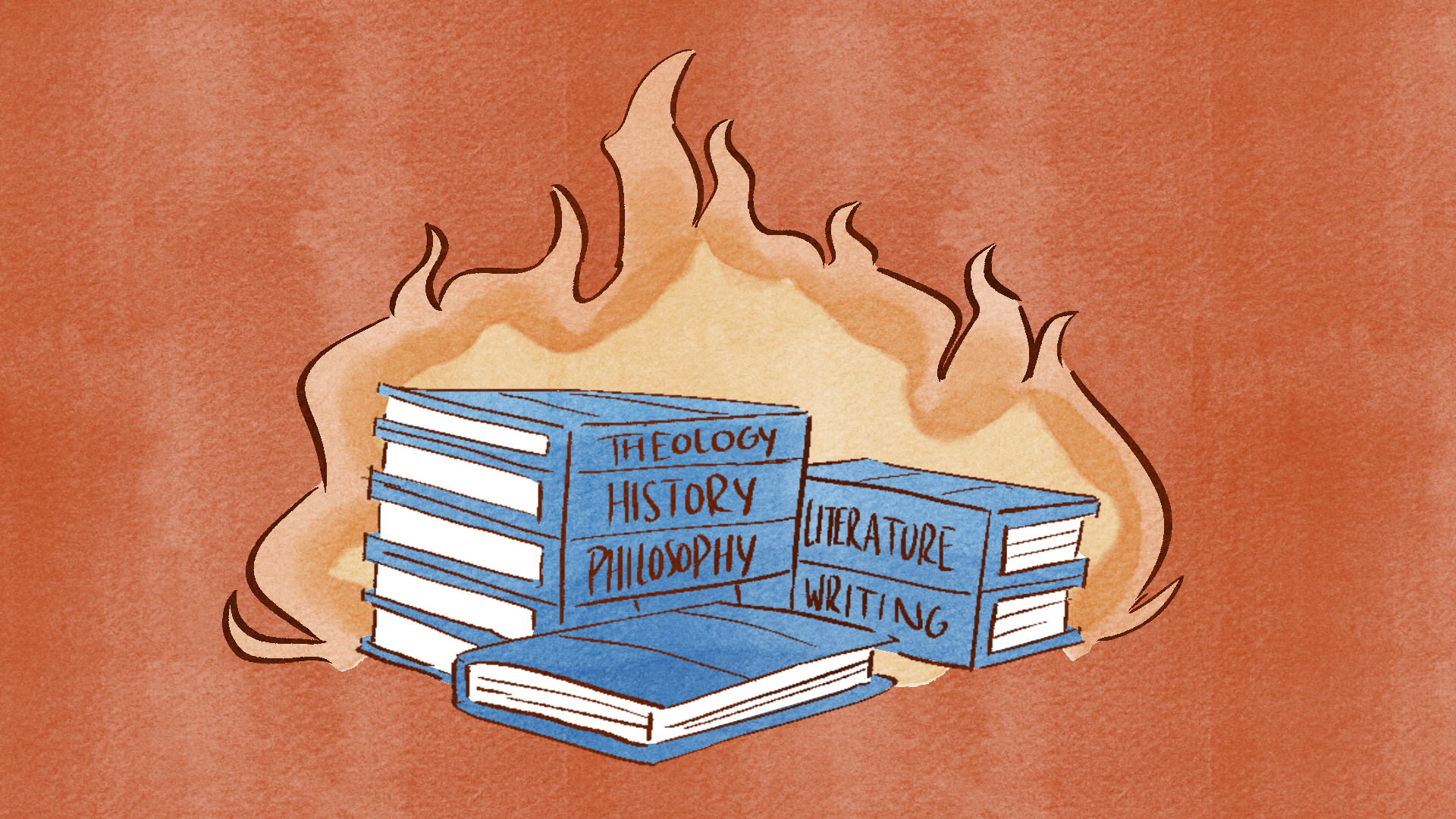
Illustration by Lexi Forman, Cartoonist.
“You’ll never get a job with that degree.”
This comment reflects a broader assumption that studying the humanities offers less practical or reliable career opportunities than other disciplines.
Humanities degrees are often associated with English, history and cultural studies degrees, but humanities programs can consist of many other disciplines that prioritize critical thinking skills, writing and analyzing relevant societal issues.
In recent years, the number of U.S. university students earning bachelor's degrees in the humanities has significantly decreased. According to a study conducted by the American Academy of Arts and Sciences, universities across the U.S. have given students the lowest number of humanities bachelor’s degrees since 1991. The reasons for this sharp decline remain unclear, but employment concerns and decreased interest in teaching were identified as factors, according to the study.
At Chapman University, many humanities majors are placed under Wilkinson College. Rick Bischoff, senior vice president of enrollment, says that enrollment at Wilkinson College has remained steady throughout the years.
Other humanities majors, such as philosophy and communications, can be found at different colleges (Schmid College of Science and Technology and the School of Communications, respectively).
Bischoff praises Chapman for offering a unique range of humanities majors that go beyond traditional disciplines, such as communications and the new cultural and creative industries (CCI) major. CCI started as a popular minor with over 300 students and also became a major in 2026.
“What I think is interesting about what Chapman offers is not just traditional humanities fields in English, history or philosophy,” Bischoff said. “I would argue that some of our majors, such as communications and CCI, are very ‘humanities-adjacent.’”
According to the National Center for Education and Statistics, Chapman’s business administration major has remained the most popular program among undergraduate students. However, Chapman’s humanities programs are deeply meaningful for faculty and students who dedicate themselves to their studies.
Assistant professor of journalism, Angelina Hicks, was a strategic communications major and journalism minor during her time at Chapman. While she currently focuses on writing journalistic articles and teaching journalism to students, Hicks attributes her strong writing skills to her enjoyment of reading complex novels while emphasizing the importance of humanities courses.
“A lot of humanities courses come down to, ‘can a student read a passage and be able to think critically about it and form a conclusion from what they just read?’” Hicks said. “I think, a lot of times, we lose a little bit of reading comprehension and understanding complex topics when we don’t have a focus on the humanities.”
In recent years, various educational institutions and workplaces have embraced AI literacy as a valuable skill for anyone trying to build their resume.
Hicks acknowledges the importance of using AI programs and other advanced technologies in the workplace, but also believes that the strong writing skills often taught in humanities classes can distinguish students from their peers and even help them troubleshoot if they’re unable to access AI technologies.
“Being able to stay up-to-date on certain technologies is important to make sure that students are competitive in job applications, but everyone needs to write emails, communicate with co-workers and explain themselves well,” Hicks said.
Relying on AI for writing and communication can prevent someone from effectively handling situations where they’re unable to access these systems.
“I can see plenty of opportunities where you might be in the workplace and might not have access to a certain system at some point, and you shouldn’t get lost if something like that happens,” Hicks said. “You should still be able to function independently without that system if you need to, and have that option for yourself.”
Freshman English major Mia Lavi said that the versatility of her major will help her stand out to employers.
“I could, with an English major, become an author, a teacher or a publicist because you learn about people instead of focusing on one specific idea,” Lavi said. “At the end of the day, interviews and job applications come down to how you present yourself and communicate your ideas.”
Sophomore political science major Amaya Hepburn said that her humanities classes teach many transferable skills that may help distinguish her from other students. She is also minoring in honors and rhetoric and composition Studies, two disciplines deeply rooted in the humanities.
Hepburn said that humanities classes often teach students to embrace different perspectives and participate in a welcoming environment.
“You want people to feel comfortable around you and create a comfortable environment, whereas if you’re not taught those elements, you’re not thinking of how to make people feel more comfortable,” Hepburn said.
Hepburn previously believed that she needed to take STEM classes to make herself more marketable, but now sees her extracurricular achievements as valuable attributes to her resume.
In addition to her major and two minors, Hepburn is also a political science research assistant and has worked on multiple research projects that demonstrate her knowledge in collecting data, performing statistical procedures and forming conclusions.
Lavi is passionate about her humanities classes, but also hopes that universities can integrate humanities and STEM programs rather than enforce competition between the two disciplines.
“We should value and uphold the humanities more than we do already,” Lavi said. “Not in a way that discounts STEM and science, but in a way that makes them equal.”