
Solidarity: Fostering awareness and education on campus
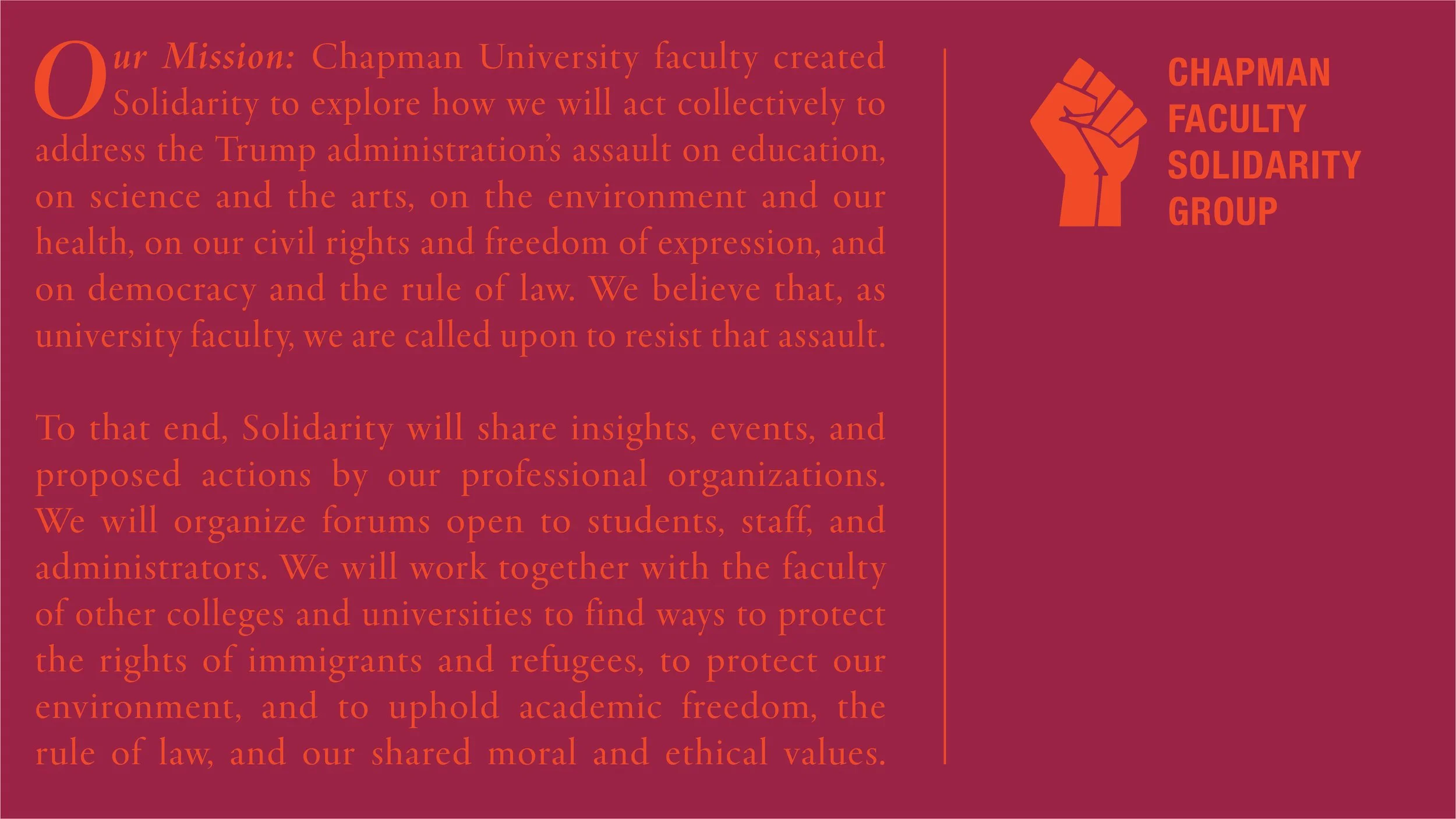
Photo Collage by Easton Clark, Photo Editor
Last February, amid campus controversies, Chapman faculty formed Solidarity to resist local and national attempts to dismantle diversity, equity and inclusion.
English and peace studies professor Richard Ruppel, the group’s founder, summed up the organization’s goal.
“We are cataloging, analyzing and then finding ways to resist the many ways the Trump administration is assaulting all of the values that we have,” he told The Panther.
Solidarity includes 145 staff members from all Chapman colleges. However, the group is not an officially sanctioned Chapman organization.
“We will draw attention to events on campus that are related to our concerns,” Ruppel said. “We will also co-host events.”
One event the group co-hosted last year was Chris Kluwe’s talk on civil disobedience.
“It was effective in the sense that it had a large audience, but many who could have benefited from hearing the talk were not there,” Solidarity member Lisa Leitz, a sociology and peace and justice studies professor, told The Panther.
This year, Solidarity has tentatively scheduled a conference for late February of next year, titled “Rhymes, Echoes, & Contrasts: 1930s Germany & the US Today.”
Solidarity also supports many of the Engaging the World events that Wilkinson College puts on. In October, Pete Simi, a sociology professor and Solidarity member, is facilitating the discussion on “Christian Nationalism, White Supremacy, and the Future of Democracy.”
Further student involvement in events is expected this semester, although it is in the early stages.
Senior creative writing major Michael Daniels said he sees the integration of students into a faculty group as “natural” and “fluid.”
“I think it's extremely important for students and faculty to align and to be in communication, because there are different advantages that students and faculty have,” he said.
Student involvement also provides a sense of transparency.
“Not everything can happen behind closed doors at faculty senate meetings,” said Daniels. “I think a lot of these things are very open and blatant issues, and we shouldn’t pretend they aren’t there and that they’re not affecting students."
Increased political violence and attacks against minorities continue to worry Leitz.
“Over the last few days, there has been so much violence, often with a political aim or politicized by others,” she said. “It's heartbreaking, but not surprising in a country where violence and militarism have been used as an answer to problems for all but two years of our history.”
Nonetheless, there is hope for the semester among the faculty of Solidarity.
“This semester I hope to see Chapman faculty supporting students who are hurting because of the dismantling of the DEI office at Chapman, rhetoric attacking minorities and who are terrified because of the militaristic and often racist attacks on immigrants,” Leitz said.
Ruppel also has positive expectations for the upcoming semester, as he doesn’t blame Chapman’s administration for figuring out “how to keep the lights on” while living in what he views as a dictatorship.
“The people who are in charge of the university now, seem to me, are good people,” he told The Panther. “They are committed to (academic freedom). That said, they are in a very difficult position.”
Both Leitz and Ruppel agree that political labels and differences have interfered with core values of Chapman and the United States, which is what we need to reflect on and revert to.
“Loving your country and the United States means recognizing its imperfections and working to make it better; that's what American patriots do,” Ruppel said. “They don't walk around waving a flag and sneering at immigrants and non-whites. We — patriotic Americans — believe in this country and believe in its values, which are inclusive.”
Editor’s Note: The tentatively scheduled conference for next February has been cancelled.