
Student government remains in limbo
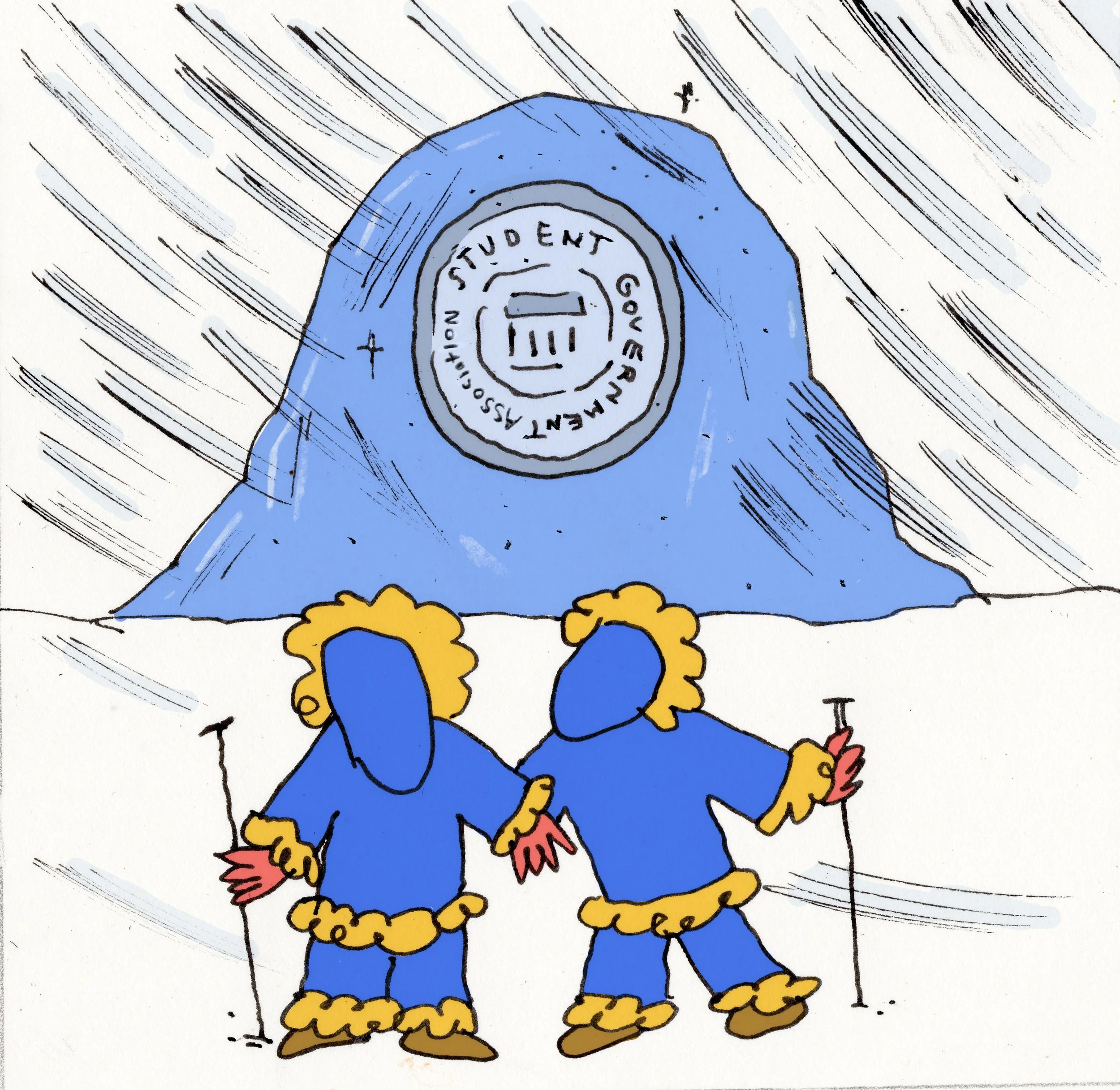
Illustration by Sami Seyedhosseini, Photo Editor
Five months after Chapman’s Dean of Students stripped the Student Government Association (SGA) of its power, the student body still lacks a functioning elected government. Students involved in Chapman’s probe of an election scandal have been told that it could continue well into the fall semester.
The SGA was indefinitely frozen in March following a contentious election marred by accusations of cheating, a disqualification and an effort to restage it. The ongoing probe has raised questions about who now oversees more than $1 million in student activity fees and about when elected representatives might return to office.
Alexis Reeves, who was a vice presidential candidate in the disputed election, said she has been told that the university’s review remains ongoing, with additional interviews required as recently as July and a potential timeline extending into November.
“This whole situation has been unnecessarily dragged out for months and months, and the scope of the issue has spiraled wildly out of control,” Reeves told The Panther. “We've been in the dark with no idea of what the outcome will be, giving information when asked, and just waiting to hear something back.”
The Dean of Students’ office declined to comment on the status of the SGA investigation. Bob Hitchcock, Chapman’s director of strategic communication, has confirmed the review but has not stated what is being investigated.
“In line with the University’s anti-discrimination policy and process, a review involving the Student Government Association is underway, and until this process concludes, SGA will be on frozen status and not conducting official organizational business,” Hitchcock said. “Strong student leadership is an important part of the Chapman experience, and we look forward to the return of SGA to recognized status.”
The events leading up to the suspension
The spring 2026 presidential cycle ran from Feb. 20-25, with presidential candidates Jason Wu Chen, Maximilian Wiseman and Anthony “Rusty” Henry. The vice-presidential candidates were Reeves, Chen’s running mate, and Mile McAndrews, Wiseman’s running mate.
Before the election results were announced, the Chen-Reeves ticket was accused of cheating. One week later, the Elections Committee, made up of students, reviewed alleged violations involving Chen. The committee disqualified the Chen-Reeves ticket, a decision that the Judicial Review Board, also a student board, upheld on appeal, according to Chen.
A week after the election closed, SGA announced that Chen and Reeves had won the popular vote, while Wiseman was told he had been certified as president-elect because Chen and Reeves were ineligible.
Reeves said she was frustrated by the outcome.
“What's the point in voting if two unelected committees can determine the outcome?” Reeves said. “For this election to be stolen from the entire student body is a travesty.”
Wiseman and McAndrews did not respond to requests for comment.
But on March 9, SGA leaders reversed their decision. Instead, they announced that a special election was required, with all original candidates eligible to run.
That election never happened.
In an email sent to students on March 16, former Dean of Students Jerry Price cited alleged failures to comply with university policies and procedures following allegations of discrimination. The exact policies were not stated. The suspension halted the special election and placed SGA’s operations under university oversight.
“Earlier this morning, I informed SGA that it is being placed on frozen status, so the University, through the Office of Student Conduct, can review its alleged non-compliance with University policies, procedures, protocols, and standards, follow up on related allegations of discrimination in line with University policy, and resolve any issues,” the email from Price said.
Cintya Felix, the outgoing SGA president, has been caught up in the SGA probe. Traditionally, SGA presidents have spoken at commencement; however, Felix was notified a week before graduation that she would not be giving a speech during the ceremony.
The university has not stated a reason for the cancellation of her speech other than the SGA's frozen status.
Students and some members of the faculty responded to the news that Felix would not speak by organizing an alternative “Students’ Commencement” with Felix’s speech on the program, at the First Presbyterian Church of Orange. It was held the same night as the university’s commencement.
Felix graduated in the spring but is involved in the ongoing SGA review. She has declined to provide a comment, citing the investigation.
SGA serves as the official representative body for undergraduate students, advocating on behalf of the student body, organizing campus initiatives and overseeing the allocation of student activities fees to clubs and organizations. Every undergraduate student contributes to those funds through tuition, paying approximately $160, making SGA’s budget decisions some of the most consequential made by student leaders each year.
A review that could extend late into the fall
Months later, the university’s review remains unresolved. The administration has not stated why the review is taking this long, when it will end or what’s being investigated.
The prolonged review has created uncertainty for students who may be elected to leadership positions in the future.
The president and vice president were to be trained by the outgoing leaders to facilitate meetings, manage and distribute the budget and other campus matters after the election. Instead, no new leaders were elected, and many of the students who had served in SGA have since graduated.
That leaves whoever eventually takes office with a shortened transition period and potentially a loss of institutional knowledge.
What happens to the student government's responsibilities?
Due to the suspension, functions normally performed by elected student representatives have been halted.
One such function is allocating student activity fees to clubs and organizations. Every undergraduate student contributes to those funds through tuition, adding up to approximately $1 million.
With SGA suspended, however, there are no seated elected senators voting on behalf of students.
“The aftermath is that, right now, no one is advocating for students, no one is carrying the concerns and needs to the administration or voting on how their activity fees get spent,” Chen said.
He also said that projects already underway have been paused, with uncertainty about when, or if, they will be completed.
In its March 16 email announcing the freeze, the Dean of Students Office said that “funding requests that have already been submitted (by student clubs), and are still pending review, will be temporarily reassigned to the Student Activity Fee Advisory Committee (SAFAC).”
SAFAC is an administrative body made up of student workers, faculty and Student Affairs staff, along with the Vice President and Dean of Students. According to Hitchcock, it is an advisory group that provides guidance to the Vice President and Dean of Students on student activities and the use of student activity fees. He added that the committee serves in an advisory capacity; final decisions regarding funding, fees and other matters remain with the appropriate university leadership and established university processes.
While SGA and its Allocations Committee normally manage day-to-day club budgets, SAFAC serves as a fallback resource.
Hitchcock did not state where the funding SGA would have gotten from student fees has gone, but confirmed that SAFAC will continue to ensure financial support for student clubs and organizations, typically funded by SGA, through the fall.
Now that much of the previous SGA board has graduated, “the situation will not have a clean resolution,” Reeves said. “Everyone loses.”