
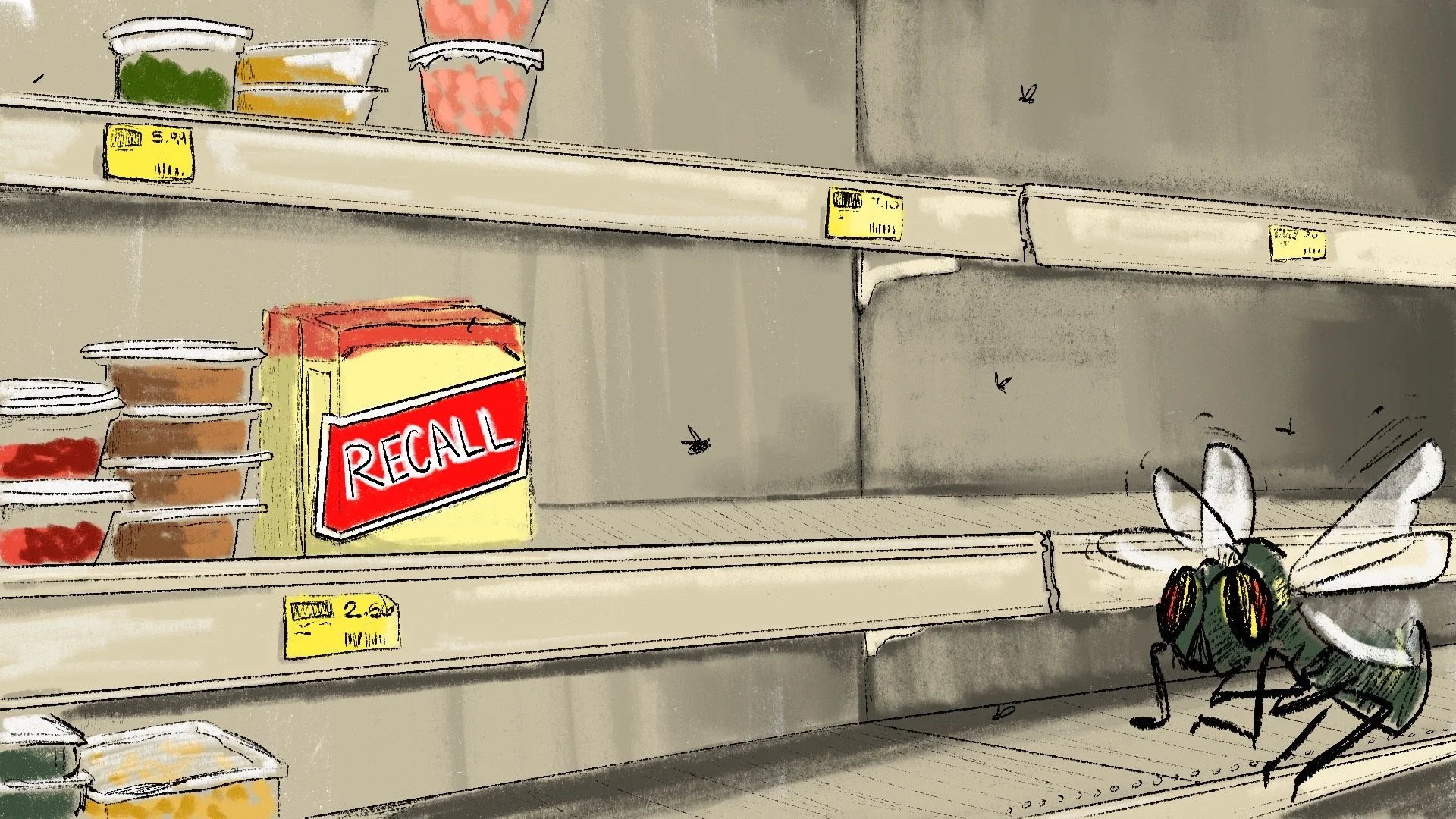
Illustration by Zoe Wren Arntsen, Illustrator.
From Taco Bell lettuce to Chipotle jalapeño peppers, recent issues such as Salmonella and Cyclospora parasites have left consumers wondering: What is safe to eat at grocery stores and restaurants without risking being locked to the toilet with an upset stomach?
In July 2026, a multistate Cyclospora outbreak spread across the U.S., tracing the cause to lettuce from Taylor Farms in central Mexico. One of summer's big food safety issues, social media blew up on the various food recalls; hot topics forming around foodborne illnesses, outbreaks and what is safe to consume.
According to the Sedgwick Product Safety and Recall Index, U.S. product recall volume has exceeded one billion units so far in 2026, surpassing one billion units recalled annually for only the fourth time in the past 15 years. These products include automotive devices, food and drink items, pharmaceuticals, medical and other consumer products.
Food recalls are regulated and overseen by the U.S. Food and Drug Administration (FDA), the Food Safety and Inspection Service (FSIS) and the U.S. Department of Agriculture (USDA). They are announced due to contamination risks, choking hazards, allergens and other consumption concerns.
The FDA organizes recalls through three distinct classes based on the level of the hazard involved. Class One recalls are the most serious classification, indicating a reasonable probability that exposure will cause adverse health complications or death. Class Two is an intermediate classification in which exposure causes temporary or medically reversible health consequences. Class Three is the least severe, with the product unlikely to cause adverse health consequences.
In food alone, there are currently almost 200 recalls, similar to 2025’s total of around 320. Though comparable, there were a number of high-profile recalls this year, including the cyclosporiasis outbreak, which had around 20,000 reported laboratory cases between May and August.
This year, recalls so far have covered a vast array of food products, such as certain branded frozen blueberries with potential contamination of Escherichia coli (E. coli) and alfalfa sprouts and eggs with potential Salmonella.
Though these recalls have received widespread media attention, no objective data shows that the U.S. food supply in 2026 is fundamentally less safe than in the past. But a number of high-profile outbreaks and policy changes have caused public confidence in products to significantly decline.
Associate Director of the Food Science Program and Chapman professor Rosalee Hellberg explained that these recalls aren't necessarily a bad thing; in fact, they can mean the system is safe and actively working.
“It can actually mean that the system is working better than it used to and that we have better detection mechanisms, we are reacting more quickly to potential dangers and we are publicizing it well,” said Hellberg.
Hellberg further explained that the high publicity and quick reactions to these recalls don't necessarily mean the food is less safe; instead, they can indicate that we are being more proactive.
A study conducted by Gallup in early October revealed that American confidence in grocery store food has fallen to a record low of 65%, down from 2025 results, which reported 73% confidence, and 72% in 2024.
Along with these results, the study also revealed that 47% of Americans are confident that the federal government will help ensure food safety, while 73% have avoided certain foods after a recall or advisory is released.
Hellberg explained there are various reasons the confidence has dropped so significantly, including the heightened publicity of these recalls and also Americans’ general confidence decreasing as a whole.
“A lot of people don't realize that our food supply is one of the safest in the world,” said Hellberg. “Because they're seeing more stuff about food safety in the news, it actually can be an indicator that our systems are working.”
In California, there have been numerous statewide and national alerts tied to food recalls. Some of the recent recalls include the Once Upon a Farm toddler soft-baked bars recall in early November due to choking concerns, Happy Hens organic eggs due to possible salmonella contamination and Whole Foods Market cheese for including an undeclared egg product not listed on the label.
With these high-profile recalls, some of the best practices for shoppers are to stay up to date on announcements and check several sources, particularly given the quick spread of information on social media platforms.
Hellberg explained that it's important to stay up to date on press releases on food recalls and to understand that the recalls are very specific to a certain brand, product and lot number.
“Just because there's a recall does not mean that all of that food is going to make somebody sick, it just means there is a possibility,” said Hellberg.