
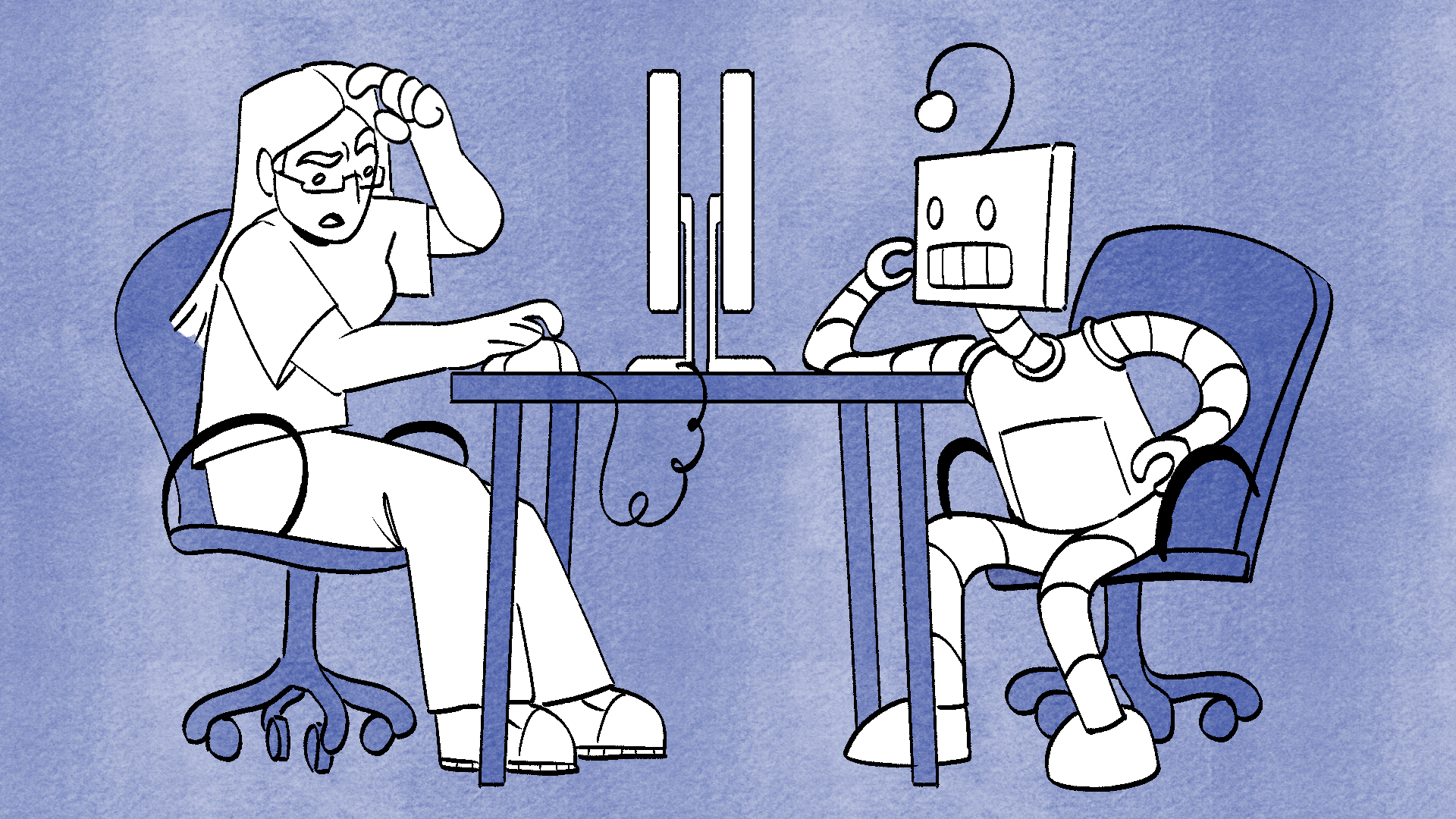
Illustration by Sami Seyedhosseini, Photo Editor.
When you hit submit on a job application, chances are a human is not the first to read it.
Artificial intelligence (AI) is now the gatekeeper between a candidate and a recruiter, and for college students entering the workforce, that changes everything about how the game is played. It means competing not only with other applicants but also with an automated screening process.
Seth Benzell, an assistant professor of economics and management science at Chapman University, said the shift is already showing. Entry-level workers in fields most exposed to AI have seen hiring rates decline slightly compared to other sectors over the last two years.
"The evidence is maybe mixed, but slightly negative," Benzell said. "It is a more challenging job market for entry-level workers versus advanced workers."
On the hiring side, Benzell said employers are increasingly using AI and machine learning models to do the first read on applications.
At the center of that shift is the rise of AI-driven resume screening, known as Applicant Tracking Systems (ATS). Rather than a recruiter reading through every application, companies can use AI software to score and rank candidates before a human ever gets involved.
Benzell said for large companies, that process is now standard.
"Big companies are usually doing some sort of filtering for any open application role," Benzell said. "There are just too many documents to screen through."
The technology has also moved beyond keyword-matching tools for searching resumes. Newer systems can evaluate context, experience and the fit of a candidate's background to the role.
"I'm hopeful that the new AI filters are being a little bit more subtle and sophisticated," Benzell said. "(A resume) doesn't have this keyword, but it's better in other ways."
For college students, that means writing a resume that works for a computer first and a person second.
Chapman’s Career and Professional Development Center has already begun adapting its career resources to the growing use of AI in hiring. In 2024, the university introduced VMock, an AI-powered resume review tool that evaluates resumes and provides feedback on how they look, how they read and how well they match the job description.
Chapman has since expanded the platform to what it calls Chapman Career AI, which also gives feedback on cover letters, LinkedIn profiles and mock interviews. The platform can also optimize resumes for specific job postings.
That puts students in an increasingly automated cycle. Employers can use AI to evaluate applications, while students can use AI to prepare those same applications.
Erin Berthon, manager of Career Development & Alumni Relations at Chapman’s Wilkinson College, who has held that role for the last 10 years, says tools like VMock can help students prepare for AI interviews.
“If that’s our future, you have to be prepared,” Berthon said. “And if you practice and practice and practice, then you’ll just get better at the robot thing.”
She also tells students to learn how a company uses AI before they walk in, whether or not they like the technology.
“If you go into the interview and they ask you an AI question, it’s only to your benefit, even if you believe in it or not, to know how they’re using it,” Berthon said.
Automated interviews have taken away the personal side of interviewing, Berthon said, leaving students one less chance to make an impression. “You don’t have that interaction and that feeling like you’re doing a good job,” said Berthon.
Berthon stresses the importance of practice, allowing students to understand the AI systems prior to facing them.
“If that’s our system and our future, then that’s why Chapman has the tools,” Berthon said. “So we can practice, and we can go over it and go over it.”
Berthon believes many students still haven’t seen just how much the process has changed.
“You have to now learn how to play this, try to beat the system,” Berthon said.
Berthon knows students have mixed feelings about AI, but says you have to adapt to an evolving industry.
“I know we don’t like it, but you’ve got to figure out how to embrace it because it is there,” Berthon said.