
Life in the trenches
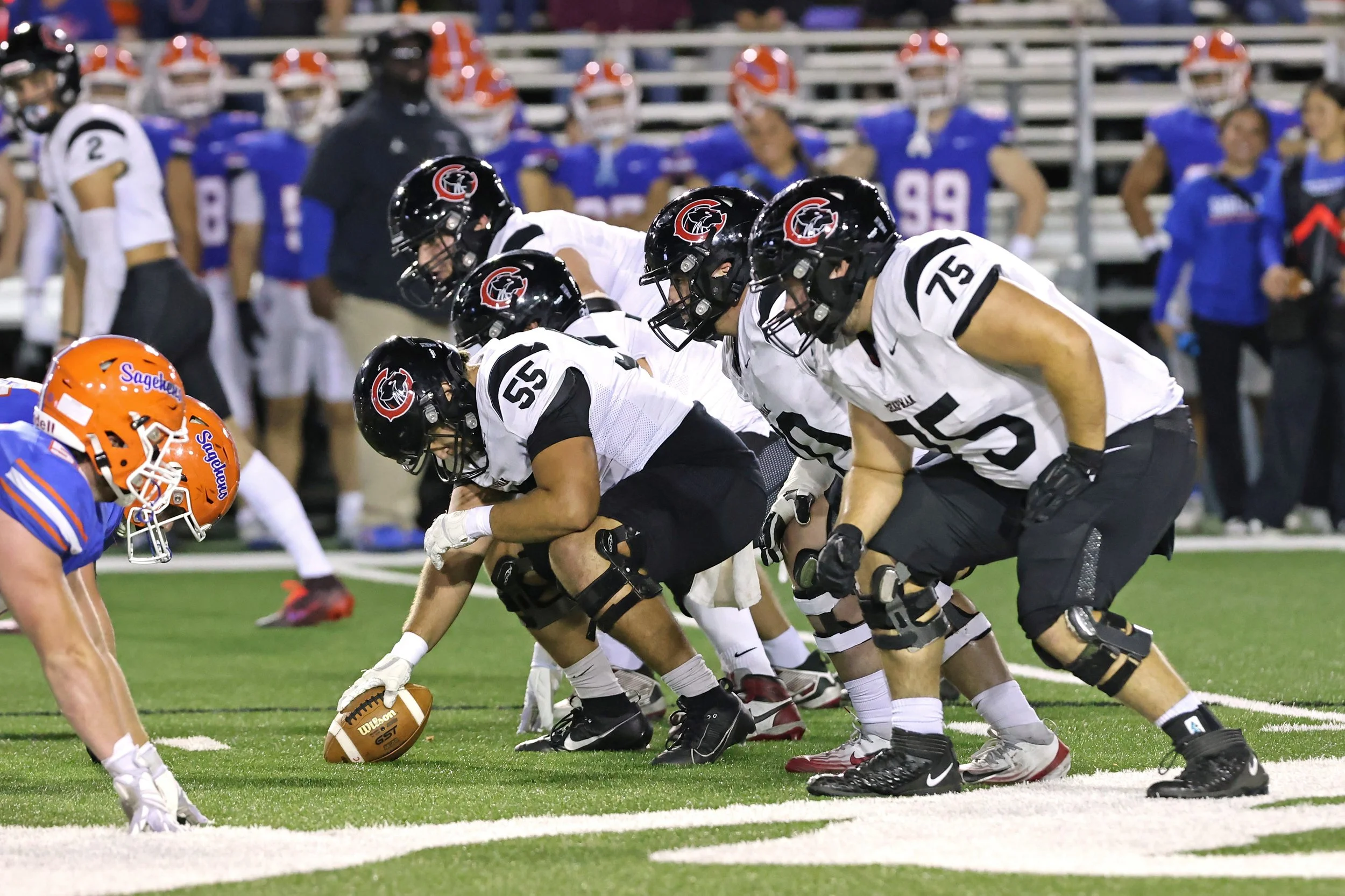
Photo courtesy of Larry Newman
Hands in the dirt, eyes up, defenders in front of their face. The defense shows three men rushing, but a last second adjustment brings six rushers to the line. The ball is snapped, and Chapman’s offensive linemen burst out of their stances, punching through their opponent's chest. A gap is created between the left guard and the left tackle, and the running back bursts through the open hole. With nothing but green grass left in front of him, he sprints 54 yards for the touchdown.
This play from the Panthers game against Pomona on Oct. 11 is a prime example of what a good offensive line can do for a football team. While they don’t often get the glory, the effectiveness of an offensive line is arguably more crucial than any other position group on the field.
There are not many available statistics to truly assess how good an offensive lineman is. The number of sacks and pressures they have allowed tells part of the story, but not nearly enough. There are a few measures, though, that give some extra insight into the value of a good offensive line.
A 2022 study conducted by Andrew Falce of NFL Spin Zone used Pro Football Focus (PFF) data to evaluate the differences in performance of teams based on the strength of their offensive line. He found that since 2012, teams with a top five ranked offensive line won about three games more per season than teams with a bottom five offensive line. He also found that teams with a bottom five offensive line have only made the playoffs seven times in this timespan, and none have made it to the Super Bowl.
And for the players who line up in the trenches, this statistic isn’t surprising. Senior offensive lineman and business administration major Gavin Scott talked about how important a good line is for offensive success.
“If you don't have an O-line, you can't protect the quarterback, you can't get the ball off … you can't run the ball. The holes aren't going to be open for the running back,” Scott said. “When you have a good O-line, it's so much easier for the team to get going.”
It’s easy to look at an offensive line from the outside and feel that it’s an easy or unimportant job. They aren’t diving for catches, they aren’t jumping over defenders and they aren’t making big tackles. What they do isn’t flashy. But the technique, knowledge and skill needed to be an offensive lineman is just as complex as any other position on the field.
Chapman offensive line coach Scott Wilford described some of the intricacies involved in every play for the O-line.
“Everybody that doesn't understand football thinks that they just block straight ahead, which is the farthest from the truth,” Wilford said. “If the (defender) is on my outside shoulder versus head up versus my inside shoulder, that's three completely different approaches I have to take to this block depending on where the ball is going.”
Scott also mentioned some of the different techniques that offensive linemen have to account for before a play.
“You have to know so much, it's kind of crazy,” Scott said. “One little mistake can screw up the whole entire play … if you take the wrong step even slightly, like an inch, or miss with your hands, or if you don't do your assignment.”
And the defense doesn’t make this an easy task. Defenses will adjust their alignments right before the snap and send different combinations of rushers to put stress on the offensive line and pressure them into making quick decisions, sometimes forcing them into penalties. Junior offensive lineman and journalism major Lane Forti talked about the challenges offensive linemen face against various defensive schemes.
“Defenses do a lot of different things up front to try to confuse you,” Forti said. “They send different blitzes. They have defensive linemen on different twists and stunts, and so to be able to be disciplined enough to, in a split second, realize this guy I thought I was gonna block suddenly isn't, and reroute yourself to go block somebody else … that part is overlooked.”
This is where communication among the offensive linemen is key. Calling out blitzes, coordinating blocks, reacting to shifting fronts — all in the span of a few seconds. These are the psychological components to the position that many viewers don’t consider. Both Forti and Scott said that Chapman's lineman have enough experience and chemistry to simply give each other a “look” to know what they need to do.
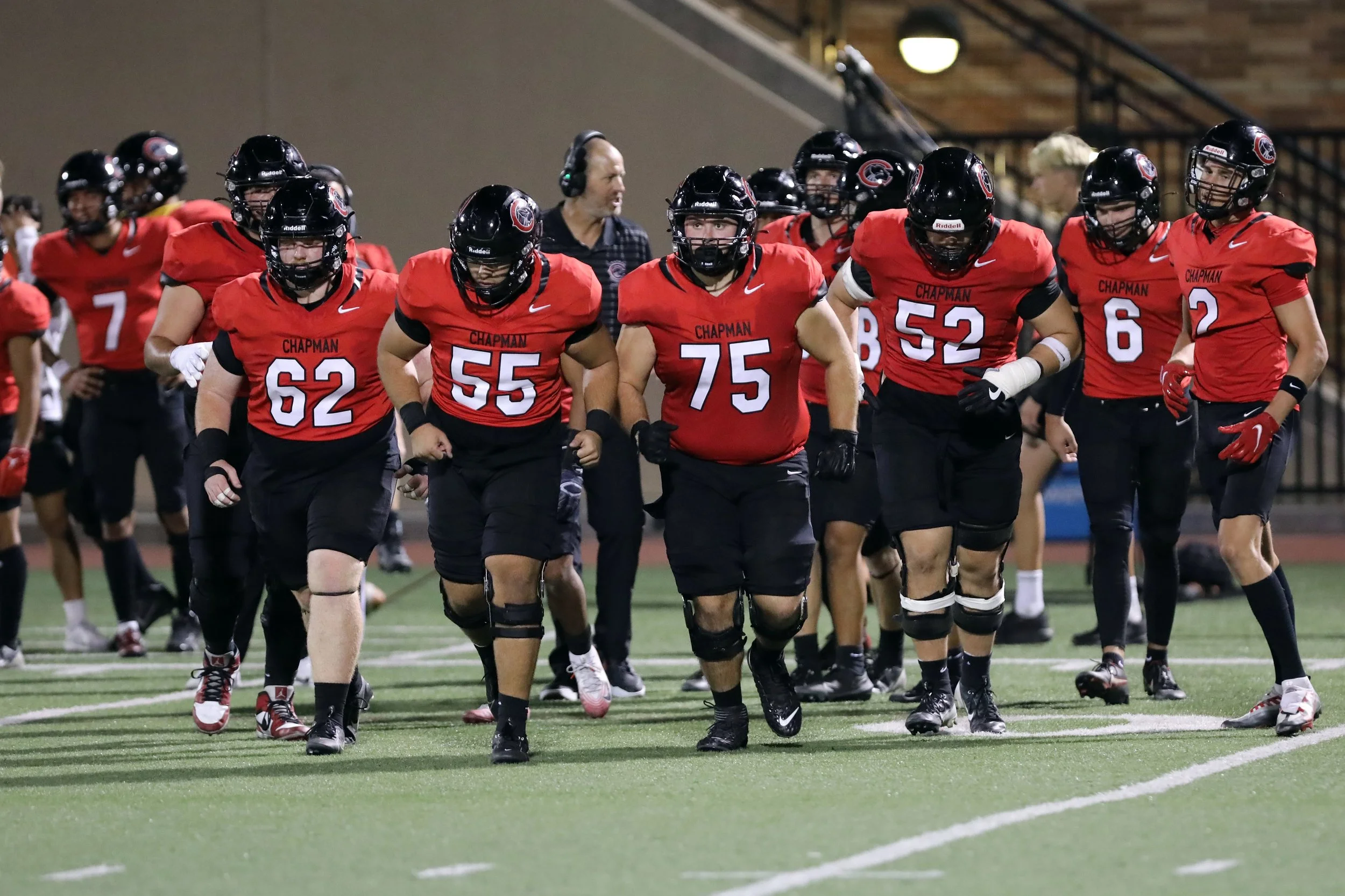
Photo courtesy of Larry Newman
The mental game of an offensive lineman is severely overlooked, but even the physicality that they’re known for isn’t given enough recognition. Sure, you see a 6-foot-5-inch 300-pound man and think to yourself, “no one is getting past him.” But as Scott mentioned, the mechanics of the position challenge the laws of physics.
“It's just not a natural position, especially for pass blocking,” Scott said. “You're trying to stop a guy that's more athletic than you, smaller than you, faster than you, while you're going backwards, which just doesn't make sense.”
Coach Wilford also mentioned how unnatural this technique really is.
“Tackles have to have great feet, because they're playing against a guy that probably ran the hurdles in high school. Yeah, he's an outside linebacker in football, but in the spring, he probably ran the 300 hurdles. He's an athlete,” Wilford said. “He's coming full speed forward and we're going backwards, and we have to try and figure out how to slow him down and stay in front of him.”
Forti acknowledged another unique aspect of the position — they rarely see what’s developing once the ball is snapped.
“It's the only position in sports where you play with your back to the ball. It's just complete trust in the guy next to you, yourself, your quarterback, your running back, your receivers,” Forti said. “You're sacrificing your body for something you can't even see happening, and that just doesn't happen in sports.”
Against Claremont-Mudd-Scripps on Oct. 25, that trust in their teammates paid off, as junior running back and business administration major Andrew Latu was named Southern California Intercollegiate Athletic Conference (SCIAC) athlete of the week. This recognition is a testament to Latu’s ability to find and finish productive runs, and it couldn’t be done without his efficiency. But it’s also something the Panthers offensive line sets in motion every play — even if their names aren't in the headlines.
Accolades like these are what make an offensive line proud. There may not be a perfect way to determine the value of an offensive line each game, but Forti believes that there’s only one metric that matters.
“I think that the scoreboard is our stat sheet,” Forti said. “If there's enough points on there to win the game, well, shit, we did enough.”