
The forgotten division of college athletics
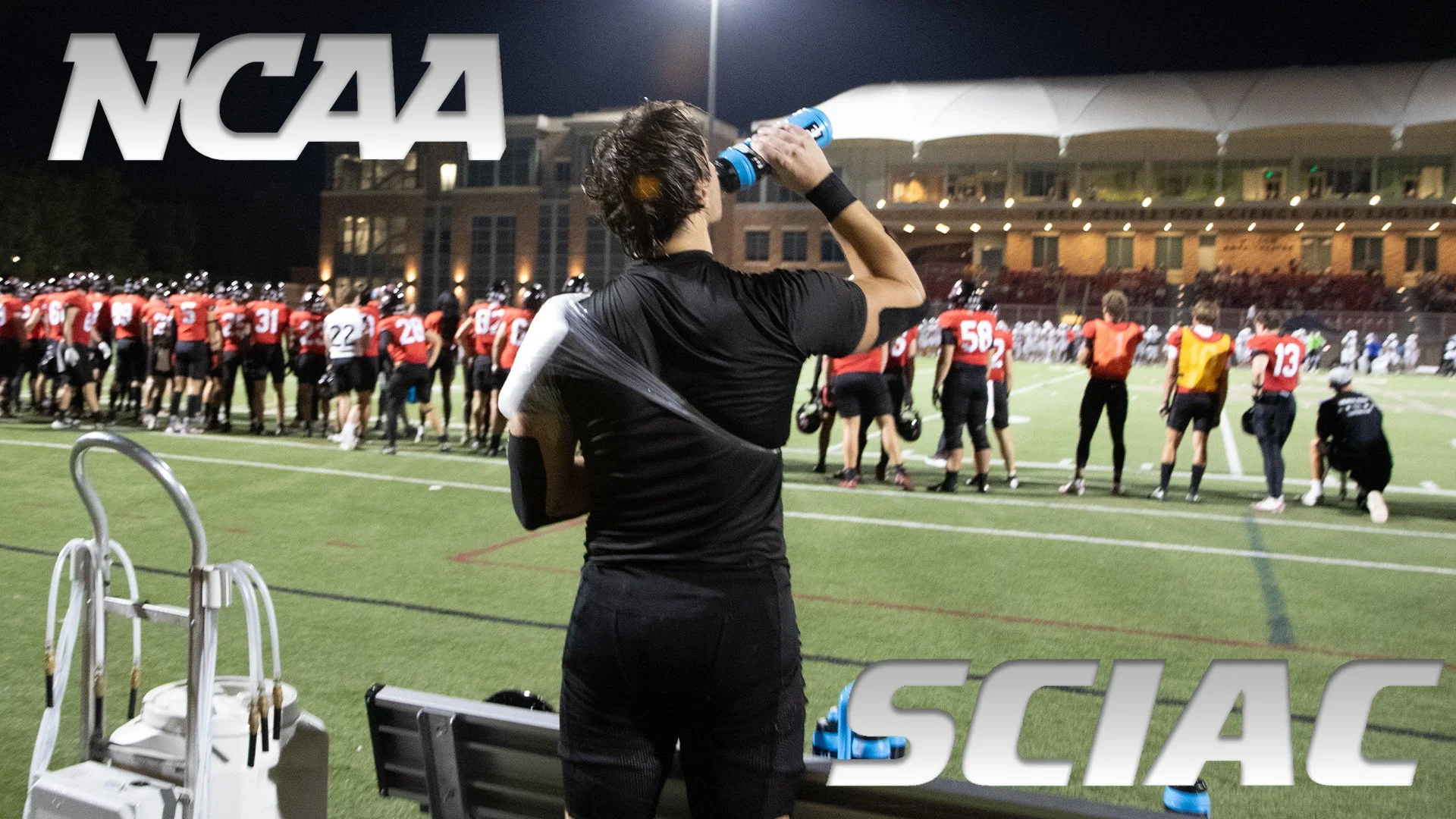
Graphic by Easton Clark, Photo Editor
Let’s be honest: when you think of college sports, a Division III (DIII) program isn’t exactly what comes to mind. It’s the packed stadiums and powerhouse status of a Division I school, right? But there’s a whole world of talent hidden below the surface, and it’s a place where the heart of college athletics beats the hardest.
There is an outdated stigma about DIII athletes — they’re less talented, less committed, and less competitive than their Division I and II counterparts. But where’s the proof? Many have come to this judgment partly based on the absence of athletic scholarships. However, this structure allows student-athletes to focus on their academics while also pursuing the sport they love. As a result, some claim that DIII programs don’t recruit top-tier talent, and that the athletes are lukewarm.
These students are not shooting for the Olympics. They’re aiming to go to school for school, to have a well-rounded college experience that’s just partially consumed by athletics. It’s all about balance.
“At the Division III level, young people are attracted to school based on a good academic environment and a place for them to hone their athletic abilities,” track and field and cross country head coach Tony Veney said.
Yes, scholarships aren’t an incentive in this case, but that goes to show that DIII athletes compete because they love to compete.
“We got guys on the roster who are extremely good football players,” senior business finance major and quarterback Tyler Pacheco said. “It’s all about competition. We obviously love football and we love our team.”
DIII also gives coaches the opportunity to guide athletes down the road to success and develop them into well-seasoned talents. These programs are a goldmine when it comes to finding developmental athletes. To coach a prospect from the ground up is not something you see too often in the higher divisions, and there’s something beautiful in that.
“People on the outside, when they hear DIII, they think we're kind of the NCAA step children of sports,” Veney said.
Veney has experience coaching all levels of cross country and track and field, most notably at Division I schools such as University of California, Los Angeles (UCLA), Portland State University and the University of Oregon. In 2024, Veney joined the Panther cross country and track and field staff as an assistant coach and was promoted to head coach of both programs ahead of the 2025-2026 season. Veney hasn’t just seen all levels of competition; he’s seen every type of athlete.
He says that one of the biggest differences with DIII athletes is that they’re not here to make money; they’re here for the game. You see a different kind of athlete when it comes to balancing athletics and academics. But credit is not given where credit is due, as they both occupy the same level of importance.
To those who don’t follow sports closely, it’s an automatic response to assume that DIII is subpar. That’s because the label “college sports” has become a blanket term that identifies all student-athletes as just athletes —but it’s more than that. This culture is deeply misunderstood, and until people realize that being an athlete is not a one-size-fits-all situation, the stigma will persist. The complexity of athleticism will fall victim to a narrow perception.
“To people that don’t play, it doesn’t make sense,” Pacheco said. “Just being a part of something bigger than yourself is great.”
Here at Chapman, the softball office has a poster hung up titled “Why We Play Division III Athletics.” The first line reads, “It’s not about getting a scholarship, getting drafted or making SportsCenter. It’s a deep need in us that comes from the heart.”
Because at the end of the day, it’s all for the love of the game.