
The silent struggle
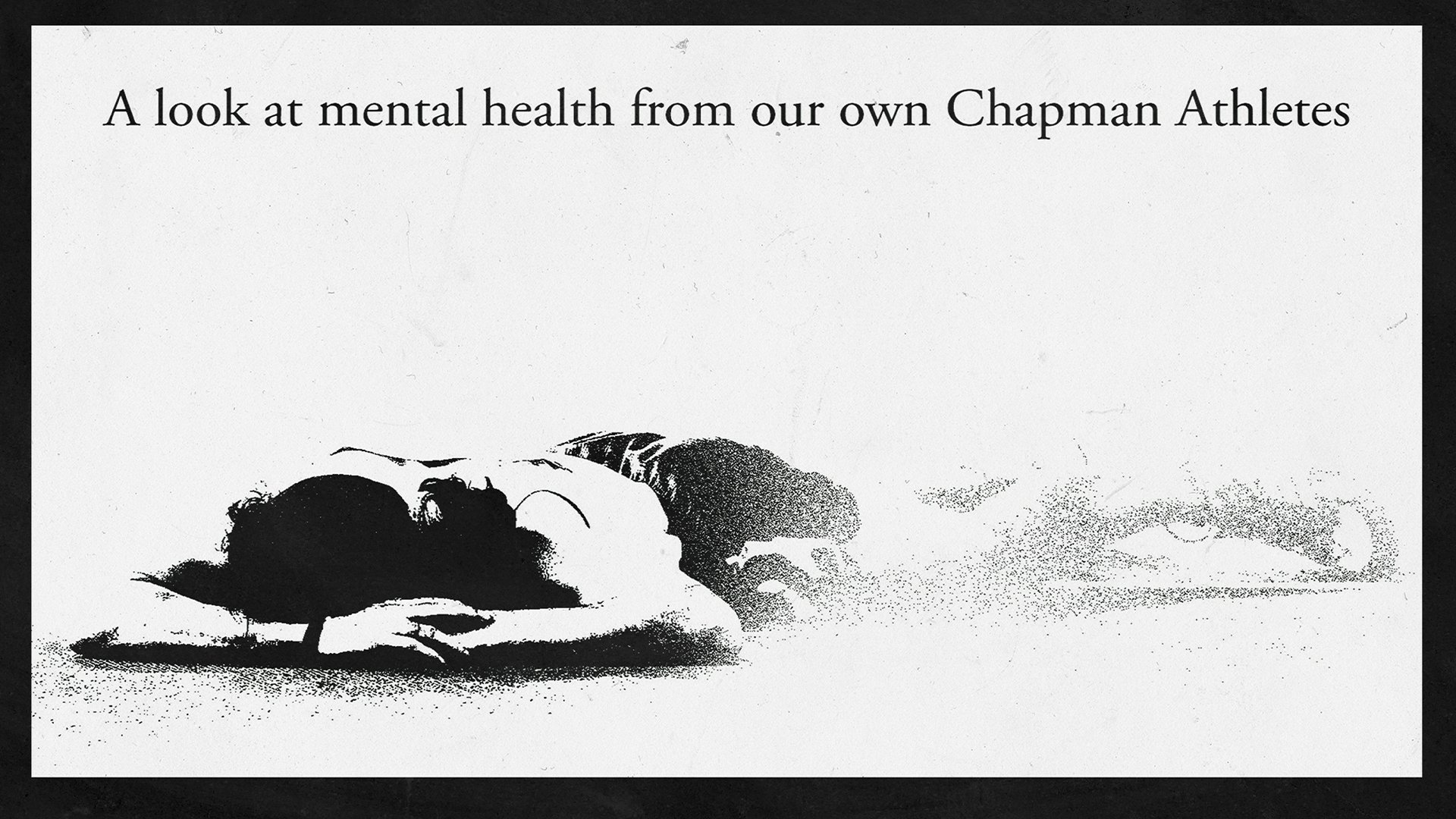
Collage by Easton Clark, Photo Editor
Unlike a cut, bruise, tear or broken bone, mental health battles are an injury nobody can see. Nico Ursino knows that feeling all too well. After being benched in his sophomore football season at Chapman, his world turned upside down.
The saying goes, “when it rains, it pours.” And for Ursino, a communication studies major, that’s exactly what happened.
Going through a breakup, quitting football and looking back on both of those experiences as positive is something he never would’ve seen coming. But after a year of perspective and growth, Ursino is all smiles and looking forward to his senior lacrosse season.
And many other athletes have dealt with struggles. For some, injuries on the field can hurt their mental state off of it.
George Walter has torn his ACL twice in the past three years: First in his junior year of high school, then in his freshman year of college. Having to fight through just one ACL tear is something most athletes never have to do, but two, on the same knee, within three years, is almost unheard of.
Instead of quitting when it would’ve been easy to, when he had every excuse in the world, Walter, a business major, decided to keep fighting for his dream of being a college lacrosse player and making it on the field for his junior year. He was resilient.
But not every athlete is able to bounce back. The debate on athletes' mental health can spark two opposing perspectives. On one side, you get told to tough it out. That athletes don't cry. On the other, there's empathy. You get lifted up through your struggles and not put down.
This was shown in December 2018 on “First Take,” a popular sports debate show, when Max Kellerman, Stephen A. Smith and Tedy Bruschi were discussing talented NFL player Josh Gordon's decision to step away from the Patriots to focus on his mental health.
During the debate, Smith made many insensitive comments about the amount of teams Gordon has played for during his NFL career. Even going as far to say, “I'm disgusted. I'm sick and tired of this guy getting chances.”
Kellerman, on the other hand, took a different approach. Instead of beating down on a man who was obviously struggling, he took the moment to speak to not only Gordon but everyone watching.
“Everyone you meet is fighting a battle you know nothing about, be kind always,” Kellerman said. “Being addicted to drugs does not make you a bad person. It’s a weakness, it needs to be addressed. The struggle goes on — there’s no end to the struggle. This is life. We struggle every day. We just try to struggle better, and he’s trying to struggle better … He’s a superhuman athlete, but he is still a human being.”
It was a sentiment that resonated with many famous sporting figures. Michael Phelps, Naomi Osaka, Simone Biles and Kevin Love are some of the most known examples of athletes opening up about their mental health. Their vulnerability has helped bring awareness to this side of sports that is often overlooked.
Some athletes choose not to talk about it publicly, which is understandable given the personal nature of the topic. But many athletes don’t open up about their struggles with anyone, and it can impact their focus or passion for the game they love.
Whether you’re a professional athlete or just beginning your sports journey, mental health struggles could crop up at any time. It’s important to surround yourself with people that care about you and push you to get uncomfortable and talk about your mental battles.
Pain in the body and the brain
As he waited for the ambulance after tearing his ACL for the second time, Walter was trying to come to terms with what had happened and feared he would be out for his first college lacrosse season. With fall practices wrapping up and the spring season finally starting, this was the worst time to get an injury of such a drastic measure, especially as a freshman fighting for a spot on a new team.
Having just spent nine months healing from his last tear, Walter began questioning his recovery, feeling frustrated that he just spent the better half of the last year trying to get better, only to be reinjured in the exact same way.
“When I got to college and tore it that second time I was like, ‘Well what the hell was all of that recovery for, that obviously meant nothing because I just tore it again.’ So I fell into a crisis where I didn’t know what was going on identity-wise, and I just fell apart for a week or two and didn’t know what to do.”
Walter kept lingering on questions of “why me?” “Why did God pick me to get a second tear?” and “why is it happening again?” — until he got on a call with his trainer Blake Swan back in New Jersey.
Swan gave Walter advice that has stuck with him since. It’s something he tells himself before each practice, game or challenge he may face.
“God gives his strongest battles to his toughest soldiers.”
Now, having faced yet another nine months of recovery, Walter is back out on the field contributing to his team and finally playing the game he loves once again. Having spent 18 of the last 36 months training to be back on the field, Walter has chosen to define his success with a different mark this time around.
“When I came back my sophomore year and I didn’t get a lot of playing time, I just took everything and just was like ‘I’m going to put everything I can into playing in practice every day,’” he said. “I care about winning and I want to win, but I also want to be there with my friends and take each day one at a time … Each practice I make it through is a win.”
For players like Walter, these injuries are just mountains they need to climb in order to get to the next opportunity, challenge or stage in their life. But for many others, consistent injuries are the culprit of many lost careers and abandoned dreams. Walter not only encourages those with injuries to stay positive, but also urges friends and family of those with injuries to be aware of the potential impacts on mental health.
“Lean on your friends, but also surround yourself with friends who will still hangout with you. I think my first time tearing (my ACL) I didn’t have a lot of friends who were there and constantly checking on me,” Walter said.
The hits keep coming
Not all players struggle in the way Walter did. For others, it may not be about injuries or the physical ability of playing a sport. Instead, it may be about the mental journey of playing a sport for so long, and suddenly having that relationship change. That’s what happened to Ursino.
A former linebacker for the Chapman University football team and current two-way midfielder for Chapman's lacrosse program, Ursino is no stranger to playing under the Friday night lights.
Having played flag football since elementary school and beginning tackle in seventh grade, Ursino has had a relationship with football long before his playing days at Chapman.
He described his decision to stop playing football as a long and winding one, beginning in the fall of his sophomore year.
Ursino thought he was going to go into fall camp competing for a starting spot on the team, or at least some good playing time. Freshman transfer Roman Hardin came in and began to put on a show, dazzling the coaches and quickly getting them to fall in love with him.
In the first game of the season, Nico was placed third on the depth chart behind a senior and Hardin. Although the coaches told him he was going to rotate in for some play time, he never saw the field and the Panthers lost.
After that game, the coaches deemed Hardin the starter and Ursino spent the rest of the year trying to show that he was the best option with the limited reps in practice he was getting.
Going into spring, everything collapsed. Ursino said that, while playing lacrosse and going to spring football practices, he felt overwhelmed. He tried to switch positions in football, but missing out on watching game film and making team meetings due to lacrosse made it much more difficult.
And then Ursino took another hit off the field.
“I was just super duper stressed out, the most stressed I’ve ever been. And then in April my long distance girlfriend of two years and I broke up, and that was in the heat of lacrosse season. Like, we were in the playoffs. So, I didn’t really have time to process that breakup because I was so locked in.”
Going into summer Ursino had a lot on his mind. He felt as though he lost a major relationship while at the same time losing the sport he’s been playing competitively since elementary school. It was an identity crisis.
“My whole identity as a person was wrapped up in this relationship and me being a two-sport athlete, it was who I was,” he said. “So, I lost this person that I’m wrapped up in, and now football's not going well and so I’m really wavering in my identity as a human being. It's like, ‘Who am I?’”
With fall football once again on the horizon, Ursino began feeling incredibly anxious for the season to come. Wondering if he was finally going to get the opportunity to compete for a starting job, he went into camp with a positive mindset and attitude.
Quickly he realized nothing had changed, even with Hardin transferring to a different school. The coaches took a player who normally played receiver, switched him to safety and began giving him reps over Ursino.
“I'm basically teaching this kid how to play the position, and he’s above me on the depth chart. So I’m going through camp and it’s still not getting better, but maybe it’ll change when the season comes around and they’ll see I'm the better player.” Ursino said.
Everything came to a head after the first game of his junior year. After getting no playing time, Ursino's parents joined him on the field.
“I just remember after that first game my parents came down on the field and I’m in a horrible mood, just pissed off and I’m in tears on the field crying with my parents. My mom didn't straight up tell me that I should quit but she basically said ‘This isn’t good for you.’”
That week, Ursino made the decision to meet with then head coach Bob Owens to discuss his future with the team.
“I met with (Owens) for like two hours and I told him everything I was going through and how I was feeling and everything, and he gave me a whole spiel about how ‘We love you as a person, we love you on this football team, but you got to make that decision for yourself,’” said Ursino. “And so I made the decision to quit and it was probably the number one best thing I could’ve done.”
Looking back on his journey with football, Ursino wouldn’t do a singular thing differently. When his friends ask him if he regrets it, his answer is always the same.
“I always say ‘Absolutely not,’” he said. “I’ve never once thought about ‘Did I make the wrong decision?’ It was ‘That was the right decision to make.’”
While Ursino was struggling, there were a few things that helped him carry on and really put one foot in front of the other during an incredibly difficult time of his life.
Ursino spent each day making an active decision to focus on the positive aspects of his life, instead of the negative. He focused on his classes and spent as much time with friends as possible.
“There were times I would walk around campus and I would just look around and appreciate where I am right now,” he said. “That's something that I didn’t do the first two years at Chapman, I felt like I had my head down all the time just focused on football practice, lacrosse practice, going to class and was just so busy and all over the place I never took a minute to appreciate where I was.”
The bigger picture
As both Walter and Ursino move forward with sports in their own individual journeys, they’re not blind to the fact that they’re two cases out of thousands of athletes who are all dealing with some assortment of mental hurdles.
“I think the mental game of playing whatever sport you play is the hardest aspect,” Walter said. “You can do anything physical, but there are mental blocks your brain (creates). I think that people struggle with talking about these mental things because they don’t understand how much of it is important, but realistically it changes your whole game.”
Ursino talked about the importance of talking to your coaches and others around you.
“It’s just being open and honest and not thinking you have to be Superman,” Ursino said.
While strides have been made by professional, collegiate and youth programs worldwide, cases like the recent death of 25-year-old Vikings wide receiver Rondale Moore show that mental health in sports is still a prevalent issue today.
From professionals like Phelps and Biles, to athletes here at Chapman, there is a simple message:
Reach out to your family, friends or anyone else who needs it. Those struggling the most might be the ones smiling the widest. It’s important to talk, check in and make sure everyone is heard. Because there may become a time where saying something could be the difference between life or death.