
Chapman’s production of ‘Woyzeck’ is sure to leave you unsettled
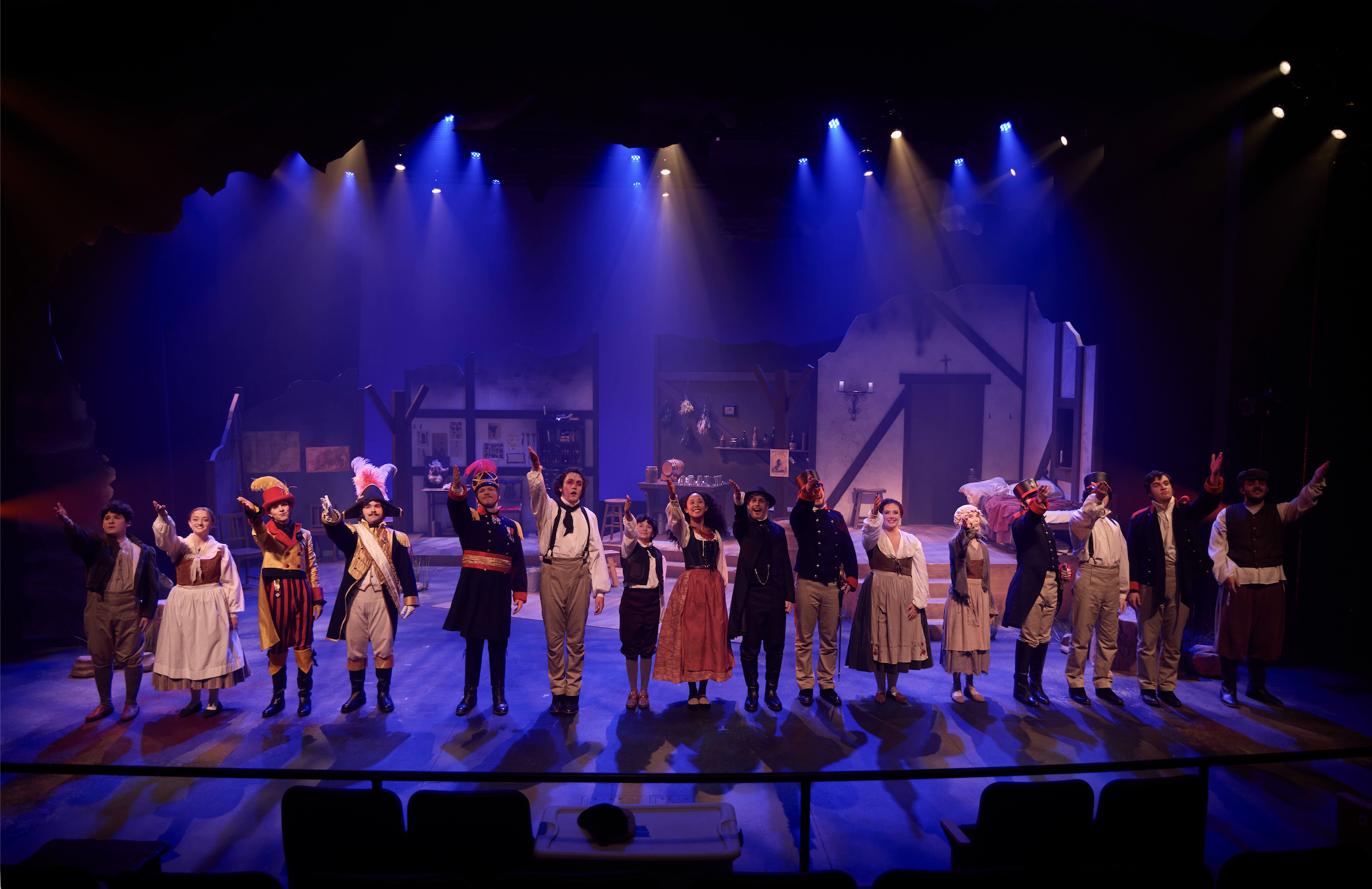
Photo Courtesy of Alissa Roseborough
As the audience entered Waltmar Theatre, Samuel Barber's “Adagio for Strings,” a heartfelt orchestral piece, played overhead as “house music.” Unsuspecting viewers were met with blue-hued lighting and an empty set, dollhouse-like fragments as if they remained still in time.
I knew this wasn’t going to be a typical play. I was about to be transported back to early to mid-19th century Prussia, and there was no going back.
The world of “Woyzeck,” a play by Georg Büchner, dives into soldier Friedrich Johann Franz Woyzeck’s psyche and his spiraling into a corrosive state following “an unchecked medical experiment orchestrated by a quack doctor,” as put in the director’s note.
It’s a play following not just the relationship between Woyzeck and his wife Marie, but the physical strains of power, poverty and psychological affairs that are inflicted on the human body.
The play was done in tandem with all three degree programs: B.A. theatre, B.F.A. theatre performance and B.F.A. screen acting. The production choice was a result of the Department of Theatre’s faculty in consultation with that season’s selection committee.
Director of the play and Department of Theatre chair, Tamiko Washington, balanced Büchner's original intentions with her own artistic vision by focusing on the character's mental fragmentation and fatalism through a creative vision grounded in a heightened realism.
“I challenged the actors to meet the complexity of the overall script and its characters with a deep love of the craft of acting and a trust in their immense talent and abilities,” said Washington. “They met the challenge with great professionalism, dedication and artistry.”
The atmosphere of the story was brought to life and was equally enthralling as the acting performances themselves. The costuming, lighting, scenic design and sound design transitioned the audience into the play’s universe seamlessly.
The audience is invited to sit in on the chaos, examining Woyzeck’s paranoid sense of self and his physical agonies as he moves through his interactions with those around him. Portrayed through auditory and visual hallucinations, Woyzeck (played by senior theatre performance major Landon Smith), is a visceral permanence in the result of neglect.
The set was broken into mini scene constructions: a captain’s office, a doctor’s laboratory, a pub and Woyzeck’s home where he returns to his wife, Marie, and their child. It’s a disjointed reality mirroring Woyzeck’s unraveling mind.
Marie is characterized by her flaws, a young mother living in a world with limited choices, but is also a symbolic reminder of the need for stability in disarray.
“I feel like she is not a villain,” said Maya Chizer, senior theatre performance major and actor for Marie. “I see her as a reflection of how women are often judged for their choices without thinking of the conditions shaping them.”.
In preparation for the role, Chizer did a lot of grounding work, such as meditation, to step into Marie’s headspace, also integrating voice work. She worked on the softness that didn’t serve Marie, stripping away anything unnecessary that molded into her character’s maturity.
With a character as nuanced as Marie, Chizer felt that almost every scene was a challenge.
“There isn’t a traditional arc to lean on. I had to build her through small decisions and bold decisions,” said Chizer. “The scenes with the Drum Major were particularly challenging because they require grit and agency rather than flirtation. I had to really examine why she makes the choices she does and make sure they felt conscious rather than impulsive.”
Washington helped guide the actors in approaching the intense material in the play through detailed script analysis, building believable characters and their relationships and conducting research.
“The play examines power without accountability, and Marie becomes one of the people caught up in that,” said Chizer.
“No guile exists in his mouth” is Chizer’s favorite line from the play. To her, it conveys a turning point for Marie. She recognizes purity in someone else while knowing her own faults are far from pure.
Washington said that the actors learned tackling dramatic plays with difficult subject matter is within their reach and capacity, as well as performing such texts with great depth of emotion.
At the end of the play is when the audience can play an omniscient part, where they see Woyzeck hide the knife to plan the murder of his wife, Marie. When the time comes, we can only yelp out in our heads to warn Marie of her tragic feat that is about to commence.
At that moment, Chizer hopes the audience can be left with empathy. Marie is flawed, but she’s also deeply human.
“Woyzeck’s descent is not sudden; it’s a gradual process, shaped by forces who have more power than him,” said Chizer. “The play brings to light this idea that communities fail to recognize suffering until it’s too late. And that feels incredibly contemporary.”