
‘KIN’ reimagines portraits through the eyes of the artists
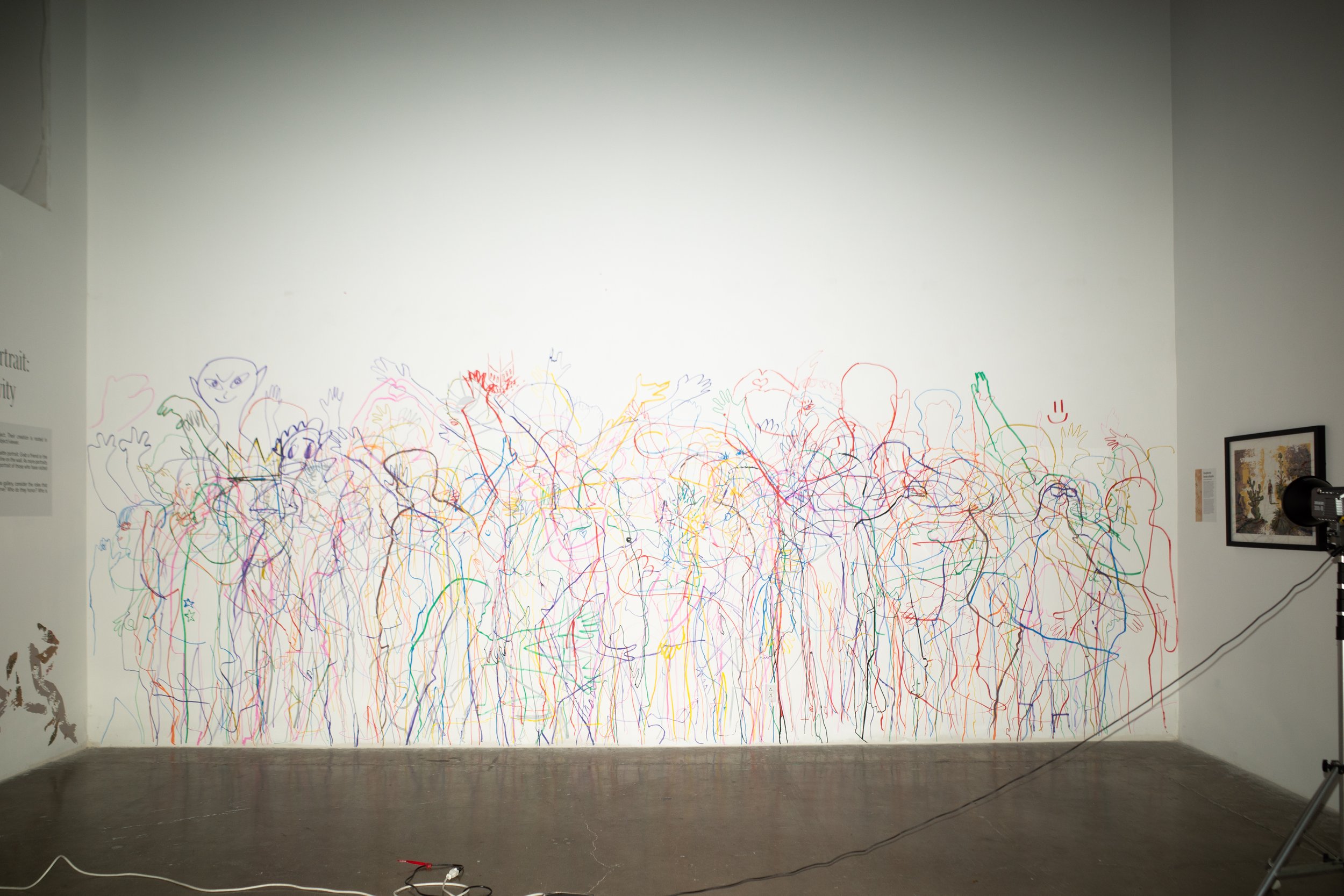
Photo by Easton Clark, Photo Editor
When you think of portraits, you may think of historical figures or world leaders. Yet, at Guggenheim Gallery’s “KIN: Portraits from the Escalette Permanent Art Collection,” the portraits look more like donut boxes, tree branches and bologna.
This year’s spring exhibition pulls together portraits from Chapman’s Escalette Permanent Art Collection, a “museum without walls” that usually lives in hallways and classrooms across campus.
For “KIN,” the Escalette staff, Guggenheim Gallery staff and student Art Ambassadors collaborated to curate three sections that frame portraiture as a “site of relationship, belonging and interdependence,” according to the Escalette staff.
Jo Martinez, a senior communication studies major, is Escallette's student graphic designer. She assisted in co-curating the exhibit and its design.
“(The) portraits are more than what they appear to be,” said Martinez. “We want to evoke a sense of connection, if not intrigue, into the meanings and representations these different pieces aim to convey.”
Martinez’s role of designing the layout of the exhibit was her favorite.
“Once it was decided that Shizu Saldamando’s portrait of Carolina Caycedo would be the centerpiece for the exhibit, we began to work on ‘KIN’’s visual identity,” Martinez said.
Shizu Saldamando is a visual artist working in Los Angeles, and typically creates portraits that express stories of identity, culture and social stereotypes.
Martinez helped design, print and hang a tree branch design across the walls of the exhibit, inspired by Saldamando’s centerpiece. She also worked on the exhibit labels, banners, flyers, stickers and other materials for the branding of “KIN” across campus.
“This show was a wonderful opportunity to raise awareness of the collection — highlighting its variety of media, subject matter and featured artists,” said Martinez.
Every section of this exhibit allows space to resonate with those who view it. Jessica Bocinski, the collections manager for the Escalette Collection, assists in coordinating exhibits such as “KIN.”
“Almost every building on campus has pieces from the (Escalette) collection,” said Bocinski. “We work a lot with students in classes to help curate the spaces and a lot of these pieces here will be displayed on campus afterwards.”
Mis/placement: Portraits as Resilience
This first section is curated by the Escalette Student Art Ambassadors, exploring expression of artists’ experiences with immigration and assimilation in the United States. Phung Huynh’s “Michelle Sou Donut Box” piece symbolizes “where first and second generation immigrants found their home in the U.S.,” according to the staff.
“Ninety percent of California’s donut shops are run by Cambodian immigrants and/or Cambodian Americans, yet their story is largely unrecognized,” according to Huynh.
Huynh designed this detailed portrait, printed on a pink bakery box, turning the art piece into a cultural memory.
Another piece, “Bologna” by Lorena Ochoa, transforms a nostalgic sandwich into a portrait of immigration and conformity.
This portrait is printed on an actual slice of bologna. It “compares bologna to ‘flesh,’ whereas the cut through the center reads as a wound,” said Ochoa.
Proof: Portraits as Testimony
Curated by Guggenheim Gallery Staff, this section dives into self representation. These pieces are meant to lead towards reflection on how we portray people, and how those portrayals have come to be.
One of the pieces is Lorena Ochoa’s “Autorretrato Retraction,” which “stages the body as both image and target,” according to staff.
This portrait is of a figure that is wrapped like a piñata hanging above the floor. The piñata “uses logic to point to the ways celebration can mask extraction,” said Ochoa.
Entanglements: Portraits as Branches
Lastly, curated by the Escallette Collection Staff, this section embodies the entirety of the exhibit. This is where people and nature intertwine, where artists “remind us that portraits of nature are portraits of ourselves,” according to the staff. It creates a relationship with nature and community by expressing the environment as more than just a view.
The centerpiece, “Portrait of Artist Carolina Caycedo” by Shizu Saldamando, exemplifies a recognition of kinship with nature.
The portrait is a combination of oil, glitter, paint and other materials, all on a wood panel.
“Environments like rivers and bodies of water are like me. They’re political subjects with the agency to change the course of events,” said Caycedo.
Through student-driven design and curation, the show centers on inclusion and recognition.
Martinez’s favorite piece was Huynh’s “Michelle Sou Donut Box.” This piece resonated with her most through personal experiences of “embarking on this journey to self-discovery, community and reclamation.”
All those who helped curate and design this exhibition are what makes “KIN” resonate with those beyond the Guggenheim Gallery walls. Whether it is a donut box exemplifying immigrant stories, or tree branches creating a relationship between nature and human, this exhibit asks us to recognize the deeper meaning in our own lives in the art we pass every day.
“KIN: Portraits from the Escalette Permanent Art Collection” is on display in the Guggenheim Gallery now through March 19. Many of the works will later reappear across campus as part of the Escalette’s “museum without walls,” carrying these important themes and conversations into everyday student life.