
‘You’ve got a friend in me’: The Statewide Arts Initiative fosters hope for arts education
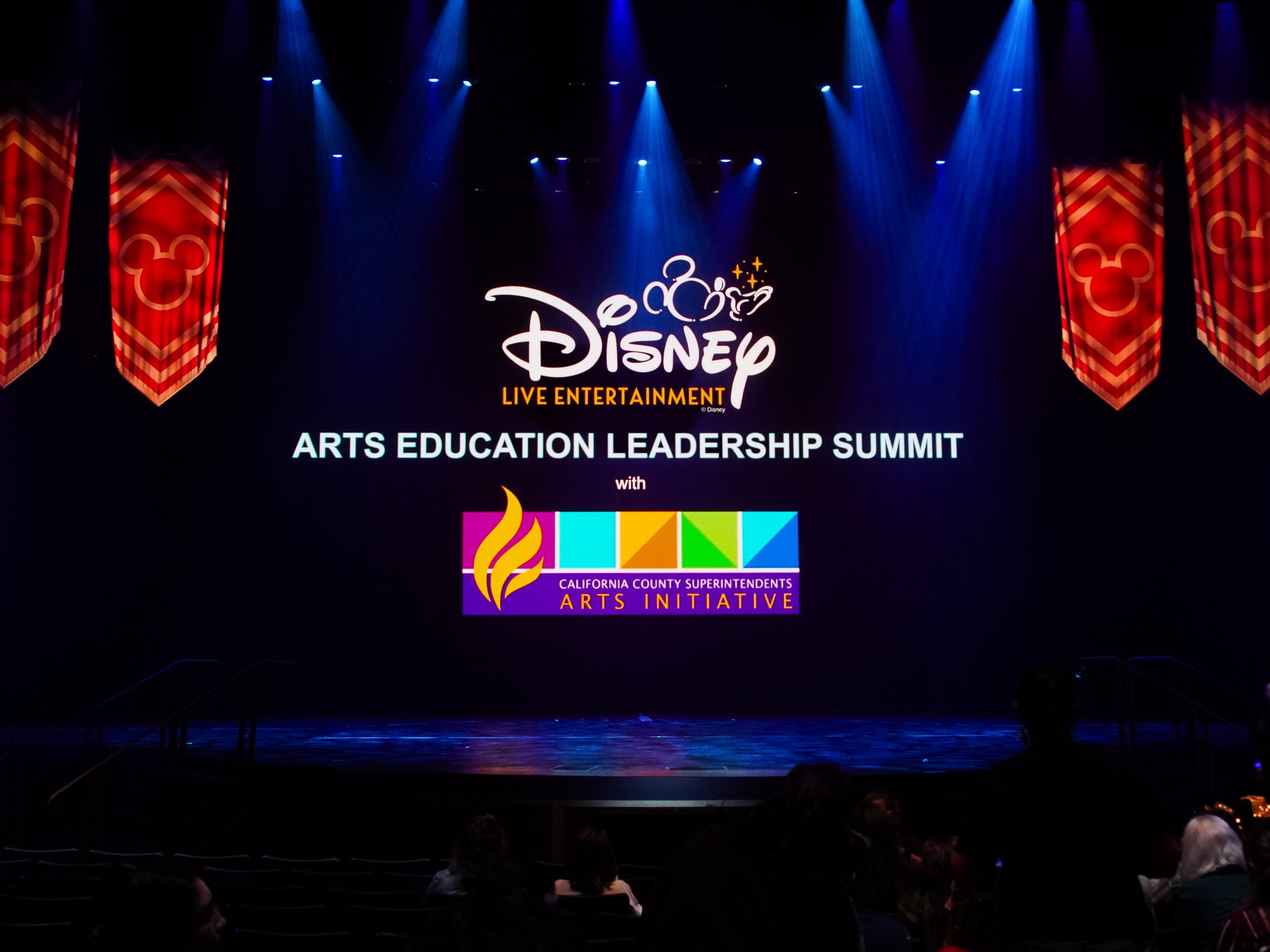
Photo Courtesy of Kaveh Ghaemi
With Disneyland’s Animation Academy, Hyperion Theater and other spaces of the park acting as conference rooms, district administrators and education leaders came together for sessions on how to design meaningful arts experiences that reach every student.
In a collaboration between Disney Live Entertainment and The California County Statewide Arts Initiative, creativity in education as an important foundation was discussed and embraced between diverse forums.
On April 23 and 24, the Arts Education Summit brought together educators, district leaders and site principals at the Disneyland Resort in Anaheim for an inaugural and immersive on-the-ground conference of workshops, keynote presentations, facilitated discussions and case studies.
Disney Live Entertainment of Walt Disney Imagineering pushes the boundaries of live entertainment through theatrical production and technology. Championing creative production for global audiences, the organization brings together the minds of artists, technicians and storytellers who once emerged from arts education programs themselves.
The California County Statewide Arts Initiative’s leadership and network offers statewide support and equitable infrastructures to 58 county offices by elevating the work they’re doing in the arts. The initiative sets the foundation for future creatives by building supportive systems that ensure every student has access to arts learning.
These joined forces shared skills and resources with one another so that they could return to their communities as stronger leaders of arts education, regardless of the starting point that everybody was coming from.
Tied to Proposition 28, the Arts and Music in Schools Funding Guarantee and Accountability Act — which provides annual funding in California public schools — administrators were able to discuss the navigation of creating arts plans aligned to district goals with funding application.
“It's this billion-dollar allocation every year for supplemental arts education, and it's really exciting,” said Kyle Holmes, director of the California Superintendents Stateswide Arts Initiative. “It is not just opening doors and giving us the opportunity to hire new arts teachers, but it's also engaging people in these conversations about the arts that maybe weren't a part of them before.”
According to Holmes, every school has different constraints to address in using Proposition 28 funding. However, the positive remains at the forefront; the conversation has now shifted from how they can get more money for the arts to how they can achieve equitable arts learning for kids through the proposition.
As a former theatre teacher, Holmes felt the transformative impact of the arts from an early age. From his first period theatre class in freshman year of high school, it quickly became an oasis in countering his anxiety.
It was after teaching theatre for 10 years when Holmes had an opportunity in 2019 to be on the committee that helped rewrite the visual and performing arts standards for California.
“I got to go to the California Department of Education (CDE) two days a month and meet with other theatre teachers and music teachers and go through this process of, ‘What's important for our kids to learn and how do we want to write that?’ We went through all of it with a fine-tooth comb,” said Holmes.
In helping create the Arts Education Leadership Summit with Disney Live Entertainment, Jeff Hall, who was also a theatre teacher, believes they share a dream big, execution-based approach.
As many administrators in education were not arts teachers, the two wanted to have folks leaving feeling more confident about the arts when at times they can feel a little chaotic — especially for administrators that didn't teach them or didn't spend as much time with them, according to Holmes.
“He had said, ‘Well, what if we use Disneyland as one of the big appeals of that professional development opportunity?’” Holmes said. “Disney has a huge commitment to the arts and education, and education in the arts, so it just kind of made sense.”
With Proposition 28 and its abundant funding brings critical hiring shortages — and no one to fill the arts positions.
“I would hope that college kids knew and kept in mind that there are high paying jobs that are waiting for people — qualified, trained people — to come and fill them,” said Holmes. “If you graduate with your undergraduate degree, and you think that you want to be a theatre, a dance, a visual art or a music teacher, you can go get your credential in a year, and right now there are tons, and I mean thousands, of unfilled, high-paying jobs for these people. The money is there, but we can't fill it.”
In discussions on how to address this issue, Holmes notes that there are paths for young aspiring creative leaders to teach in the arts that used to not exist before.
“If that's not where your heart is calling you, but you still love some of these things, it's contributing to community organizations,” said Holmes. “There are schools that are hiring after-school teaching artists that want to come in. We have a tremendous hiring shortage right now in California, especially special education, not just the arts, and these are really good careers that we would love to have passionate people step into.”
The work that the California Arts Initiative county offices are doing has a different approach at every office of education, but these leaders are redefining curiosity as invention in a time as crucial as now. They are helping train the future arts leaders and educators of tomorrow in the classroom so large-scale creative projects such as Disney Live Entertainment are designed and sustained over time.
“We have education leaders that are just being so innovative in how they can create equitable access for every student to have the arts in their life,” said Holmes. “And those are the same people that were running these workshops at Disneyland, and they're doing amazing things.”