
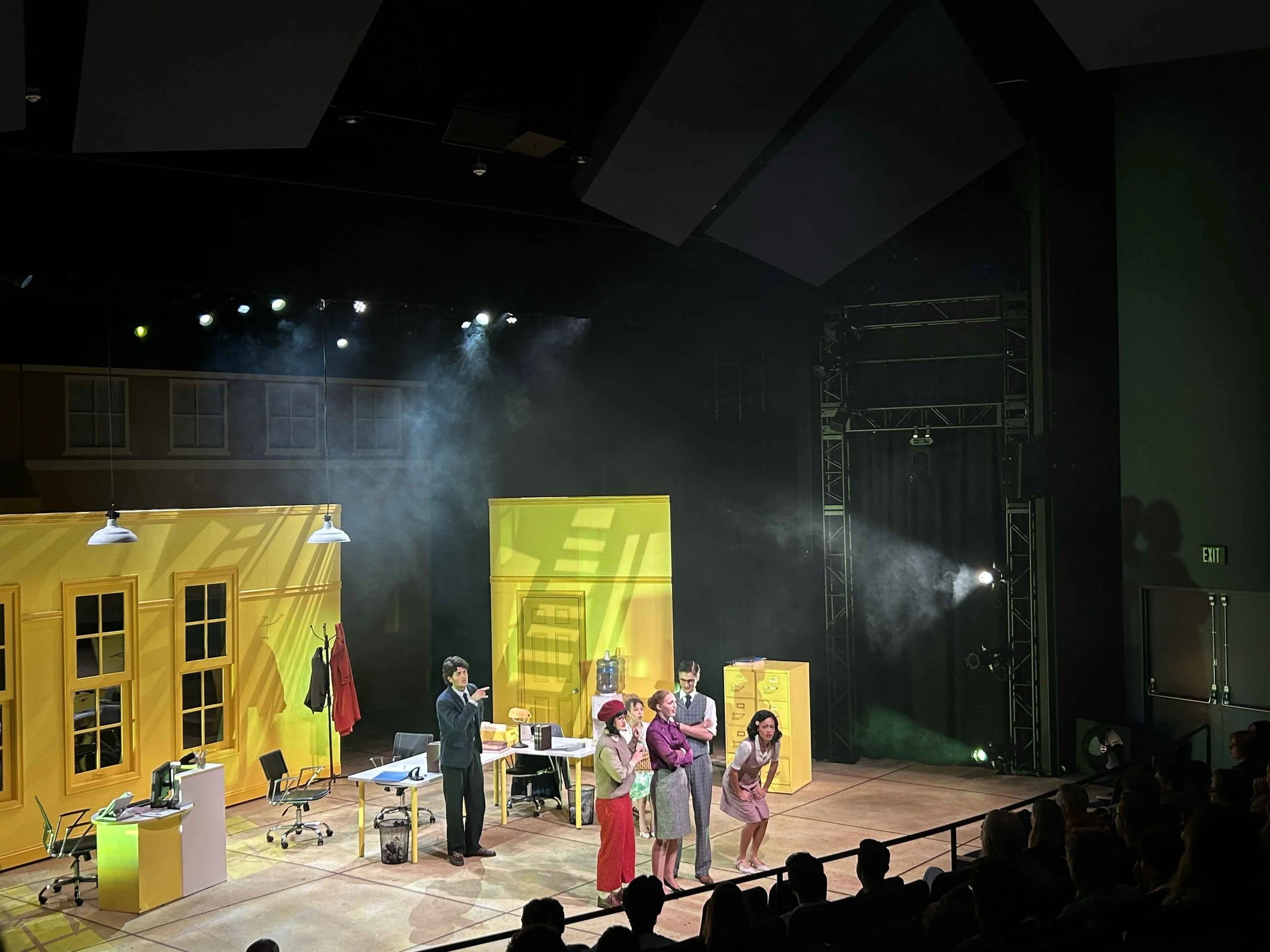
Photo by Bella Balmaceda.
Everyone wants to belong. But what if belonging comes at the expense of staying human?
In Chapman’s College of Performing Arts (CoPA) rendition of French absurdist playwright Eugène Ionesco’s “Rhinoceros,” joining the herd means giving up your humanity. Literally.
The Department of Theatre presented “Rhinoceros” in Waltmar Theatre, exploring how the pressure to conform can mean losing what makes you, you. Hosting this adaptation of the play on campus brings conversation to its messaging’s relevance today.
The play begins with an ordinary Sunday: Two friends meeting at a local cafe chatting casually about self improvement. Their conversation is then interrupted by a rhinoceros running across town.
The unusual becomes the usual. One by one, the characters decide themselves to transform into rhinoceroses, one follower after another.
As the herd grows, choosing to stay a human becomes the unordinary. What does it take to resist when everyone else is giving in?
One of the characters from the play, Ms. Botard, initially dismisses the stories over the herding rhinoceroses, needing evidence over assumptions to believe it. Yet, once she sees the herd with her own eyes, she takes part too.
Senior theatre and performance major Catherine Healy performed in the play as Ms. Botard. Healy interpreted her character’s initial disbelief as a commitment to facts. Her character questions whether reports of the rhinoceroses can be trusted or whether someone is manipulating public opinion.
“I think it's kind of a reference to propaganda in a way,” said Healy.
She connected that distrust to the flow of information on social media today and how quick users are to believe a claim seen online without fact checking whether it is really true.
Finding connections between the play and real life made the role even more meaningful to Healy.
“I was reflecting back to when I was applying to Chapman and I always wanted to be able to use theater and film for change,” said Healy. “This is the first time that I've really felt like I was doing what I set out to do.”
Although Eugène Ionesco’s “Rhinoceros” takes place in the late 1950s, the play explores issues that remain politically relevant today. From economy in the workplace to prejudice in character reactions, and to the rhinoceroses, the three-act play exhibits important themes to bring to light.
“This is important to do at college because there are so many people at this school that are in such an impressionable time in their life and making their own opinions,” said Healy.
For Healy, that makes campus’ production an opportunity to bring conversations about the wider world into students’ lives.
“It's important to expose them to different types of theater, media and culture that are relevant to the world to open up a lot of conversations that are really important to have,” Healy said.
That interest in theatre as a space for conversation reached the audience, too. Wren Dudney, a student at University of Southern California, came to Chapman’s showing of “Rhinoceros” to support a cast member.
“I think it's sick and I think this is exactly what you should be doing in theater,” said Dudney. “They should be doing stuff that speaks to political and social issues.”
Theatre production has the capability to have a purpose that extends beyond the final act.
“I think good artistry leaves you talking about it,” said Healy. “People are putting on plays for social change everywhere and I don't think that we should be limited to not putting those on.”