
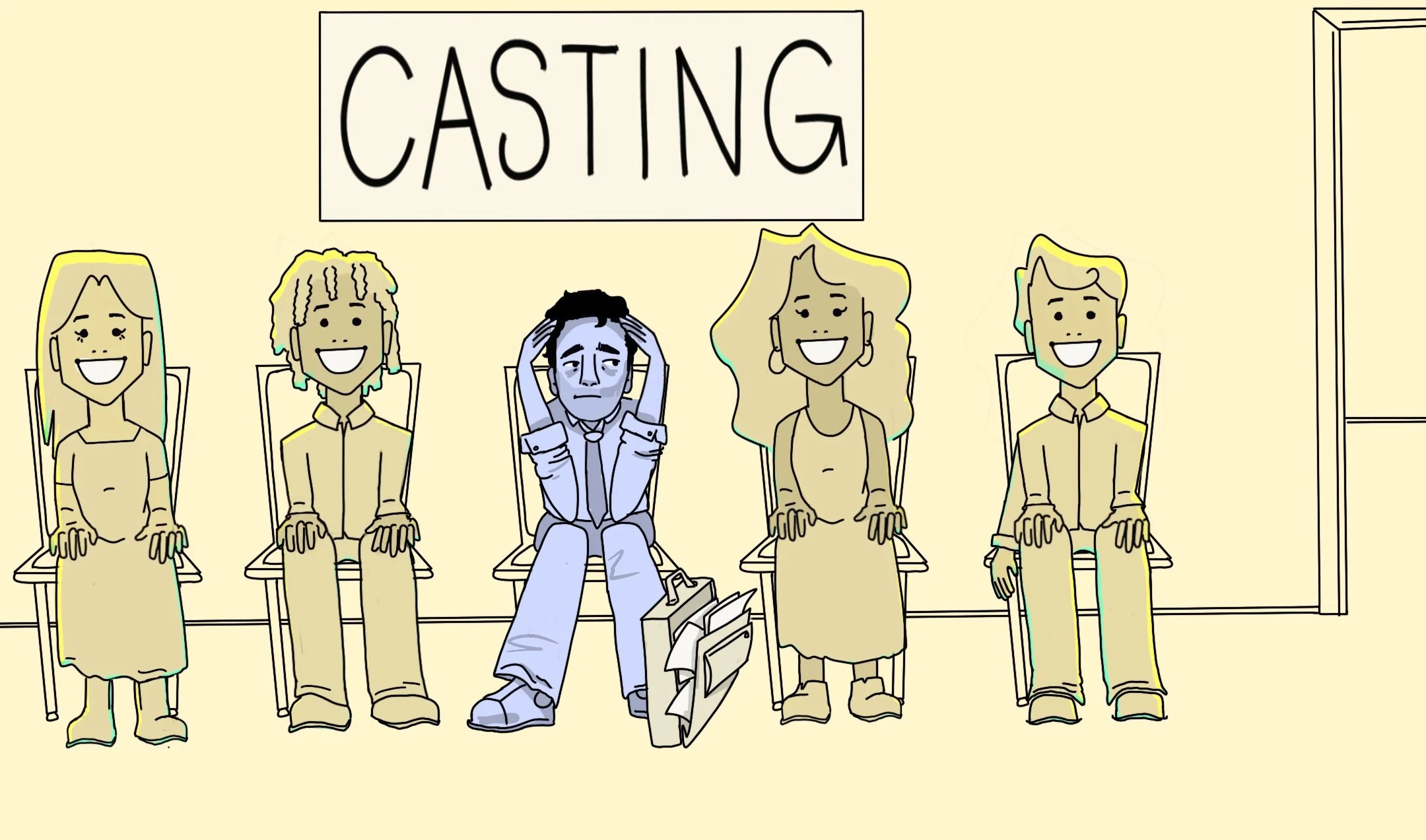
Illustration by Zoe Arntsen, Illustrator
When Adrian Brody was awarded the Academy Award for Best Actor, it wasn’t just his performance that got people talking, but the use of AI to help him fine-tune his accent when speaking Hungarian. Although the use seemed minor, some people said that it detracted from the art of being an actor and gave him an unfair advantage. However, his use of AI did not replace anyone's job; instead, it enhanced the viewer experience.
The scariest part about pursuing a creative passion and turning it into a career is the uncertainties that come with it. Recently, the biggest obstacle has been the rapid and aggressive advancements in AI.
In more fact-based industries like law, AI can easily replace paralegals by handling research, but it can’t replace the people who stand and argue cases in court. However, in creative industries — more specifically film — it's not so black and white. The debate over whether AI will be the future of the film industry remains unresolved.
Just two years ago, actors and writers shut down Hollywood with protests to demand protection from AI, but it is still slowly and surely making its way into the industry. Two Oscar nominees (“Emilia Perez and “The Brutalist”) shared that they employed AI to alter voices in the making of their films. Some of the biggest stars in Hollywood, like Tom Hanks and Harrison Ford, are using it to digitally de-age. While AI has advanced quickly, the film industry has not yet reached the point of using it to displace human workers.
“Although I worry about the use of AI in most workplaces, I feel that the creativity that screenwriting requires protects the art form from the threat of AI,” said Chloe Avant, a senior writing for film and television major.
Creativity that audiences love is deeply rooted in the human experience. So, the question is, if AI is not taking away anyone's job, is it acceptable? Or does that then compromise the authenticity of talent?
We even see the big names in Hollywood shut down AI ideas due to the risk of bad publicity and copyright issues. The Walt Disney Company planned to use deepfakes of Dwayne “The Rock” Johnson in the remake of “Moana,” allowing Johnson to have fewer time commitments when making the film. However, they couldn't guarantee full ownership of the copyright for the AI-created sections of the film. Additionally, Disney’s new “Tron: Ares,” a film about the rapid progression of AI, was actually going to utilize AI in its creation, but they did not want to risk the backlash it could’ve received.
Particle 6, a production company that has shown more courage recently, has created the industry’s newest controversy, named Tilly Norwood. The actress came out saying she was looking for a Hollywood agent, just like thousands of actors do; the difference is that Norwood is an AI actor created by a company that calls itself the first-ever artificial intelligence talent studio. Guilds, filmmakers and especially actors have not responded positively to the AI product.
“I think Tilly’s ‘career’ ended as soon as it started. AI’s role in film can be revolutionary if used right, but I don’t think it will ever replicate a real person’s authenticity,” said Birva Pandya, a junior creative producing major and an ACTRA (Alliance of Canadian Cinema, Television and Radio Artists) actor, recently seen in “The Institute” and appearing next in “The Testaments.”
Norwood received so much backlash that the Screen Actors Guild released this statement: “Creativity is, and should remain, human-centered … It has no life experience to draw from, no emotion and, from what we’ve seen, audiences aren’t interested in watching computer-generated content untethered from the human experience.”
The response created a positive response among the industry’s youth, as the statement set a clear precedent that there is still no space in the industry where AI usage to that degree is welcome.
“The response from the Screen Actors Guild to Tilly Norwood restored my confidence in the industry's stance on keeping creative fields creative and run by human creators,” said Avant.
The film industry is always evolving, and it is currently in a very vulnerable place. Times are changing when it comes to what people want to see on-screen, and creators are at a point of confusion on where they stand as the industry evolves. Furthermore, the threat of AI also contributes to the uncertainty surrounding the industry's future direction.
The question remains: Where do we draw the line? One shortcut leads to another, and there are talented and passionate young people who will lose the jobs they have spent their lives working for. As creatives, do we stand against change or embrace it in hopes of being successful?