
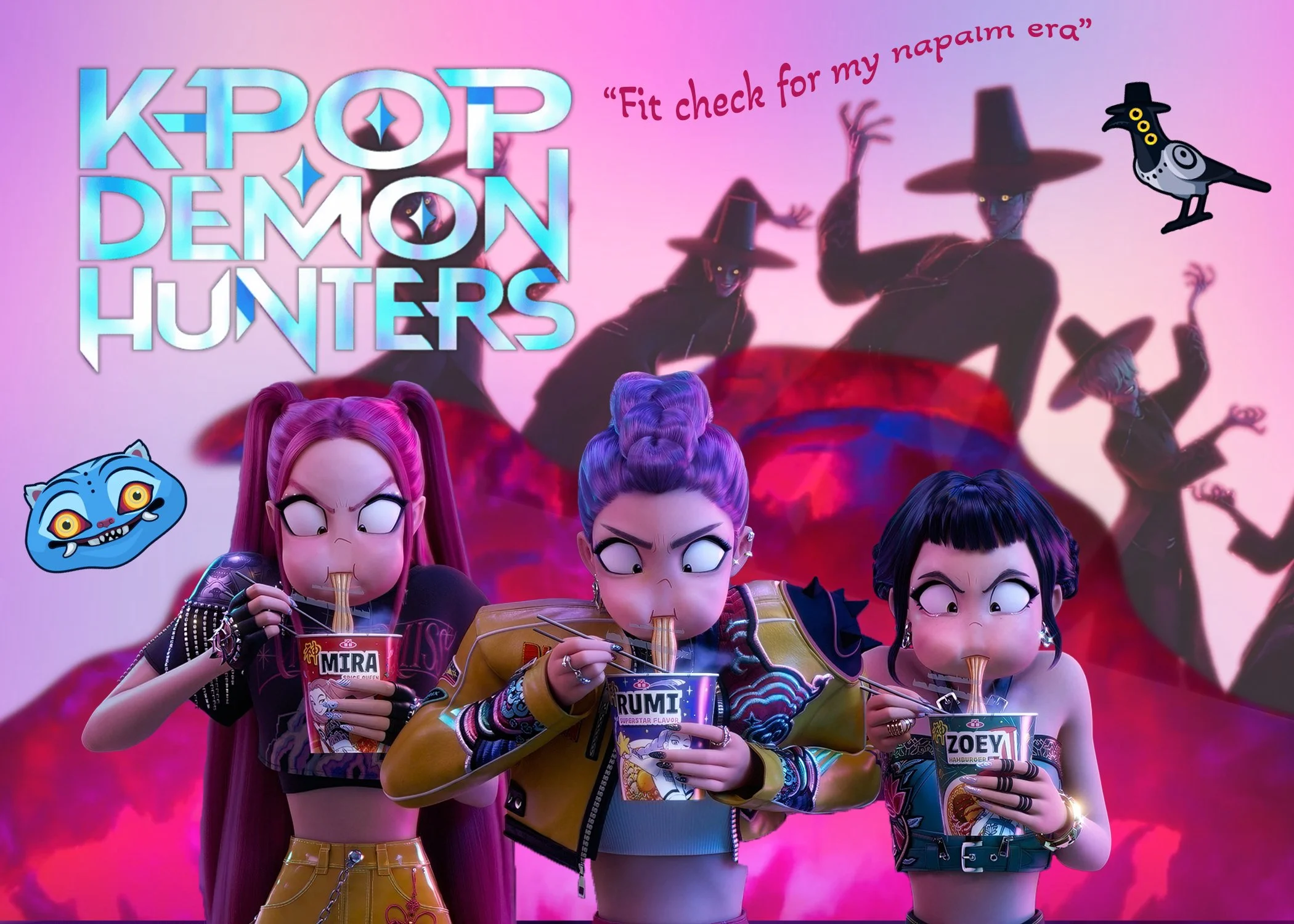
Collage by Samantha Rosinski, Staff Photographer
Netflix and Sony have an unprecedented hit on their hands, and in an era defined by profitable remakes, sequels and reboots, it’s an original K-pop animated musical with its fair share of demons and original songs.
“KPop Demon Hunters” had little lead-up to its release, but in the weeks and months following its debut on Netflix in late June, the film has only grown in popularity. In mid-August, it surpassed the previous record holder, “Red Notice,” to become Netflix’s most-watched film in the platform’s history. With discussions of sequels, a spin-off series, and a concert adaptation, the “KPop Demon Hunters” phenomenon looks like it’s here to stay.
“Every gender, race, age (group), they're all talking about it,” said music professor Beverly Min.
Min is currently teaching a first-year foundations (FFC) course titled “Hallyu Rising,” also referred to as the Korean Wave. The class covers South Korea’s increasing cultural influence, and Min dedicated an entire class block to discussing the film.
South Korean pop culture has exploded in the international zeitgeist over the last two decades, and “K-Pop Demon Hunters” reflects a new type of blockbuster built on streaming’s global reach and the opportunity to draw the attention of an ever-expanding fanbase.
When I first heard about “KPop Demon Hunters,” I thought it was a joke. Over the summer, I worked as an intern at my local theater camp for elementary school-aged kids. The film’s title alone made it sound like the kind of bizarre concept the kids would create for their skits shown to parents at the end of the week.
But what started out as a few kids referencing the film spread like wildfire, and by the end of the summer, every camper knew the entire dance to “Soda Pop,” one of the film’s most popular tunes. They would repeatedly ask me to play the soundtrack on loop for the full eight-hour days, which I obliged to, at times begrudgingly.
“I think ‘KPop Demon Hunters’ (and K-pop groups like BTS are) comforting the younger generation with their songs,” said Associate Professor of Film and Media Studies Nam Lee. “We all live in uncertain times. So I think the themes of loving yourself and being open to others that (are) promoted through this content (are) resonating with global audiences, especially young audiences.”
Some of my campers had even seen the film upwards of twelve times. Many proudly displayed HUNTR/X merch, the band from the film, and used the film to influence their short plays. We would spend hours discussing the animation, fan theories and the music. “I like the one with abs,” said a camper enthusiastically, referencing a member of one of the film’s fictional bands, Saja Boys.
Spending all my time with nine-year-olds, it felt like an isolated vacuum of popularity. But as I returned to college and began interacting with people my age again, I was shocked to find the same adoration for all things “KPop Demon Hunters.”
“It feels like in 2013 when ‘Frozen’ came out,” said junior creative producing major Kathleen Canham. “That was my shit. That was my ‘KPop Demon Hunters.’ It's so rewatchable because it's accessible. It's on Netflix, so you can just keep easily pressing play.”
It feels as though the film’s popularity is inescapable. When I was out to eat at Olive Garden one night, I walked past a kid, no older than six or seven, watching “KPop Demon Hunters” at full volume on their iPad in the middle of a family dinner, presumably not for the first time.
Streaming uniquely platforms movies like “KPop Demon Hunters” for this culture of rabid, rapid rewatchability, but it’s perhaps that fan base that has enabled the film to now approach its eleventh consecutive week in Netflix’s top 10.
“It might be the streaming that actually made it easier for people to just watch from home, but a lot of Netflix shows don't get recognized at all," said animation Professor Mariam Hamed, who has also worked in the animation industry on projects such as “Encanto” and “Puss in Boots: The Last Wish.”
Referring to whether a full theatrical release could have impacted the popularity of “KPop Demon Hunters,” she said that the platform probably didn’t matter.
“I don't think it's the streaming that makes a movie successful,” Hamed said. “I think it's the content and the audience that receives it as either bad or good.”
In a rare move, though it only received a limited release, Netflix broke its all-streaming model of distribution for a one-weekend-only release of the film’s “sing-along” edition. The release consistently sold out and — despite not being picked up by the largest theater chain, AMC Theaters — “KPop Demon Hunters” topped the box office during its lone weekend in theaters. On Aug. 23 and 24, the film played to 1,700 theaters, grossing an estimated total of $18 million in just two days.
“KPop Demon Hunters” joins a recent trend of wide theatrical releases capitalizing on the promise of a collective spectacle, courtesy of trends on social media. Between the sing-along release of “Wicked” and audiences yelling “chicken jockey” during “A Minecraft Movie,” there seems to be a demand for movie theaters to become the site of genuine social phenomena.
Canham described her eager anticipation for the sing-along screening in a similar vein to a live concert experience, even noting that her friend got tickets to their screening as soon as they went on sale.
“People were super into it, and even if they weren't singing, you could tell that everybody was a big fan,” said Canham. “When I was going to the bathroom after, I saw a family with HUNTR/X t-shirts on and they were all singing it and I was like, ‘Oh, there's a real community there.’”
As the film’s concert-esque weekend in theaters exemplified two months of a build in popularity, the soundtrack’s success on music charts only affirmed this overwhelming response. In mid-August, the “KPop Demon Hunters” album became the first film soundtrack to ever have four hits on Billboard’s Top 10 simultaneously. Along with consistent engagement on Spotify’s charts, the music for the film has played an undeniable role in its success. The songs were largely composed by TWICE, a K-pop girl group with a considerable fan base.
“(Netflix) basically spent almost zero money on the advertisements, which is crazy because the fans are the people who actually did the job for them,” said Hamed. “(K-pop fans) are really highly active online. So it's younger generations in general on TikTok who would do the reviews, and it's going to be a viral thing and everyone will want to watch it.”
Min described how modern K-pop took shape in the 1990s with bands like Seo Taiji and Boys. Since then, the genre has rapidly evolved into a global phenomenon, reaching beyond the language barrier with other popular artists such as BTS and BLACKPINK selling out concerts on world tours.
K-pop made substantial splashes in the North American market with PSY’s “Gangnam Style.” The music video became the first video on YouTube to cross one billion views, redefining what popularity for music looked like in the 2010s. Today, it feels as though the film’s consistently record-breaking numbers are making similar shifts to how we define popularity in a digital world where that definition is always evolving.
“TWICE was already very established,” Professor Beverly Min said, “I think there is actually so much discipline. Musicianship is still such a big part of Korean culture. When we grew up, pretty much everybody played an instrument in public school.”
Between “Squid Game” becoming Netflix’s most-watched show of all time and “Parasite” winning Best Picture at the Oscars in 2020, South Korean content has become a substantial part of the general American media diet. In this sense, despite being an American production, the blending of K-pop and Korean culture with Hollywood storytelling reflects the height of this relationship with mass culture industries between South Korea and the United States.
“I think this kind of reinterpretation of traditional Korean culture can be imagined more by Korean-American artists who were involved in this project than Koreans who have been living in Korea all their lives,” said Lee. “They combine Korean culture with a global kind of sensibility because they have the cultural roots in Korea, but they have been living outside of Korea. So they kind of have a look at things with a different perspective.”
Director Maggie Kang, who is Korean-Canadian, visited South Korea seeking inspiration for her directorial debut. Her American co-director, Chris Appelhans, had previously directed another Netflix and Sony collaboration, the Shanghai-set “Wish Dragon,” which took a similar approach to Asian mythology.
Blending contemporary cultural aesthetics in South Korea with mythological characters and settings provides an important element of research for the film’s animation team. Through this, “KPop Demon Hunters” maintains a level of authenticity in its direct engagement with Korean culture.
“It actually made me very nostalgic, because the details of the Korean stores in the background feel very much like I'm in Korea,” said Min. “The street food, the snack food is something I grew up eating in Korea. It's also funny some of the Korean terms they throw in here and there. I introduced a few of the phrases in class. I don't even think they were included in the subtitles necessarily, but those are just lingo I would use in Korea.”
Figures from Korean folk painting, like the magpie and the tiger, are prevalent in the film — but it adds new dimensions to these figures that, as Lee described, seem to fit the emerging cinematic language of Korean-American culture. This re-approach to presenting South Korean culture has also made its mark in South Korea.
“The Korean response is very, very positive,” said Lee. “I think in a way, Netflix is narrowing the identity of Korean cinema in general with what the global audience is expecting from Korean cinema. And I think ‘KPop Demon Hunters’ is a very good alternative.”
With strong global reception, it’s hard not to see “KPop Demon Hunters” as anything but a new kind of blockbuster. With a shift away from the theatrical market, it has become increasingly difficult to classify what makes a film a success. While most understand the 21st century blockbuster to be the rare franchise film that breaks through the noise and makes a profit at the box office, the arrival of “KPop Demon Hunters” into a broadening, globalized culture displays how an original concept film released on streaming can make a similar — if not larger — splash.
As Netflix and Sony enter early talks with Kang and Appelhans on sequels, a spin-off series and a live stage show, the success of “K-Pop Demon Hunters” has become both a global phenomenon and a probable franchise starter in only two months. While it’s still unclear exactly how future installments will be approached, until the next time we see HUNTR/X on our screens, there will be more K-pop to sing-along to and more demons to slay.
As Hamed put it: “It’s an explosion, everyone loves ‘KPop Demon Hunters.’”