Review | ‘No Other Choice’ holds a mirror to the cutthroat job market
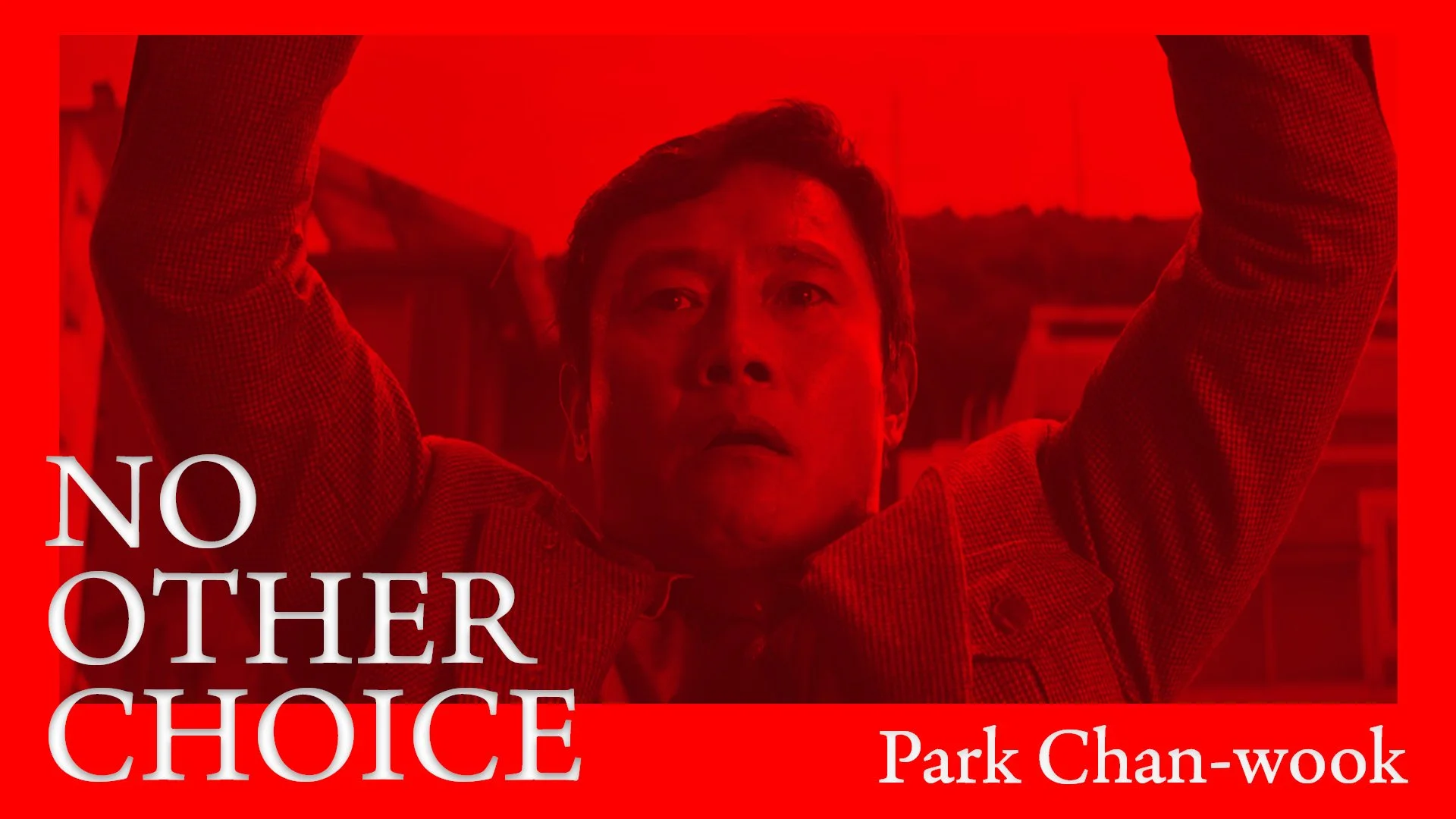
Graphic by Easton Clark, Photo Editor
With pitch-perfect social commentary, strong performances and impeccable craft, “No Other Choice” is one of the year’s strongest films from one of the most influential voices in global cinema.
As the 26th annual Newport Beach Film Festival came to a close, a line wrapping around the block filled the late-October air with a crisp excitement for Park Chan-wook’s new film. Following its premiere at the Venice Film Festival, “No Other Choice” has become a hot ticket through the festival circuit, playing to sold-out crowds in Toronto, London and now Newport Beach.
Anticipation for the film exploded among the audience, whose energy only grew through the film’s many twists and turns. Arguably, it’s difficult to see this energy fizzling out any time soon, as the film aims for a wide release this December.
The film follows Yoo Man-soo (Lee Byung-hun), whose idyllic life is stripped away after being laid off from his job at the paper factory. From here, the film highlights the cutthroat nature of the modern job market as Yoo struggles to find his place, spiraling into a string of murders to remove competition.
With delicate commentary on social media and AI, the film is a poignant reflection of our times and the ways in which neoliberal politics challenge our humanity. In a brief interview following the screening, Park Chan-wook went in-depth on the film’s themes, highlighting humanity as a core point of interest.
“I have a very strong faith towards humanity, which is why I put my protagonists in different situations and observe how they react regardless of the subject matter,” said Park. “You test them to their limits and study them under a microscope. If I had no hope or love for humanity, I wouldn’t go through that ordeal.”
In many ways, the film evokes much of the same subject matter approached in recent popular South Korean media. With poignant class commentary, contemporary South Korean cinema has become a site where geopolitical systems of oppression are commented on. “No Other Choice” takes these themes to new heights, as the film masterfully balances social critiques within an accessible narrative.
For many critics, this approach recalls a similar buzz surrounding the release of “Parasite.” However, this comparison grossly oversimplifies the complexities of the South Korean film market and the thematic weight of both films. To Park, this comparison and the film’s Oscar buzz seem to have left little impact.
“I usually don’t (read what critics say about my films) because if they are criticizing my film, it makes me angry, and if they’re complimenting my film, it makes me embarrassed,” said Park.
When asked whether or not he cared about the film’s awards potential, he flatly replied: “No.”
As much as “No Other Choice” becomes a tragic film about a man’s descent into madness within the contemporary job market, the uproarious laughter filling the theater paints a different story. Within the film, a sharp, witty and satirical tone often takes control. Although the moments of tension still hold weight, many of the film’s strongest sequences embody this playful comedic approach. Certain sequences stage themselves like an anti-capitalist Looney Tunes cartoon, embodied by Lee Byung-hun’s incredible physicality and emotional range in the lead role.
Lee’s performance expertly complements the incredible craft throughout the film. Specific stylized choices of editing and sound add complex layers to an already thematically rich film. Park’s style isn’t always concerned with realism, but as Lee’s performance sells the humanity of the film’s protagonist, these choices maintain poignancy. To Park, the collaborative aspects of working on “No Other Choice” are essential for its success.
“If you just assume that you know everything about each other because you've been so close, it will ultimately lead to the movie failing,” said Park. “You have to always reconfirm with your crew on set. Filmmaking really is an endless series of conversations and confirmations. Whenever you make an assumption, it always leads to members of the crew being on different pages.”
Loosely based on Donald E. Westlake's 1997 novel, “The Ax,” Park’s adaptation takes major leaps in establishing underlying themes of AI as a core point of the film’s message. As automation continues to take over the modern workplace, and even the film industry, it’s important for films like this to question and explore the purpose of the worker in our contemporary society. Park’s complex web of social themes makes “No Other Choice” one of the most important movies of the moment — particularly as the film draws conclusions of how new technologies restructure our humanity.
This being said, it feels as though Park becomes so invested in the film’s message that the emotional themes towards the end didn’t entirely land. While “No Other Choice” is intellectually interesting and thought-provoking from beginning to end, this feels like it’s at the cost of an emotional character study upheld by Lee’s performance. Although the ending isn’t bad, the dry and distant emotions left some added pathos to be desired.
Nevertheless, it’s hard to see “No Other Choice” not standing the test of time as one of 2025’s best films. As the newest film from one of the most exciting voices in global cinema and in the midst of an exceptional run at film festivals, “No Other Choice” has a lot to live up to. Yet, through exceptional performances, tonal structure and social commentary, this proves to be one of Park Chan-wook’s best films to date.