
Did Parlow start on the right Key?
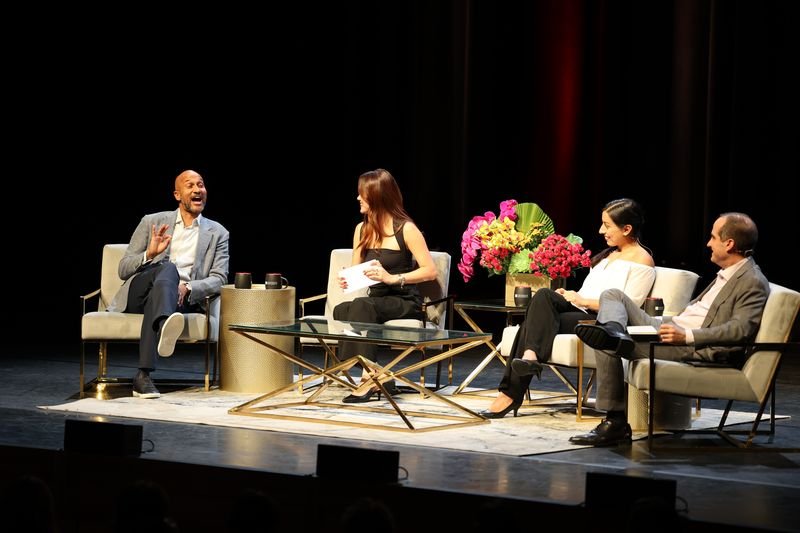
Photo courtesy of Chapman University Events
Amidst a barrage of high-profile masterclass announcements like Dwayne Johnson and Spike Lee, the announcement of Keegan-Michael Key’s Chapman visit promised something different.
Unlike the masterclasses at Dodge College’s Folino theater, Key’s visit was targeted at the wider school, and the discussion was billed as the first event of President Matt Parlow’s inaugural homecoming. From this framework, I wasn’t entirely sure what to expect from the discussion. While the masterclass format has become a staple of the Chapman experience for many, it was unclear how a discussion with the comedian would also serve as President Parlow’s introduction to much of the student body.
While Parlow’s discussion with Keegan-Michael Key proved to be an entertaining evening, the event also made attempts to break the mold of Dodge’s masterclasses to varying degrees of success.
Before Parlow or Key took the stage, the evening began with reflections on Chapman’s four pillars. Among the audience, there were murmurs of confusion regarding what the tone of the rest of the evening would take. In many ways, the evening was starting to feel like a Trojan horse.
Yet after this ten-minute prelude, the tone of the evening took a turn as Parlow walked on stage to immediately introduce Key, whom he interviewed alongside Student Government Association (SGA) president Cintya Felix and University Programming Board (UPB) chair Elyse Tran. While the conversation started with casual banter between the Chapman panel and Key, it eventually moved into the structure of a discussion with an inspirational speaker.
“Bet on yourself. And the way you bet on yourself is by telling yourself what you want, not what you don't want,” said Key. “The universe only hears the subject, it doesn't hear the negative.”
Key is mostly known for his comedic work on shows like “Key and Peele” or in films such as “Wonka.” While the conversation took time to explore Key’s work on these projects, it differed from Dodge’s masterclasses by focusing more on Key’s personal experiences. Rather than talking to a room of film students, Key spoke to the entirety of Chapman and an audience with broader interests. He went on to recount experiences with his personal identity, such as his upbringing as an adoptee and with his biracial identity growing up in Detroit.
“The thing that I've learned about being biracial is that it has so much more to do with culture than it does about the amount of melanin in your skin,” Key said. “If there's 600 people in this room, that's 600 separate stories, right? My dad was black, but the guy, he grew up in Utah. He didn't grow up in Detroit. Those are two separate cultures.”
Key’s perspectives on collaboration and negotiations between cultures became a highlight of the evening. When asked about how his style balanced humor with deeper social themes, Key recounted his collaborative process with Jordan Peele on their Emmy-winning sketch show, “Key and Peele.”
“Humor is at its best when we're finding a universal observation and we're manipulating that observation using the techniques that we use for humor,” said Key. “I think some of the best comedy that's ever happened in the world is based on problem-solving.”
Key found common ground with students as he discussed his time in university. Earning a BFA from the University of Detroit Mercy and an MFA from Pennsylvania State University majoring in theater, Key spoke to the importance of establishing methods of collaboration throughout the university experience.
“There are people who you're very close with when you're in undergrad,” said Key, “Find your tribe and work within that tribe. Sometimes the tribes fracture… (but) I'm not a singular person. I'm an extremely social person. I'm a symbiotic yin and yang kind of person. I have to work with others.”
While Parlow shied away from discussing his plans for the school or even spending the time to formally introduce himself to the audience, the discussion allowed Key to share his unique perspective on how to make the most of your college experience. Striving to offer something different from Dodge’s usual discussion with an actor, the tone or message of the evening ultimately became muddied and unclear.
In spite of this, it’s difficult to say the discussion wasn’t a marginal success, as a buzz of excited chatter filled the theater following the conversation. Key stayed in the Musco theater for an additional 45 minutes, taking pictures and talking individually with students. While the evening became emblematic of an indecisive kickoff for Parlow’s inauguration, the event potentially highlighted how Parlow will continue to uphold Chapman’s liberal arts culture and creative spirit.