
Sluts, assholes and 50 years of ‘Rocky Horror’
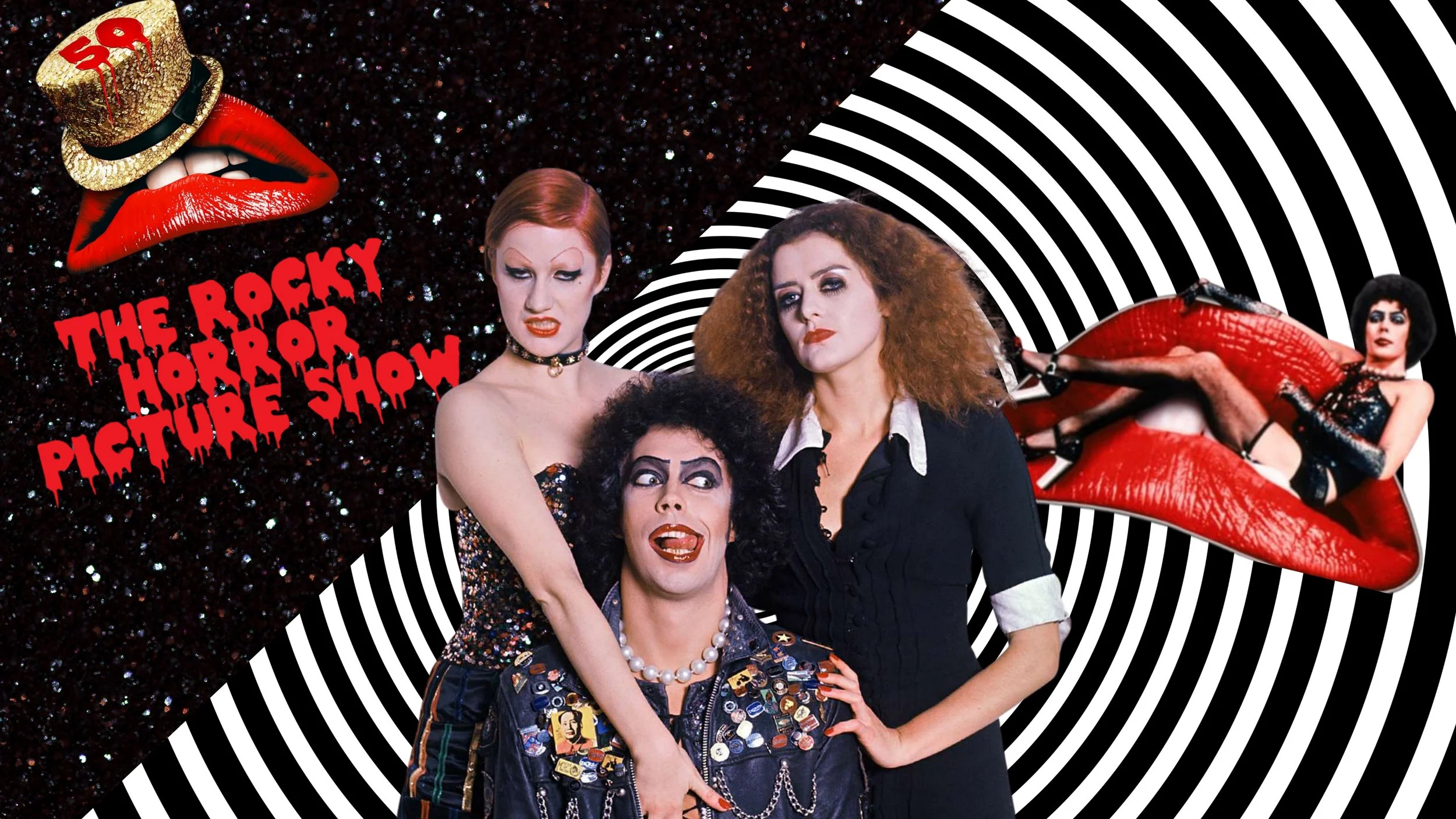
Graphic by Sienna Lewis, Staff Photographer
“In the beginning, God said, ‘let there be lips.’ And there were lips. And they were good.”
Across the globe, audiences have been shouting these words as the prelude to “The Rocky Horror Picture Show” for 50 years. The bizarre musical about aliens, classical Hollywood and sexual awakenings is widely considered to be the longest continual theatrical release of all time.
“In my years in ‘Rocky Horror,’ we had people come to us that were kind of misfits of society,” said Bill Ung, who was part of the Midnight Insanity shadow cast for 25 years. “When you got to ‘Rocky Horror,’ all of a sudden, you felt like you were at home. Whoever you were, whatever you were, or who you wanted to be, you were cool here. People didn't judge you. Everybody was welcome, as long as you weren't a jerk.”
But “Rocky Horror” wasn’t always the cultural staple it is today. Starting as a stage show, 20th Century Fox picked up the film rights, utilizing much of the same cast and crew from the London musical. Despite the financial struggles of its initial theatrical release, Fox’s marketing team cultivated an interactive culture around the film that has only grown exponentially over the last half-century. What started as audiences yelling at the screen quickly became rehearsed and coordinated “shadow casts” that perform the film on stage while it is playing.
“What made it a staple was that weird little niche fandom that formed around it, originating from the original stage show,” said Annie Pasmann, currently playing Dr. Frank N. Furter in this year’s performance of “Rocky Horror” for The Players Society (TPS) at Chapman. “I think Rocky would not be the staple that it is without the people that showed up to every screening, and that enjoyed the silliness and absurdity of it all.”
As “The Rocky Horror Picture Show” marks a half-century of playing to multigenerational audiences around the world, its legacy stands at a unique crossroads. While the show still stands as a landmark of queer cinema, its theatrical roots and ever-changing political context are reshaping its cultural perception.
Like many, I first watched “Rocky Horror” in my freshman year of college. Entering the Irvine Lecture Hall and being labeled a virgin — among the “Rocky Horror” community; someone watching the film for the first time — I was in for a dizzying experience. Quickly, I became entranced by the lively atmosphere and the film’s playfulness with gender archetypes. It’s been a few years since that first screening, and I now watch the movie at every opportunity.
“Freshman year is the first time that a lot of people get away from their parents and kind of start getting to do their own thing,” said Brandon Gill, who is playing Janet in TPS’s production. “I feel like ‘Rocky’ is a really freeing experience, and for people with stricter parents, this is the first taste of freedom. I feel like it's just a freeing show.”
TPS, which has been performing shadow casts alongside “Rocky Horror” for over two decades, is gearing up for its annual shadow cast production this October. As a long-standing tradition, the performances manage to reinvent themselves each year by experimenting with casting and the film’s themes. This year, the troupe chose to cast a gender-bent Brad and Janet, the archetypal representations of binary gender roles in the film.
“When you gender-bend it, you can play with these ideas of exaggerated masculinity and femininity from the perspective of the other gender,” said Isabel Hau, the director of this year’s TPS production. “(‘Rocky Horror’) has a way of interacting with gender and queerness in a way that is so open, unashamed and allowed to be almost grotesque to the outside world. It allows itself to love every part of gender, queerness and the expansiveness of that.”
However, in recent years, with increased social prejudice towards trans identities, much of the film’s message has been put to question in online spaces. While the film presents its themes through queer camp aesthetics and bright musical numbers, the ultimate narrative of the film focuses on a “transsexual” who sexually abuses and kills the film’s cisgender and heterosexual characters.
The film also utilizes dated language, such as the term “transvestite,” a derogatory denotation for the trans community. For all of these reasons, on paper, the film dates itself at every corner with overtly transphobic and homophobic messaging.
Yet “Rocky Horror” isn’t a film that exists “on paper,” so to speak. Despite all of these valid issues with the film text, the performative component of “Rocky Horror” intentionally subverts and parodies the contents of the film itself. As shadow casts are able to put their own spin on the film’s messaging, this simultaneous revision of and participation in this dated piece of queer media becomes an act of reclamation and reappropriation.
“The argument that this is a transmisogynistic piece of media is essentially that it co-signs the idea that transfeminine people are inherently predatory and need to be punished,” said Samantha Allen in a 2024 Them article on the film’s discourse. “But as we’ve seen with so much horror media, queer people tend to reclaim monstrous and even intentionally hurtful depictions of our community. Villains become icons. Killers become heroes.”
Writing this article as a queer person, my personal involvement with “Rocky Horror” has been consistently validating. And while I certainly find “Rocky Horror” to be a fun film, the source of my validation is almost solely rooted in the audience community rather than the film itself. Even outside of queer culture, “Rocky Horror” resonates with people precisely for the experience’s openness towards issues not typically confronted in traditional media.
“Even if you are straight or cisgendered, I believe that there can still be a message of acceptance within ‘Rocky,’” said Pasmann. “These people are in lingerie and are exposing their bodies in a proud way. I think that Rocky can also just have a really positive effect on body image.”
The demographic of audience members for “Rocky Horror” tends to be a broad range of generations, racial identities, gender presentations and sexual orientations. Ung described how the unique time and place of each “Rocky Horror” performance, along with the audience’s unique perspectives, enables the film to constantly reinvent itself. Ung discussed how a production of “Rocky Horror” following 9/11 shaped his understanding of the film’s cultural significance.
“We sat down and talked about it over the internet. We were like, should we have a show? Is it right to have a show?” Ung said. “But somebody sent me something about how after World War II, one of the first buildings that they put back together were the theaters. Because you need to have a bit of an escape, you need to have a way of trying to look at life not being bleak the entire time. So ‘Rocky Horror’ through the years has basically been a support group, a surrogate family if you will.”
In spite of the vast cultural shifts to take place over the past 50 years, “Rocky Horror” remains one of the few cultural institutions to still prioritize face-to-face interactions and the audience experience over anything else. Whether it will continue to resonate with audiences or not is up for history to decide, but as it stands now, the niche culture of midnight screenings continues to play for new generations of fans.
While the transmisogynist tropes in “Rocky Horror” are being put to question at a time when trans rights are increasingly under threat, the communal networks formed through the film’s experience are undeniable. The film offers safe spaces of free expression that transcend the dated perspectives in the film.
As curious audience members continue to discover the film and as shadow casts place their own perspectives on the film’s message of self-discovery, “The Rocky Horror Picture Show” remains a one-of-a-kind experience. If you’re daring to take “a jump to the left” into the film’s zany culture, TPS’s production runs on Oct. 24, 25, and 31.