
Photo by Logan Schuneman, Staff Reporter
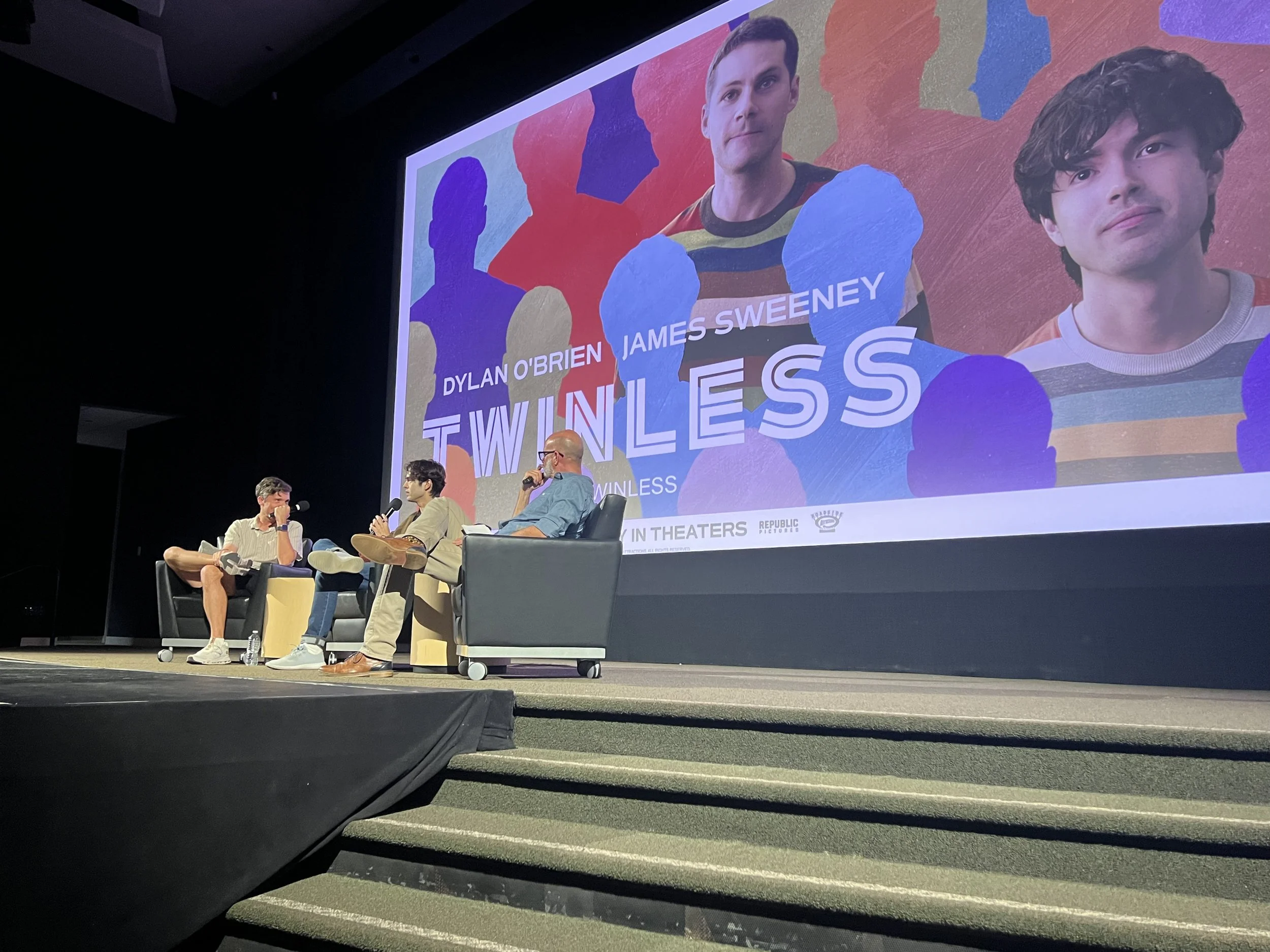
“I wish I could stand here as a role model of resilience and piety, but there was depression. It was tough,” said James Sweeney, a Chapman class of 2012 alumnus whose latest film, “Twinless,” played to an electric response from audiences in the Folino Theater on Tuesday night.
“I'm giving you advice to try to avoid the pitfalls I made,” he said. “(But) there's a lot of suffering, and I mean that in a first-world suffering sense; the Latin root word of passion means to suffer.”
Sweeney, who wrote, directed and starred in the film — which took home the top audience award at this year’s Sundance Film Festival — sat down with Greg Cotten, fellow class of 2012 Chapman alumnus and the film’s director of photography, in a wide-ranging conversation on their hardships breaking into the film industry. Moderated by Chapman University professor Travis Knox, the pair gave advice to an audience of eager Dodge College students.
“Nobody's going to give you permission to direct or act or write or whatever it is that you want to do,” said Sweeney. “It's a competitive industry. If you want to do it, you know you have to be patient, but you can't wait for permission.”
Sweeney and Cotten first met in their intro to visual storytelling (FTV 130) class during their freshman year at Chapman. Working together on projects throughout their time in college, their collaboration continued after graduating. Despite frequent collaborations, both described how their paths into the film industry weren’t always straightforward.
“Even though I had reality show experience and multiple internships under my belt, it was really hard to find any job (after) graduating,” said Sweeney. “I wrote my first script while I was working the reception desk. And I think you just have to survive while you continue to cultivate your voice.”
Sweeney and Cotten’s collaboration continued with Sweeney’s debut film, “Straight Up,” and the pair reflected on their initial struggles to sell the film while maintaining their creative vision. Sweeney initially wrote the script in 2012, and as he struggled to find financiers, the film took nearly seven years to produce, not entering production until 2018 and releasing in 2020.
Sweeney and Cotten described how their unique approach to “Straight Up” impacted both the challenges in its production and ultimately, its success. Choosing to cut the film in a 4:3 aspect ratio — a style typically associated with old Hollywood filmmaking — they struggled to find a distributor willing to take the risk of selling the film with an atypical aesthetic.
“If you want to do a 4:3 movie, you’ve got to have a known quantity person in front of the camera,” Cotten said. “The bottom line is if you're doing 4:3, you better be very important.”
Sticking to their vision, “Straight Up” ultimately found a home being championed by two of the world’s leading LGBTQ+ film festivals, San Francisco’s Frameline Film Festival and LA’s Outfest. Finding distribution through these festivals, the film ultimately received a theatrical release in February of 2020 where, in spite of the pandemic’s untimely lockdowns, “Straight Up” managed to find an audience on streaming that paved the way for the production of “Twinless,” which premiered at the 2025 Sundance Film Festival.
“I remember reading a lot about how most filmmakers are incredulous or they're crying. I had heard of that. I'm like, I wonder how I'll react when I hear,” Sweeney said as he recalled getting accepted into the festival. “I (just) felt good about the movie. I had been dreaming about that moment. Is there anything better? I don't know. It's the pinnacle of independent filmmaking. I may never get that again.”
The film went on to win the coveted Audience award in the U.S. dramatic category and the best actor award for Dylan O’Brien, who plays both of the titular twins. Getting picked up by Lionsgate and Roadside Attractions, the film landed in theaters nationwide on Sept. 5.
However, Sweeney and Cotten’s experience at Sundance wasn’t all perfect. The night before the awards ceremony, a pirated sex scene from the film’s digital screener leaked online and went viral, featuring Sweeney and O’Brien.
“I couldn't sleep at night all before,” said Sweeney. “My naked body's all over the internet. That's not the way I want to be introduced, as the twink bottom for Dylan O'Brien.”
Similar to “Straight Up,” “Twinless” takes several liberties with its visual language. Alongside a split-screen sequence that had the Folino audience hooked, Cotten described more subliminal effects in the cinematography that contributed to the film’s deeper themes.
Cinematographer Greg Cotten experimented with a blend between analog and digital filmmaking on “Twinless” to achieve a more nuanced perspective in the film. Cotten used artificial film grain over digital footage to lead into one of the film’s central twists. This process utilized Film Box, a software developed by Cotten, which has been used on several major films in recent years, including “Everything Everywhere All at Once” and “A Real Pain.”
“We wanted to experiment with artifice versus truth,” Cotten said. “On the digital side, we use some film emulation to make it resemble the essence of shooting on film, but (it’s) not quite right, because it's not the same.”
I had the chance to briefly talk with Sweeney in a one-on-one interview after the Q&A session, where he went deeper into the impact of “Twinless.” Similar to “Straight Up,” “Twinless” is part of a current influx in independent queer filmmaking that has brought voice to traditionally misrepresented stories on the big screen. “Twinless” features a nuanced and deeply flawed queer protagonist also played by Sweeney, who embodies much of Sweeney’s approach to queer storytelling.
“If your characters are unlikable, that's an easy way for people to be like ‘audiences don't want to see that,’” said Sweeney. “But I'm just trying to write humanist work. And I think the more that we can normalize queer people as having the same deeply human flaws as everybody else, I think that's progress.”
I also asked Sweeney about his influences for “Twinless” and how other films impacted the distinct tonal and visual style in the film.
“I just gave Letterboxd the list of 10 influences for (the film), and I struggled with the list because I had seen most of the films after I wrote the first draft of this film. I think sometimes whatever you're working on, you see it everywhere,” said Sweeney. “It is a different film tonally and grammatically (from ‘Straight Up’), we lean more into contrast. For me, it's all about how the visual language serves theme and story, and that typically is what drives me.”
While Sweeney and Cotten were both hesitant to discuss what they had planned next, as the pair talked with Chapman students, their collaboration was consistently referenced as a key to the film’s success.
“It's an extremely competitive industry. And I know you all know that, and I know you've probably been hearing that from freshman year,” said Sweeney. “It's a career that involves so many other people and so many resources, but that's the beauty of film school. These are the people that you could be working with for the rest of your lives. And that's really exciting.”