
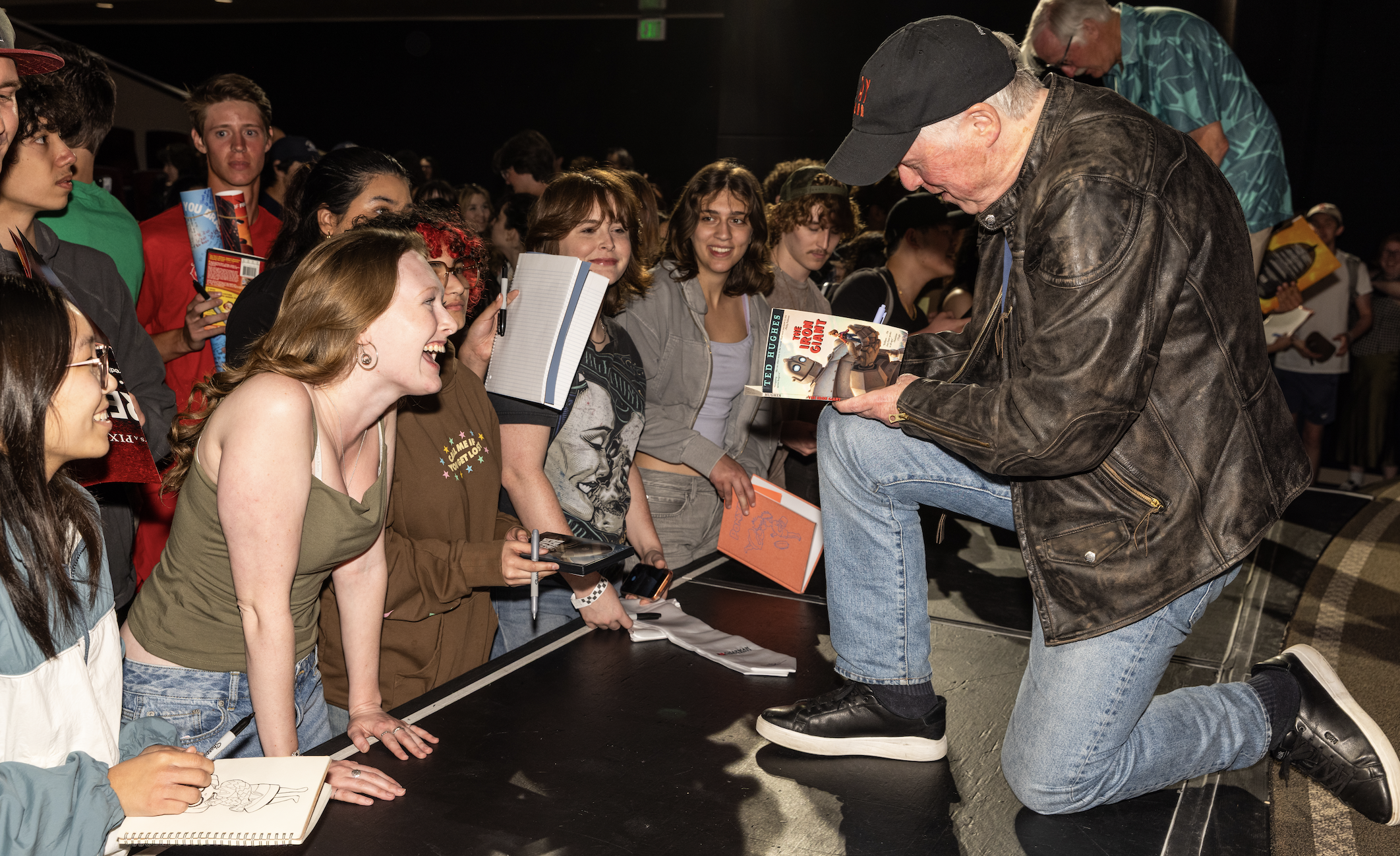
Courtesy of Carrie Heather
The master class format has run somewhat stale recently.
At least this seems to be a somewhat common sentiment among a number of Chapman students over the past year. While the 2025-26 school year has had one of the most star-studded lineups in recent memory, with the A-list likes of Dwayne Johnson and Ariana Grande, the PR-oriented approach has left some students unsure of what they can take away from the master classes.
A lot of that changed on Tuesday night when Dodge College hosted a talk with the legendary director Brad Bird. Moderated by animation professor and Bird’s longtime friend John Musker, the evening quickly became filled with casual banter highlighting the pair’s shared history and the strength of collaboration in the film industry.
The energy of the night was brimming from the beginning. After the Folino’s audience’s enthusiastic responses to the screening of “The Iron Giant,” Chapman animation assistant professor Ruth Daly took the stage, noting her involvement as an animator on the film while also giving shout-outs to several other animators from “The Iron Giant” throughout the audience. As a celebration of Bird’s cinematic legacy, the conversation began with his first experiences with animation.
“I loved animated films, and my parents indulged me and let me see them more than once in the theater,” said Bird. “(‘The Jungle Book’) left town and came back several times because it was popular. So over the course of two years from its initial release in 1967, I saw it 23 times.”
Bird and Musker spent a significant portion of the master class reflecting on their time in college. Both part of the same class of animation students at the California Institute of the Arts (CalArts), Musker brought in a slide show of caricatures, pencil sketches and other memorabilia reflecting on their college years.
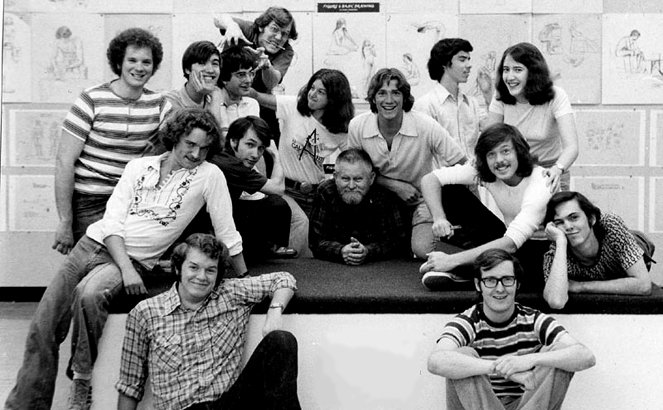
Photo Courtesy of CalArts
“This is in our classroom, A113, back there,” said Musker, referencing a class photo. “It was 50 years ago, and Brad taught me many things there, we learned a lot from each other. He taught me, being from Chicago, that we don't say ‘Oreg-ahn.’”
“Oregon,” said an Oregon-raised Bird, dryly.
This casual jokey banter offered a vast departure from the familiar formula of recounting facts and highlights from the guest’s history. While the career retrospective approach has prevailed, this more casual style allowed some of the distant and PR-trained answers otherwise common to be abandoned.
Bird talked about the time he spent working as an animator in the Disney “dark age” with films like “The Black Cauldron” and “The Fox and the Hound.” Neither Bird nor Musker disguised their sentiments on the era’s output. Feeling stretched thin under the leadership of an old generation of animators, the pair were looking to do something new.
“The studio was a shadow of itself. It was sort of weak in story and in production back then. A good chunk of ‘The Fox and the Hound’ is actually out of focus.” said Bird. “I got fired. And the funny thing was, I was basically being fired for standing up for the stuff that the Disney master guys taught me.”
After leaving Disney, Bird primarily worked in television on shows like “The Simpsons” and Steven Spielberg’s “Amazing Stories.” Gaining experience in the fast-paced environment of television animation, Bird and his team were able to animate “The Iron Giant” in just over two years, a fraction of the time usually spent on animated features.
“The only way I was able to do ‘The Iron Giant’ as quickly and with the amount of money that we had was because of those television experiences,” said Bird. “It's like that episode of ‘I Love Lucy’ where she's got the conveyor belt with the candy. That's the way it was, because if you delayed a decision, other episodes would start piling up on you. So you learn to trust your gut, ask tough questions and come up with an answer as quickly as you could. It really helped me tremendously.”
Although “The Iron Giant” was initially a box office failure due to poor marketing, the film later reached a significant audience on home video and television. Describing his experience with Warner Bros. Animation with an air of uncertainty, Bird nevertheless seemed proud of the final project. Through everything, Bird’s original vision was of utmost importance.
“There were a lot of people changing my ideas before they got to the people in charge, and they would never own it if it wasn't popular,” said Bird. “I was smart enough to write it all down, register it with the writer's guild and then pitch it so I was protected. I almost didn't get screen story credit because I had to prove that, but that's what they do. I pitched the whole thing and about halfway through it, I saw one of them … scribbling notes, and they essentially tried to get a treatment in order without me. But I had registered it, thank goodness.”
From there, much of Bird’s team carried through to “The Incredibles” with Pixar, proving to be a massive success. Even directing live action films like “Mission: Impossible - Ghost Protocol” and “Tomorrowland,” Bird’s distinct visual dynamism was at the forefront of his career, breathing life into his work spanning the past three decades.
“Animation was my gateway drug to film,” said Bird. “Even though you're drawing, instead of moving a camera around, you have to (consider), ‘Am I in a closeup? Am I on the person speaking or am I on the person listening?’ All those decisions have to be made, and when you start to make them, you start to see them in other people's work.”
The master class ended with a never before seen sneak peek at Bird’s new film, “Ray Gunn,” set to release later this year.
With the Folino’s front rows filled with enthusiastic animation students who grew up on Bird’s work, this was a master class filled with the loving and personable embrace of his industry experiences, bumps and all.