
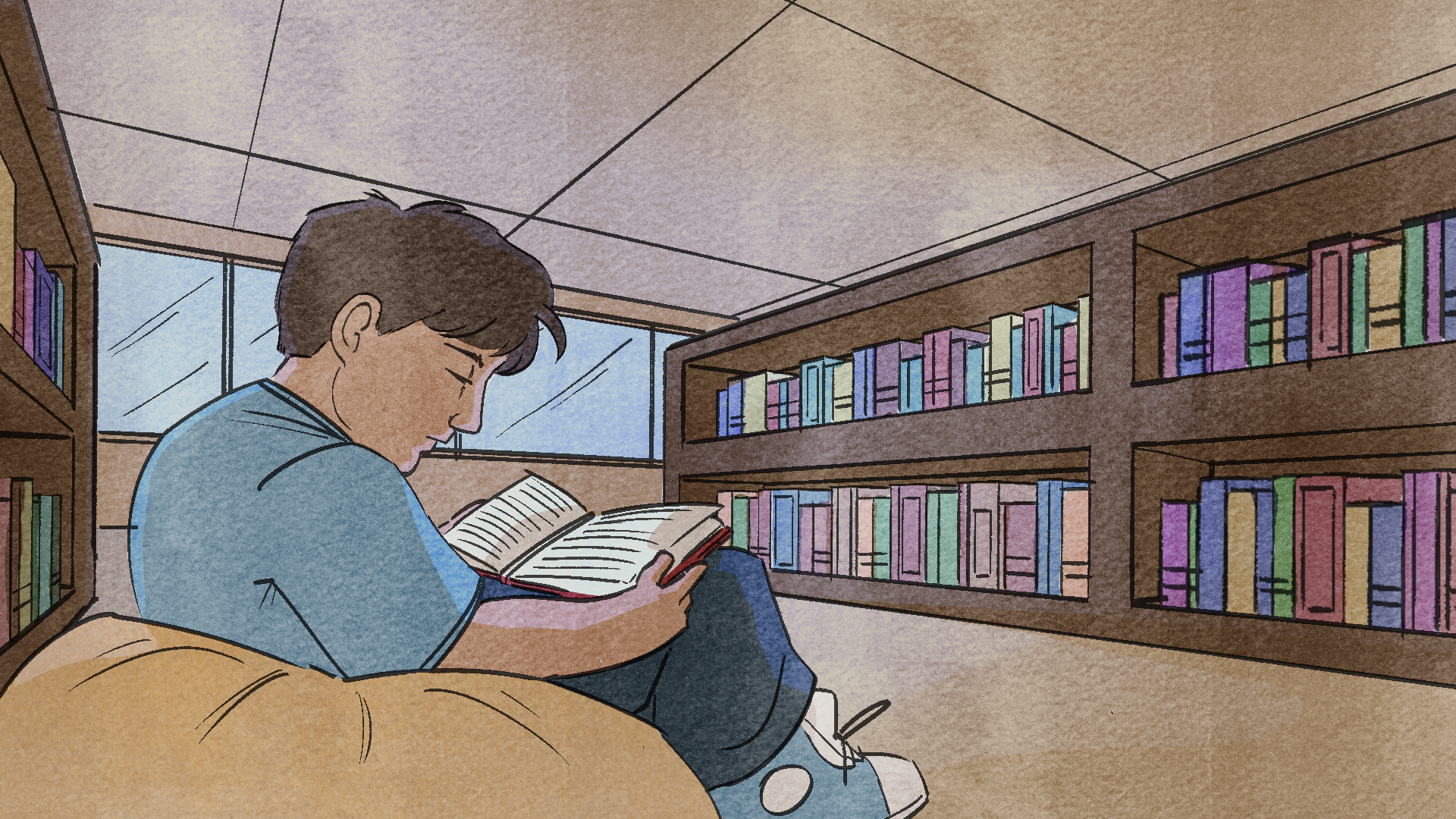
Illustration by Lexi Forman, Cartoonist.
59 million Americans are reading at or below a sixth-grade level, but social media thinks that’s sexy.
In a video for Interview Magazine, lifestyle influencer Alix Earle off-handedly remarked to have “never read a book. Like, maybe Dr. Seuss,” and an outpour of outrage ensued.
The 25-year-old content creator boasts nearly six million followers on Instagram; Earle made her $20 million fortune on get-ready-with-me (GRWM) videos. With the recent start of her beauty line and Netflix reality show “Earle Meets World,” the mogul has expanded her audience beyond TikTok and Instagram.
In conversation with Marwa Abdalla — rhetorical scholar and professor at Chapman University — she posed the question: “If we couple the overemphasis that I think Alex Earle’s online persona places on her appearance, with this messaging that, ‘oh, I've never read a book,’ I think there's room there to really assess: what are the potential harms for a demographic of young girls?”
Despite the usual celebrity idealism, Earle’s comment has actually sparked backlash from many women across platforms and larger institutional discussions on literacy.
Abdalla cites Emily Hund’s “The Influencer Society: The Quest for Authenticity on Social Media.” The Ph.D. researcher writes that “Carefully constructing authenticity is what has allowed some people to make real money,” but “it is also what has enabled some to become cults of personality, spreaders of misinformation, propagators of disingenuous lifestyle ideals or worse.”
Influencers like Earle and their audience partake in a parasocial relationship. “It is leveraging authenticity that is really at the core of what makes an influencer successful within this influencer economy,” Abdalla said. This perceived authenticity “gives (Earle) a very powerful platform, but it also makes statements like that really insidious and really harmful,” and many people agree.
Instagram users left an array of comments:
@camillemboriss: “Yeah, it’s not funny or cool or whatever to admit you’ve ‘never read a book’ in the midst of a literacy crisis. especially as someone with 6 million followers.”
@rice_annika: “WE ARE IN A LITERACY CRISIS! PLEASE GO GET A LIBRARY CARD!”
@mannie.lane: “She graduated college and high school without reading one book?”
The rise of BookTok in recent years has allowed reading to translate into the world of short-form media and notable book club hosts like TODAY’s Jenna Bush and the “internet’s resident librarian,” Jack Edwards, have even begun a reading syllabus for Earle. What’s on it? From childhood throwbacks like “The Babysitters Club,” accessible classics like “Of Mice and Men” and “Picture of Dorian Gray” to this year’s “Yesteryear,” the internet is in a frenzy to create an assigned reading list for Earle.
Coincidentally, Earle flippantly naming Dr. Seuss as the only author she’s read fundamentally dismisses the value and influence of his work. Seuss’ books were aimed at boosting child literacy; research finds that the construction of the books helps enhance phonics development and expand vocabulary.
After all, Dr. Seuss wrote, “The more that you read, the more things you will know. The more that you learn, the more places you’ll go,” but Earle may not have read “I Can Read with My Eyes Shut!” from Seuss’ bibliography.
Many have called to question how a high school and college graduate could have pursued an education without having read a single book — besides Dr. Seuss. But the idea isn't so far off.
Whether Earle meant it as a cheeky remark or fact, it is a broad overgeneralization of the literacy crisis; 28% of U.S. adults are currently reading at the lowest literacy level. As a result of exposure to addictive short-form video content, professors are facing a challenge which Abdalla describes as “the ability to sustain (students’) attention and focus.”
With the implementation of Common Core in 2010, which encouraged a curriculum shift from fiction to non-fiction texts, Gen Z is more familiar with short-form texts. Chair of the Georgetown English Department Daniel Shore told The Atlantic, “his students have trouble staying focused on even a sonnet.” Coupled with decreasing attention spans, is Earle right? Is Gen Z lacking exposure to books?
Abdalla suggests that it's not necessarily that education is being watered down, that even when a class requires reading a full book, students, on average, have a diminished capacity to focus and sustain their attention.
Gen Z is grappling with the effects of addictive multimodal content, but it doesn’t necessarily mean they are becoming illiterate; rather an indicator of multi-literacy. Abdalla teaches from Utah Halsby’s Reading Rhetorical Theory: Speech, Representation, and Power, a multimodal digital textbook, which suggests a shift to multi-literacy and multi-modal learning as reflected in modern higher education curricula, including Abdalla’s.
“But I think (Halsby’s) argument isn't that people are not going to read at all,” she said. “It's that people are adding in these other types of literacy…so I wouldn't use his argument to condone statements like Earle’s.”
Earle’s claim that “I’ve never read a book” goes beyond an ignorant remark; the aftermath suggests a larger cultural dilemma in the fight against illiteracy and how higher education is tackling it amid multi-literacy.