
Misfitclass | Jesse Gouldsbury talks making a monstrosity with ‘The VelociPastor 2’
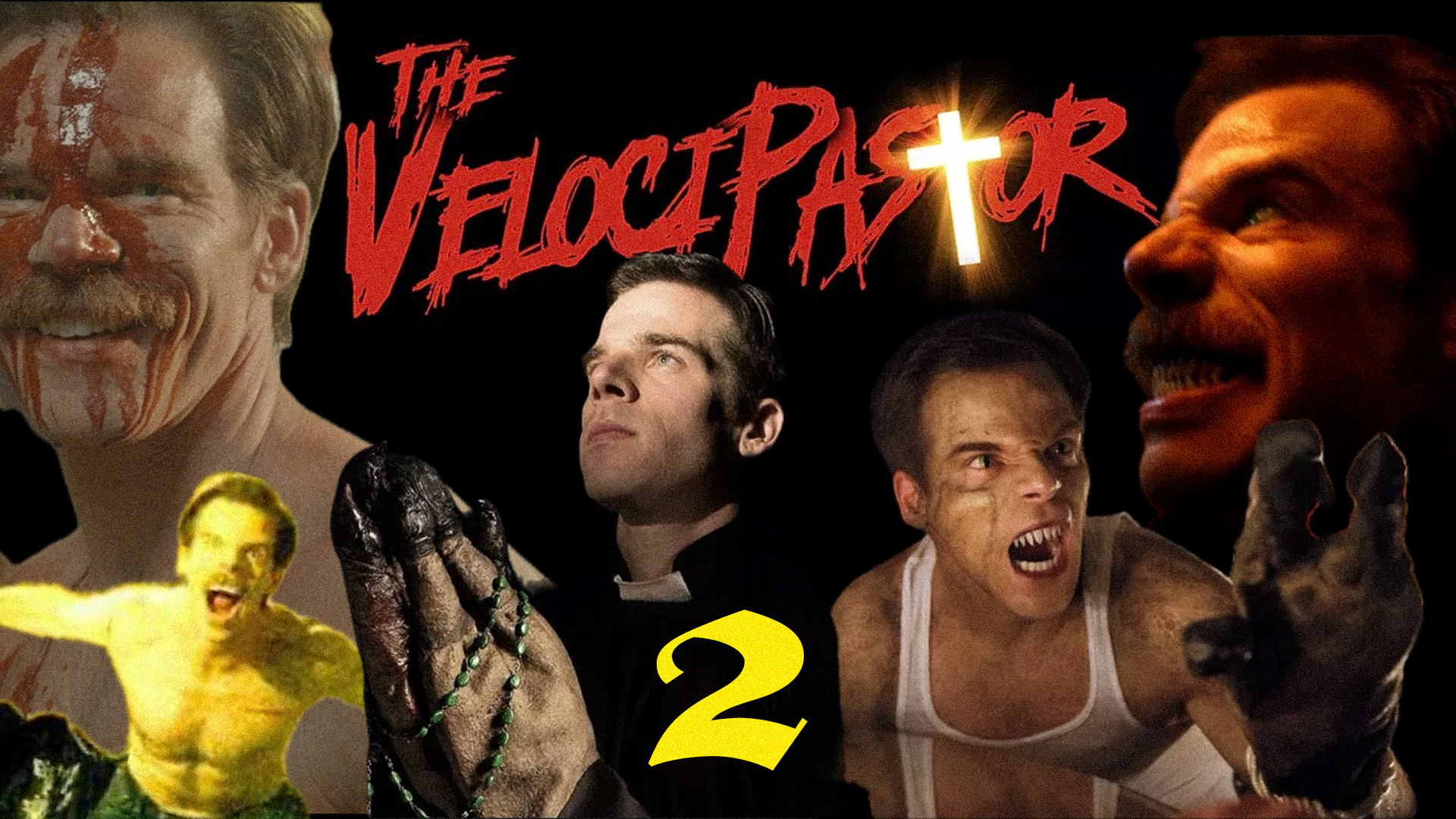
Collage by Riley LeBlanc, Photographer.
Out of the way, Feinberg.
While Dodge College’s master classes are an undeniable lynchpin of the university experience for many — featuring high-profile celebrity interviews — these discussions often center on PR-approved statements and don’t quite speak to the experiences of students preparing for a career in filmmaking after receiving their diploma.
Enter: Misfitclass, we’ll be interviewing young independent filmmakers about their experiences and advice for making films outside of the conventional Hollywood studio system.
The idea for 2018’s “The VelociPastor” came from an autocorrect error on director Brendan Steere’s phone.
Today, that film has gone on to become one of the most notable cult films of the 2010s. For students across campus looking for campy horror films in celebration of the Halloween season, “The VelociPastor” is a common pick, and it’s not hard to see why. Following Pastor Doug Jones (Greg Cohan) inheriting an ancient curse that turns him into a velociraptor, the original “VelociPastor” spoke to a fringe audience that continues to revisit the film nearly a decade later.
Now, much of the same team has returned for “The VelociPastor 2.” Directed by the original film’s producer and cinematographer, Jesse Gouldsbury — still in collaboration with his long-time friend and creative partner, Brendan Steere — the VelociPastor franchise is roaring to new heights.
“It's funny to think about us sitting in a dorm room talking about the different versions of ‘VelociPastor,’ including an incredibly serious version,” said Gouldsbury. “We were like, wouldn't it be funny if we just made a hardcore for drama with no jokes … Then we were like, no, this should be stupid. Let's make this very stupid.”
After premiering in Portland and screening to midnight audiences at independent film festivals, “The VelociPastor” firmly gained an audience with a streaming release for rental or for free on ad-supported platforms like Tubi in 2019. Quickly becoming popular in film criticism spheres on YouTube, a film with the absurd self-reflexivity of “The VelociPastor” had the perfect formula for engagement in the community. Reviews such as Cody Ko’s video calling it “the BEST bad movie I’ve ever seen” quickly racked up millions of views. In the 21st century, the origins of a film’s cult following take place online with criticism and meme culture.
“I love YouTube … The fact that I can go on there and watch how an eighth generation farmer in China grows certain produce and also watch an amazing short film or learn how to fix my dishwasher all at the exact same time is crazy,” said Gouldsbury. “The media literacy of the younger generations like Gen Z and younger is so strong from what I've noticed. I'm really hoping that’s because of the good media criticism and the video essays and stuff on there. We're finally exiting the CinemaSins ding era that I think was very millennial … We've gone back to digging and finding weird things. We are getting plotholes back, and I think that's really cool.”
“Bad movies” have been popular for about as long as movies themselves. With the B-films of the 1950s like “Plan 9 From Outer Space” flopping on initial release before finding success with sarcastic audiences later on, “The VelociPastor” and its sequel are completely aware of the popularity surrounding films deemed “so bad it’s good.” Emulating the style of what makes these films so fun to watch, one could say “The VelociPastor” is “so good it’s so bad it’s good.”
“We get the ‘Sharknado’ comparison sometimes, and there is something to that ‘so bad it's good’ genre that we do enjoy watching,” said Gouldsbury. “But a lot of those feel cynical in a way that's like, ‘we don't have to try hard because this movie is stupid.’ I like to think that our joke is: what if we were just as stupid and tried too hard.”
As a microbudget production, the VelociPastor films are a strong example of how contemporary independent filmmakers can make the most of the materials they already have. The first film was shot on a budget of $35,000 with the sequel leveling up to a more traditional independent production budget of $250,000.
“(For) the first one, we got our funds from a mysterious investor in Malaysia who we have never met in person. We have no idea what happened to her … we were like, there's no way that lightning's going to strike twice, so we’ve got to go some other route,” said Gouldsbury. “We just have a really good fan base and we were able to be like, ‘What if we actually go to Kickstarter? This will show us if the fan base is actually there for us and or if we're crazy people.’ And it was really great. We raised our money from there (and) had a couple of other sponsors that we were able to bring in for some funds to get us to that $250k … Every dollar from the merch and streaming from the first film all directly went into making the second one.”
While the budget increase was substantial, this is still a fraction of what goes into the multi-million dollar Hollywood sequels that flood our screens. Yet, it’s almost impossible to imagine what “The VelociPastor” would look like with such a large budget. As Gouldsbury described, the DIY aesthetic is precisely what makes “The VelociPastor” so endearing.
“It was kind of trying to capture that fun and off-kilterness that you can get only by (making) everything by hand and doing it all on a DIY level,” said Gouldbury. “I think we learned a lot from the first one as far as the gags that make us laugh and not being afraid to change the script and dialogue while filming to let play happen among the actors … We didn't want to lose the spirit of the original where we weren’t overly calculating everything.”
One of the most memorable moments from the first film features the reveal of the dinosaur costume (not even a Velociraptor at all). Making use of what was available to them, the sagging papier-maché T-Rex costume was a leftover prop from an abandoned play at Brendon Steere’s high school deemed “too violent” for the student body.
“We liberated (the costume) from a Pennsylvania high school … So, Pennsylvania taxpayers paid for that suit to exist,” said Gouldsbury. “It just ended up in Brendan's parents' basement and we were like, ‘Well, we have a title and we have a dinosaur costume. What else could you possibly need?’”
Yet, while Gouldsbury spends much of his time managing the VelociPastor saga, a relative success within the micro-budget independent filmmaking sphere can only do so much. Working on commercial sets, Jesse Gouldsbury finds himself in a similar position to many young filmmakers in finding the balance between passion projects and financial support.
“Honestly, I think it's taking all the frustrations from the commercial stuff and being like, ‘I can do a thing where no one can tell me no,’” said Gouldsbury. “I do think there’s some importance to the discipline that I've learned from commercial work. I was at Broadway Video for a little bit. Recently, I was the head of production for Crunchyroll, doing a bunch of their marketing stuff. When you have to deal with all these other brands, there's so many brand guidelines … Learning how that world worked was very useful, but it then gave me the tools to break those systems with the things that I want to do.”
Whether you’re a fan of the original “VelociPastor” or discovering it for the first time this Halloween season, there’s an important message to be found in the film about trusting your instincts. For as stupid and out there as “The VelociPastor” is, making something unashamedly original and embracing the constraints of micro-budget filmmaking can be just as — if not more — fulfilling as working on large blockbuster and commercial sets.
“Trust in the things you like,” said Gouldsbury when asked about tips for graduating film students. “Finding your own taste … the things that bring you joy and harnessing that will, in my opinion, hopefully make the more interesting art in the world.”