
The panther, the myth, the legend
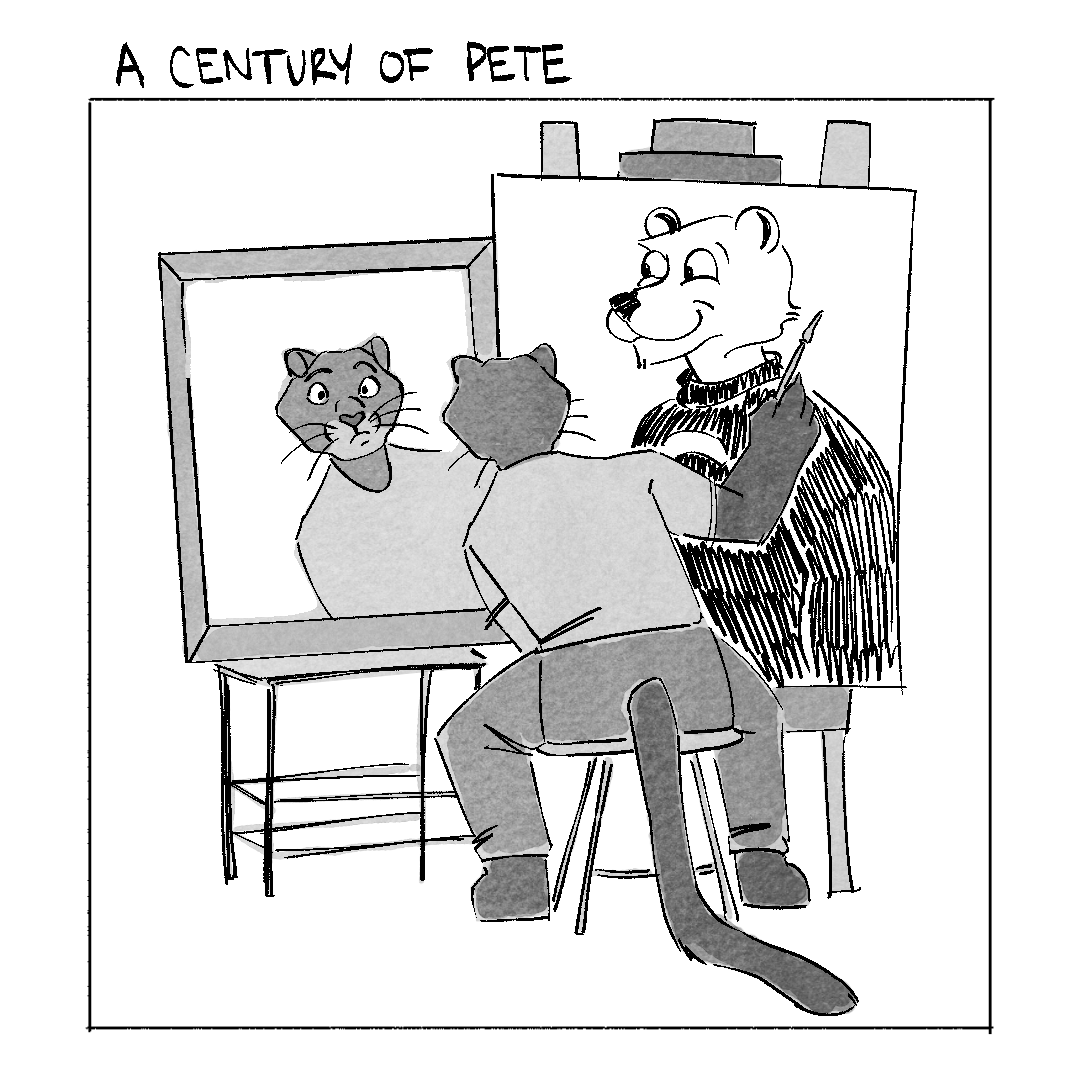
Illustration by Lexi Forman, cartoonist.
You’re wrong about Pete the Panther.
On the prowl, the friendly mascot can be found greeting fans at sporting events and welcoming new students throughout orientation week. From originating the slogan “Paws up!” to serving as the inspiration for the infamous cult classic thesis film “The Manther,” Pete the Panther is an inseparable part of Chapman’s campus culture.
“I used to say all the time that Pete is the most popular person on campus,” said class of 1999 alumnus and Interim Director of Athletics Doug Aiken. “Everyone stopped what they were doing to go get a picture with Pete or go greet Pete. It was like seeing Mickey Mouse at Disneyland.”
But most students probably haven’t stopped to consider the stories they’ve heard about Pete’s origins. Like Chapman, many universities take pride in the history of their mascots as a core piece of their identity. While much of Pete’s history is well documented, a number of convoluted timelines and loose ends have left room for rumors and speculation to take over in the evolving myth behind Chapman’s famous panther.
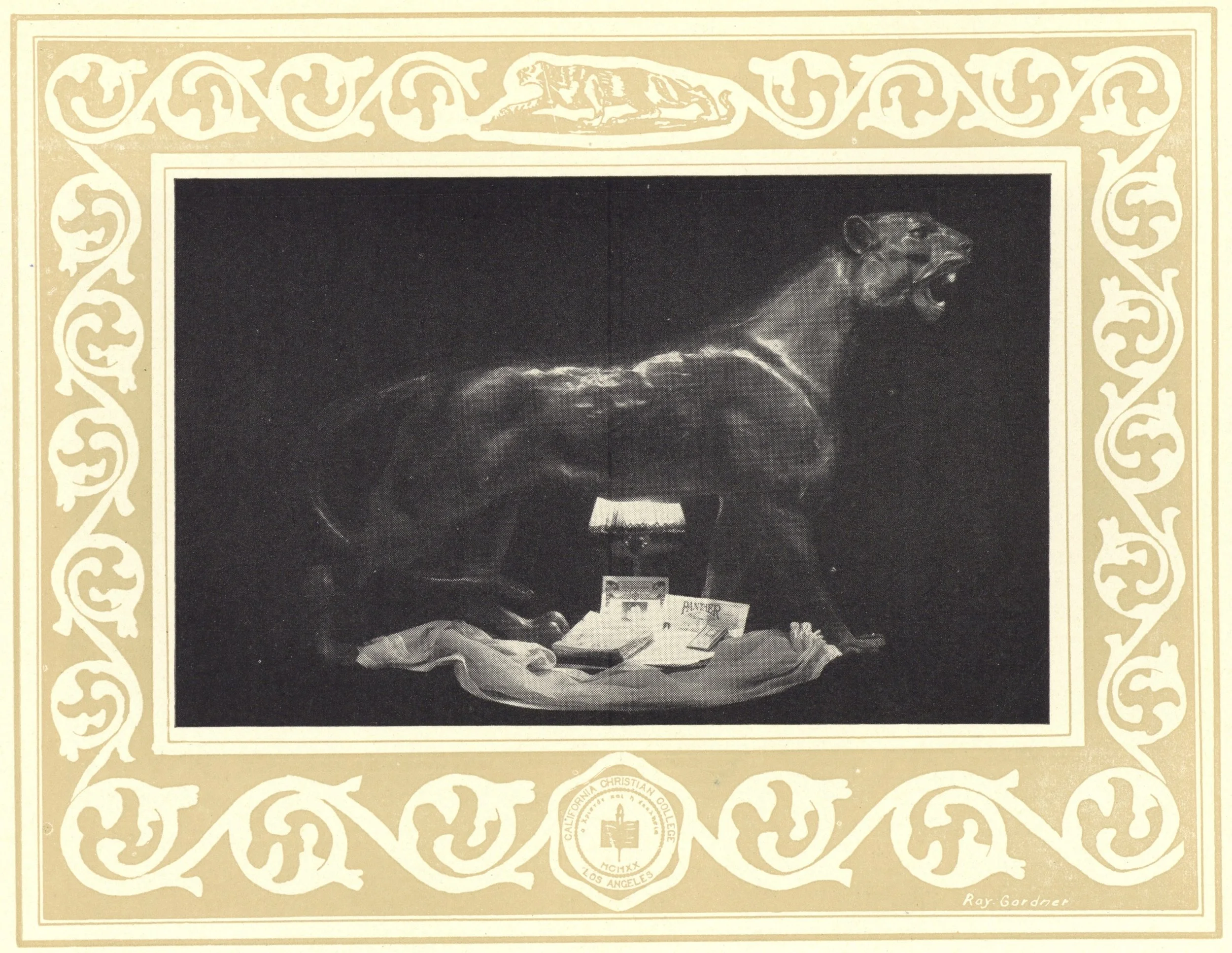
1929 Ceer Yearbook Photo Courtesy of Frank Mt. Pleasant Library of Special Collections and Archives.
Namely, investigating Pete the Panther’s history on campus initially led me to believe that the mascot had been stolen.
Perhaps “stolen” is too harsh of a term, but there is an underlying notion that Chapman University (at the time, California Christian College) took inspiration from Orange Union High School (now Orange High School) for their mascot. There is some credibility to this, as both schools continue to have panther mascots, dating back to the early 1900s-1920s.
Yet further research with Chapman University’s Frank Mt. Pleasant Library of Special Collections and Archives revealed that the Panther mascots seemingly originated independently from one another. Without widely disseminated, concrete histories of these mascots from the time, word of mouth has produced a mythological and folkloric tale of two panthers.
Before he was Pete, the panther was an abandoned paper-machié prop from an unknown 1925 silent movie set. The prop was rescued by a student and brought to California Christian College, where the community soon embraced the mascot.
“Pete embodies what we are at Chapman, which is a welcome and great place,” said Aiken. “Panthers are a very common mascot, so, how do you differentiate? How do you stand out? I think Pete gives us that…Pete's an original.”
Following an intense flood in 1934, the papier-maché panther was damaged beyond repair. Yet, as the panther prop’s decade on campus established itself with this welcoming energy, the panther’s paw prints were already too deep to wash away in a flood.
Despite losing the original prop, the panther iconography remained present in the university’s student culture through yearbooks, art, and even this very paper, initially titled “The Panther’s Meow,” a name which Orange Union High’s student newspaper coincidentally also shared.
Yet, the mascot wasn’t formalized until the 1990s when a panther costume began appearing in the stands at sporting events. In the 2000s, the alumni association donated an official mascot costume, finally naming it “Pete” after athletic hall of fame inductee Julian “Pete” Peterson.
“It's not just like they just named him Pete because of the alliteration. He's named after somebody genuinely deserving of that and kind of iconic in his own right,” said Aiken. “I always want people to know who Pete was named after so that it keeps Julian alive in that regard.”

President Emeritus James L. Doti, courtesy of Orange County Register.
At this time, Chapman University was going through growing pains as it transitioned from a small private college to a full university in 1991. As the community grew, so did the use of the Panther mascot. Joining NCAA Division III in the 1994-95 school year, Chapman began using the panther mascot in its official branding and marketing beyond the student-created legacy that had existed for decades. In many ways, the panther’s image visualizes the school’s growth into the university it is today.
In the two decades since Pete’s formal introduction in official Chapman branding, the mascot has undergone further significant changes. President Emeritus Jim Doti’s infamous photo shoot with a real panther seemed to cement the centralization of Pete the Panther’s image in the hands of university administration, a far cry from the days of student cartoons and stolen papier-maché props.
The most recent change came in a 2022 rebranding, where Pete transitioned from a more realistic and angular aesthetic to brighter and more cartoonish features.
“When I was a student, it was a dingy old mascot costume. It didn't instill a whole lot of excitement when the panther mascot was present,” said Aiken. “A few years ago, we needed a new costume, and they wanted Pete to be a little bit more inviting. He's not just an athletic mascot, he represents the whole university.”
Many universities share similar stories of how they found their mascot. Rather than originating from university administrators or faculty, students are often responsible for introducing a mascot to a university’s culture. Beyond the boundaries of a campus, these costumes serve a broader function in succinctly communicating a university’s identity to larger surrounding communities.
“I think those interactions are what it's all about, and that's why people get so excited when they see him,” said Aiken. “Seeing college students go back to when they were a kid and reacting to Pete in that way is always so fun. He brings out that child in all of us.”
As student myths and storytelling create the history behind these mascots, it’s easy to see the formalization of the panther mascot in university marketing as a self-appropriating loss of student input. Yet, student culture continues to keep the panther mascot alive. As students themselves don the costume for various events, part of Pete the Panther’s magic is his ability to be any and every student from across campus. We are all, collectively, Pete the Panther.
“You never want to know who’s under there because then the spirit goes away,” an anonymous Pete the Panther actor said in a 2019 Panther article. “That secrecy is based upon the spirit of the character; this is an actual panther instead of a person.”