
A friend turned enemy: The AI detector dilemma
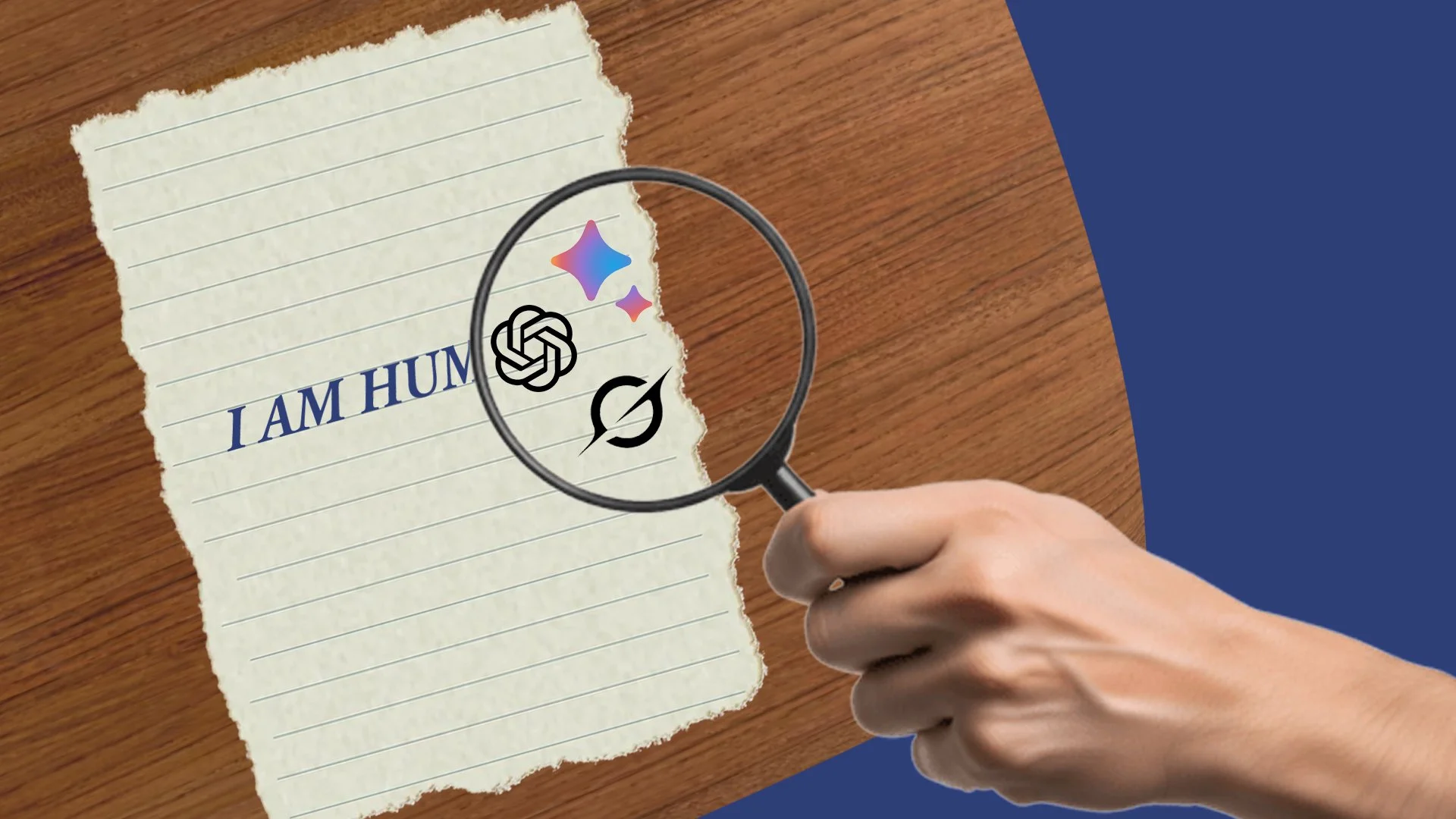
Collage by Matias Pacheco-Ramirez, Photographer
Are you a fan of using em dashes in your writing? You may be accused of cheating.
Sofia Morales Vilchis, a business administration and data science major, said she has been accused by a professor of cheating for using em dashes. The AI detector and professor claimed it was entirely AI-written, though that was not the case.
“It just makes me mad that because of AI detection tools, it is easier for professors to question a student's work,” said Morales.
How do professors decipher what is AI-generated and what is a student's honest work? And to what point are we willing to sacrifice our privacy for the advancement of AI detection sites?
In response to concerns of academic integrity when it comes to AI use in the classroom, many software companies have developed “AI detection" tools. This software's overall goal is to detect AI-generated content, though it can be far from accurate, often marking both false positives and negatives.
A study conducted by Stanford scholars found that detectors can be particularly unreliable when the author is a non-native English speaker. In a study using several detectors, researchers found 61% of essays written by non-native English speakers for the Test of English as a Foreign Language (TOEFL) were AI-generated, even though they were entirely their own work.
Further errors can also be due to the wording of prompts. Simply editing the AI prompt can reduce the detection of genuine AI-written essays from 100% to 13%, according to research by MIT.
AI platforms, particularly detection software, have had several issues with accuracy.
As of July 23, due to concerns about inaccuracies, OpenAI removed its AI detection services, stating on its website that it is working to incorporate feedback and research to improve its text verification techniques.
Turnitin, a software service used widely by universities such as Chapman, scans assignments for plagiarism and contains an AI-detection tool added in 2023. This company is also facing similar accusations of false identification, though Turnitin acknowledges the limits to its technology.
It's not unusual to see a message stating students' work will be checked by Turnitin or another AI-scanning website when turning in homework on Canvas or online; however, these AI limits are causing students to be turned against their institutions, particularly when it comes to false cheating accusations.
Morales explained that she now feels she has to look out for every factor of her work that may seem AI-written.
“Sometimes I even have to lower the quality of my work because I am scared they’re going to think AI did it,” said Morales.
Mariam Hamed, an assistant professor for animation and visual effects, said she actually allows the use of AI in her classroom; however, she requires students to use both transparency and accountability, be able to take ownership and understand their personal work.
“I think AI detection tools should be treated very cautiously and should not be considered definitive evidence that a student used AI,” said Hamad. “There needs to be additional context and evidence, and students should have an opportunity to explain their work and process.”
In early 2026, a student from Adelphi University successfully sued during his first semester of college after being falsely accused of using AI. Turnitin flagged his paper as AI-generated, while two other software websites stated it was human-written, as he claimed. The judge ruled that the plagiarism accusation lacked merit and ordered the university to remove the charge from the student’s academic record.
In response, Turnitin updated its End-User License Agreement (EULA) in July 2026. Stating key updates, it also included a reminder that “Service Reports (including AI writing detection reports) are decision-support tools, not conclusive findings. The instructor's professional judgment remains the final authority.”
This was not the only change Turnitin had announced in its new EULA. Announcing a new section on AI tools, it stated instructors must consent to Turnitin processing their input in the current AI tools for improving and developing AI tools and other products, features and services.
This change also allows the company to use both student submissions and instructor content in anonymized and redacted forms to improve its AI services and tools. Noted on the website, instructors and students would be required to accept these terms. The data gained would be “aggregated, anonymized and/or deidentified.”
With this shift, many universities in the U.S. have banned or turned off many AI detectors, and more than 50 universities across the U.S., UK, Canada, Australia and South Africa have turned off the Turnitin AI detector tool.
The main reason for these disabled tools is due to the false positives, the updated tools agreement and the impact on international students as non-native speakers are constantly being marked. This goes for many other AI detection sites.
“I think there are important questions around consent, transparency, privacy, and ownership when student work is used to develop AI systems,” said Hamad.
When it comes to AI use, Chapman supports ethical and thoughtful approaches to how AI technologies are to be utilized. Turnitin, along with several other programs, is currently one of the many tools faculty and staff use to identify AI content and plagiarism.
“I do understand that universities are trying to prevent academic dishonesty, but relying too heavily on AI detection tools creates an environment where students constantly feel the need to prove their innocence,” said Morales.
With AI continuing to evolve, there is no doubt that there are still many inaccuracies, particularly with evaluating student work, and now AI companies are able to advance themselves by using individuals' very own data and work.
“AI is becoming part of the professional world our students are entering, so I think education should prepare them to use these tools ethically rather than simply trying to prevent their use altogether,” said Hamed.